
A court in Ecuador has ordered road work threatening the last known wild refuge of the Jambato harlequin toad to stop, finding that environmental authorities failed to safeguard the critically endangered amphibian.
The decision in case 06282-2026-00060 is more nuanced than a simple “toad versus road” victory. The court did not permanently ban better access for communities around Angamarca, in Cotopaxi Province. Instead, it ruled that the project could not proceed on the strength of flawed environmental oversight while a species found nowhere else on Earth faced a serious risk.
What happened in the Jambato toad court case?
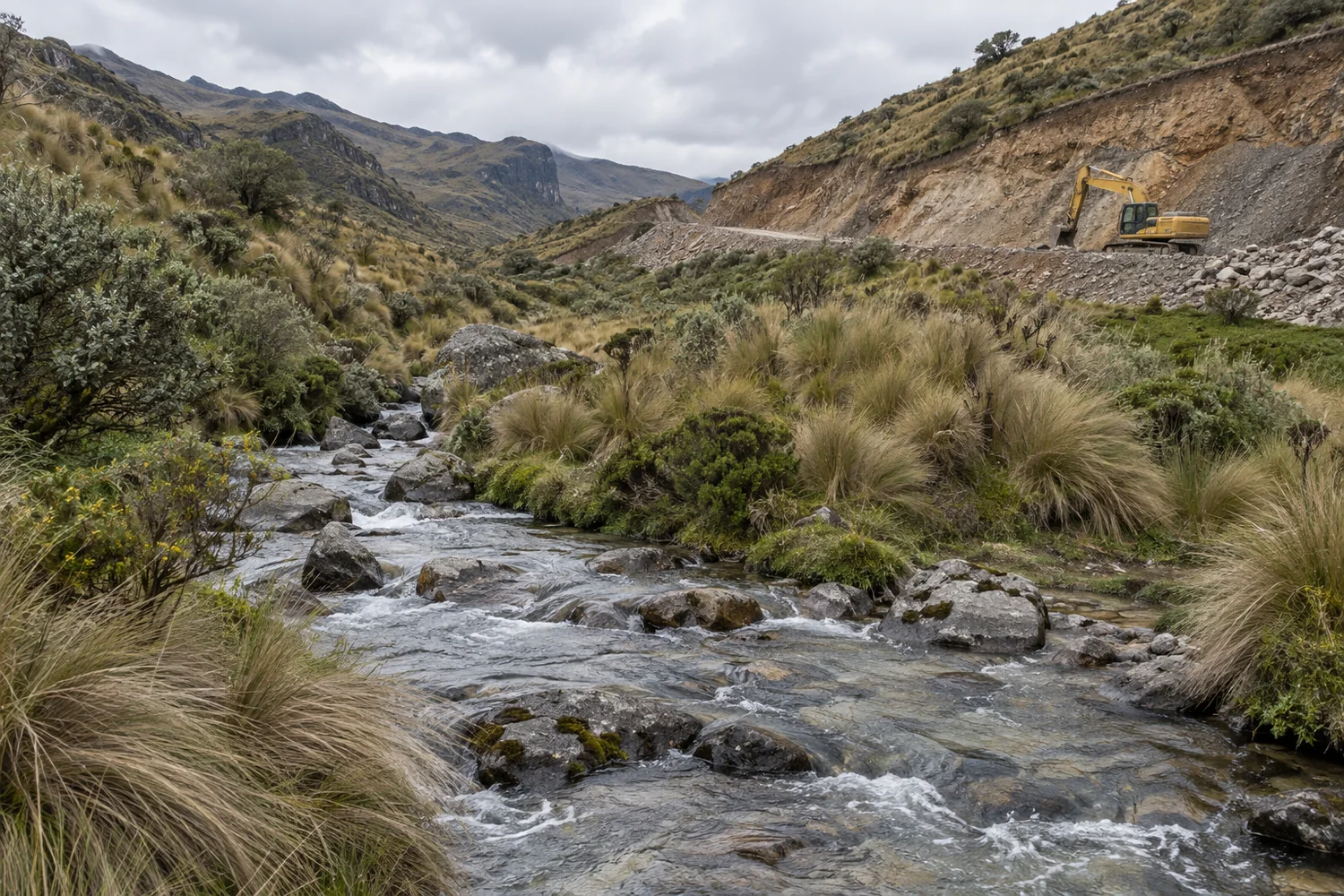
The dispute centers on work along the Pasapungo–Angamarca–El Corazón road, close to streams in the Angamarca Valley where the only known surviving population of Atelopus ignescens lives.
In early January 2026, a local court issued precautionary measures that temporarily stopped construction. Those measures were later revoked after Cotopaxi’s provincial government presented an environmental permit. A second constitutional action then challenged how Ecuador’s environment ministry had issued and supervised that authorization.
According to Ecuador’s Ombudsman’s Office, the Riobamba court concluded that the Jambato’s rights—and the constitutional rights of nature—had been violated. The judgment required the work to remain suspended while proper technical and environmental safeguards were addressed.
Legal analysis of the written decision says the court focused especially on legal certainty and regulatory procedure. The environment ministry had relied on inaccurate information supplied by the road’s promoter and did not adequately verify it, even after conservation groups raised concerns.
Why the ruling matters
Ecuador’s 2008 Constitution recognizes nature as a holder of rights, including the right to exist, persist and regenerate. The Jambato case applies that principle not only to a broad river or forest ecosystem, but to a single wild species facing an immediate threat.
The ruling does not mean that every infrastructure project loses whenever wildlife is present. Its central message is that agencies must use reliable evidence, consider warnings from scientists and civil society, and assess ecological risks before approving work that could damage irreplaceable habitat.
That distinction matters in Angamarca, where residents also want safer transport connections. Conservation advocates have repeatedly said they are not opposed to a road in principle. Their position is that construction must comply with environmental law and avoid dumping spoil, altering streams or damaging the wet habitats the toads need.
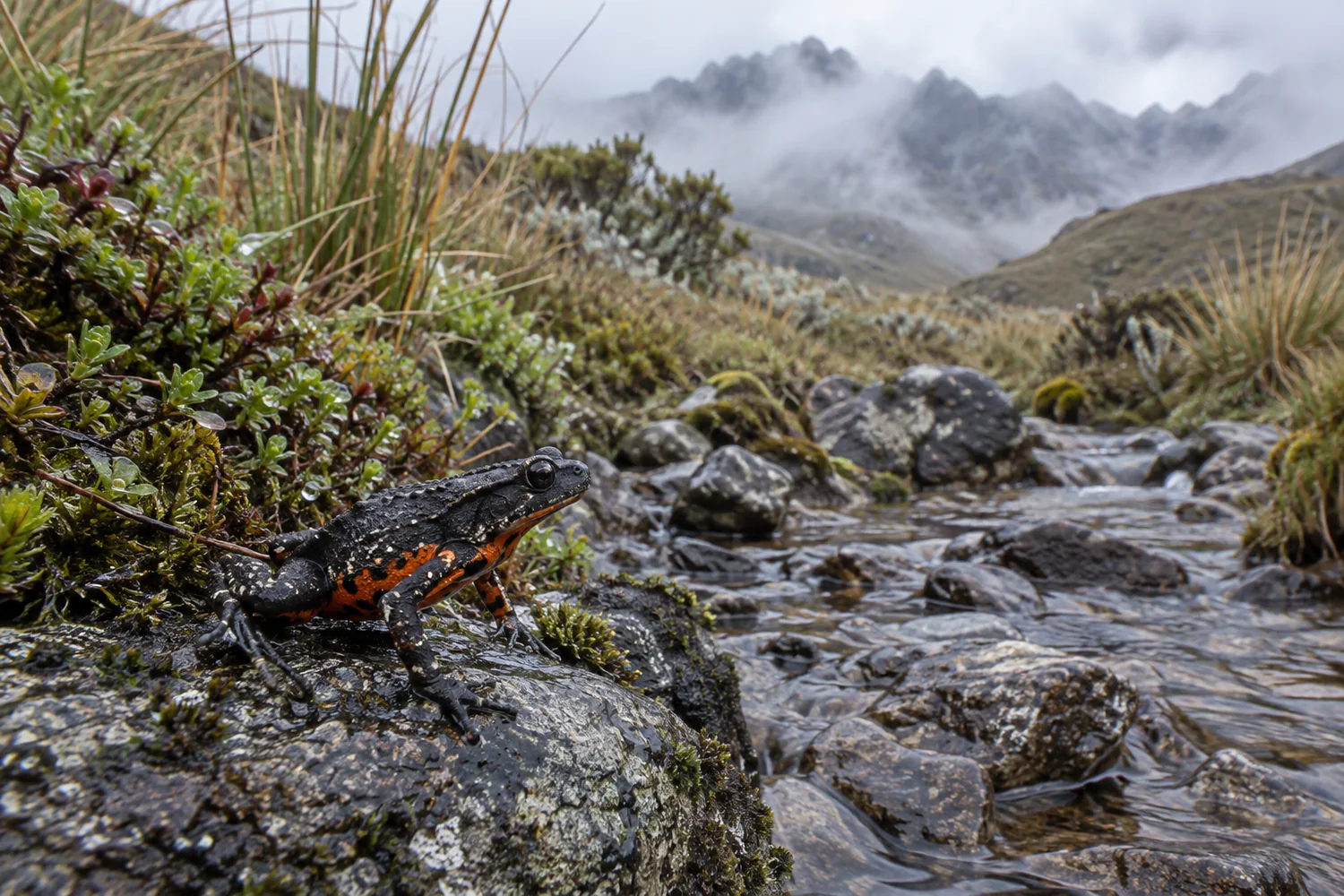
Meet the Jambato harlequin toad
The Jambato, also called the Quito stubfoot toad, is a small black-and-orange amphibian endemic to Ecuador’s northern Andes. Its dark upper surface contrasts with a vivid orange-red belly, a warning-like color pattern that makes it one of the country’s most recognizable frogs.
The species was once common around high-elevation streams and ponds. It then collapsed during the 1980s and was not recorded after 1988. Scientists feared it was extinct until local people helped rediscover a remnant population near Angamarca in 2016.
A 2024 peer-reviewed study in PeerJ documented 71 individuals over one year at different life stages. The researchers found Jambatos in a human-modified landscape, but their persistence remained closely tied to water and streamside habitat. Threats include habitat disturbance, drought and warming, fires, invasive species and disease.
The IUCN Red List classifies Atelopus ignescens as Critically Endangered. That status reflects its dramatic historical decline, extremely restricted surviving range and continuing threats—not a blanket rule that any species with fewer than 200 animals is automatically Critically Endangered.
How many Jambatos remain?
There is no exact global head count. Standardized monitoring cited by the Jambato Alliance recorded roughly 80 wild animals between 2023 and 2025, while preliminary modeling suggested a total population of approximately 92 to 359 individuals. Those figures are estimates, and the conservation group says the work is ongoing.
It is also important not to confuse “individuals” with “mature individuals,” the term used in several IUCN criteria. The Red List’s Criterion D threshold for Critically Endangered is fewer than 50 mature individuals, not 200. Species can qualify under other criteria involving decline, range and fragmentation, so a population estimate alone does not explain the Jambato’s full assessment.
For this toad, the bigger warning is concentration: its only confirmed surviving wild population occupies one small Andean valley. A road-related spill, stream alteration, severe drought or disease outbreak could therefore affect a large share of the species at once.
What must happen before road work can resume?
The judgment puts responsibility on public authorities to correct the environmental process. Based on official and legal summaries, the key tasks include reviewing the authorization with accurate information, assessing effects on Jambato habitat and applying effective prevention, restoration and monitoring measures.
The case does not justify moving the whole population out of the way. Ecuador’s environment ministry has reportedly rejected relocation as ecologically unfeasible. Amphibians depend on specific combinations of water, temperature, vegetation, breeding sites and food; transferring them is not equivalent to moving an object from a construction zone.
Long-term protection will require cooperation among local communities, scientists, Cotopaxi officials, the environment ministry and conservation organizations. Technical road design, spoil disposal, drainage and stream buffers can all determine whether infrastructure and biodiversity can coexist.
A small toad with a large legal footprint
The Jambato ruling is powerful because it turns conservation warnings into a legal obligation. Scientific evidence could not simply be dismissed as political opposition, and an environmental permit could not shield a project if the process behind it was unreliable.
For the species, however, a judgment is only the beginning. Machinery can be stopped by an order; extinction risk falls only when habitat is protected, damage is repaired and safeguards are enforced over time.
Frequently asked questions
Did Ecuador permanently cancel the road?
No. The ruling stopped the project under its deficient environmental authorization and required corrective protection and oversight. It does not amount to a permanent ban on all road improvements in Angamarca.
Is the Jambato toad extinct?
No. It was feared extinct after disappearing from records in 1988, but a surviving population was rediscovered near Angamarca in 2016. It remains Critically Endangered.
Where does the Jambato live?
Historically, it occupied high-Andean areas across northern and central Ecuador. Its only currently confirmed wild population is in the Angamarca Valley of Cotopaxi Province.
How many Jambato toads are left?
The exact number is unknown. Preliminary monitoring and modeling cited by conservationists suggest about 92–359 individuals, but this estimate is still being refined and should not be treated as a complete census.
Why are streams so important to the species?
Jambatos breed in flowing water, and their tadpoles develop among rocks in streambeds. Changes to water quality, sediment, flow or streamside vegetation can therefore affect several stages of their life cycle.