Home > Reptile Articles > Sea Turtle Throat Spikes: How Esophageal Papillae Work

Sea Turtle Throat Spikes: How Esophageal Papillae Work

Published on

Sea turtles have rows of tough, backward-pointing projections lining the esophagus. Called esophageal papillae, these keratinized structures help direct food toward the stomach and retain it while excess seawater moves back out through the mouth. They look like teeth, but they are not teeth—and they do not make every swallowed object impossible to expel.

Key takeaways

  • Sea-turtle esophageal papillae are keratinized projections, not true teeth or bony spines.
  • They point toward the stomach, helping food move in one direction and reducing reflux.
  • The esophagus also helps separate retained food from water taken in during underwater feeding.
  • Papillae differ in size and arrangement among species and along the length of the esophagus.
  • Plastic ingestion is a serious threat, but saying the papillae make regurgitation “nearly impossible” goes beyond the available evidence.

What are sea turtle esophageal papillae?

Esophageal papillae are pointed structures made from keratin—the durable protein also found in claws, beaks and the outer layer of skin. They arise from the lining of the esophagus and angle backward, toward the stomach.

Studies of green, olive ridley, loggerhead, hawksbill and leatherback sea turtles have found pointed papillae in the esophageal lining of every species examined. Their exact shape, density and distribution vary, so the dramatic interior of one species should not be treated as a perfect model for all seven living sea-turtle species.
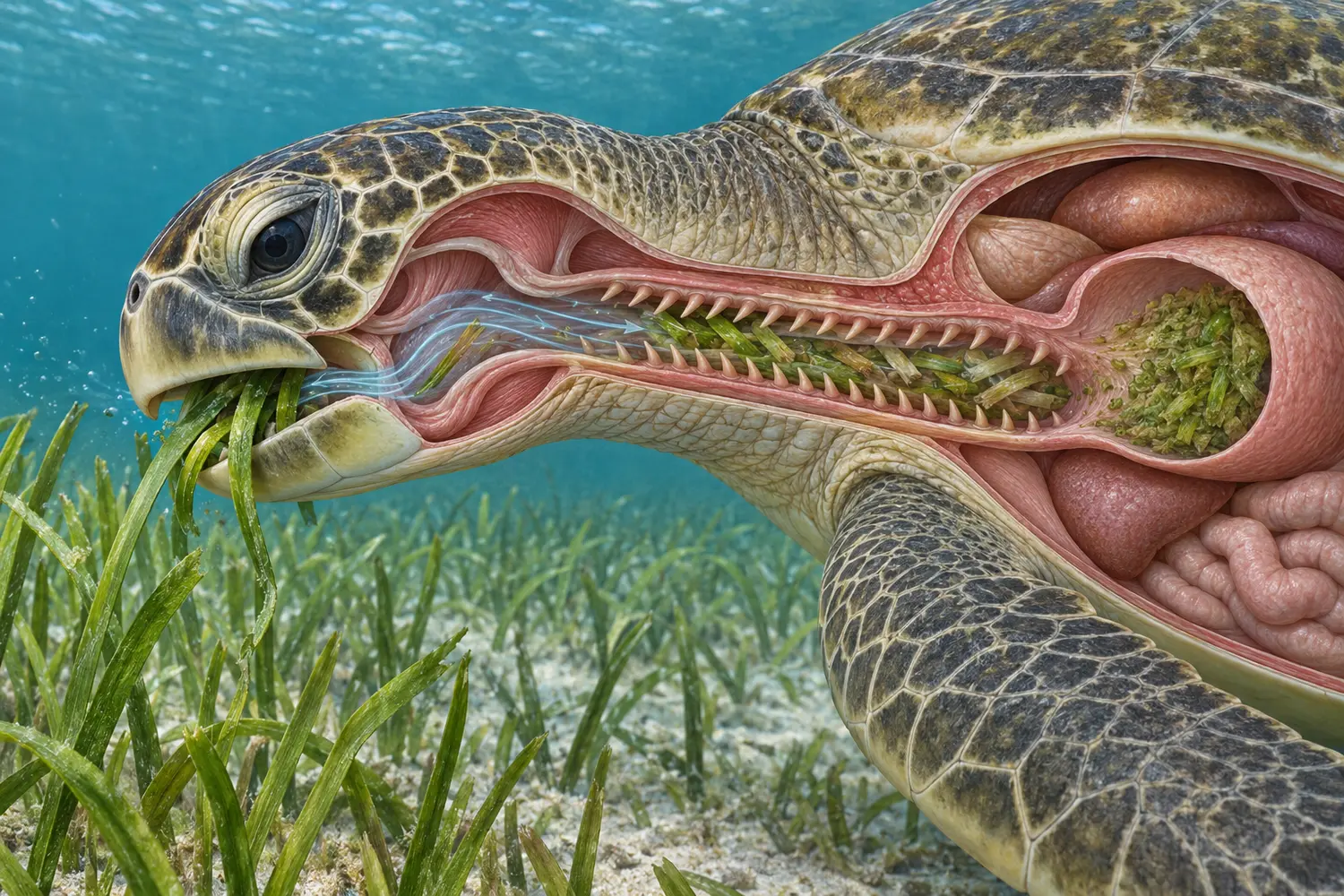
Cutaway illustration of a green sea turtle retaining seagrass as water moves outward through the mouth.
Backward-pointing papillae help retain food while excess water moves toward the mouth. AI-generated simplified anatomical illustration.

Why does a sea turtle’s throat have backward spikes?

A sea turtle cannot use lips and cheeks to create suction in the same way many fishes do. When it captures prey or bites vegetation underwater, food enters with surrounding seawater. Muscular movements of the throat and esophagus help move the meal inward while excess water is expelled through the mouth.

The backward orientation of the papillae provides friction against food moving in the wrong direction. Anatomical research also suggests that they facilitate swallowing and limit reflux, including reflux associated with pressure changes during diving.

The word “spikes” describes their appearance, but it can be misleading. These structures are part of living, flexible tissue and are covered with mucus. They form a specialized food-handling surface rather than a rigid trap made of separate needles.

Are the papillae teeth?

No. Modern turtles have no teeth. Their jaws are covered by a keratinized beak used to bite, crop, tear or crush food depending on the species. The papillae begin behind the mouth in the esophagus and help with transport rather than taking the initial bite.

StructureLocationMain role
BeakUpper and lower jawsBites, tears, crops or crushes food
Esophageal papillaeInner wall of the esophagusGuides and retains food while water moves out
StomachBeyond the esophagusChemical and muscular digestion
Salt glandsNear the eyesExcrete excess salt from the body

Do all sea turtles have the same throat?

They share the basic pattern but not identical anatomy. A 2012 comparative study reported pointed esophageal papillae in all five sea-turtle species it examined, while stomach shape and intestinal lining differed among species in ways related to diet.

Leatherbacks, which specialize heavily on gelatinous prey such as jellyfish and salps, are famous for especially conspicuous papillae extending along a long esophagus. Green turtles commonly shift toward seagrass and algae as they mature. Loggerheads use powerful jaws on hard-bodied prey. Each feeding ecology works with variations of the same general digestive plan.

What happens when a sea turtle swallows plastic?

The one-way orientation that handles natural food does not distinguish prey from marine debris. Sea turtles may ingest bags, plastic sheeting, fragments, fishing line, balloons and other material encountered while feeding. Some flexible plastics can resemble gelatinous prey, but resemblance is not the only possible reason turtles consume debris.

Juvenile green sea turtle swimming near a discarded translucent plastic bag at the ocean surface.
Flexible plastic is one of several forms of marine debris that sea turtles may ingest. AI-generated conservation illustration.

Once swallowed, debris may lodge in the esophagus or move farther into the digestive tract. Consequences can include obstruction, internal injury, reduced feeding, false satiation, abnormal buoyancy and exposure to associated chemicals. A NOAA-linked study of four Pacific species found most recovered debris in the large intestine, showing that plastic can travel well beyond the papillae.

That evidence is important because it corrects a popular oversimplification: the papillae do not act as a proven absolute lock that makes all regurgitation physically impossible. Their backward orientation may impede outward movement, but the documented harm from plastic depends on the debris, its location, the turtle’s size and other factors.

How do sea turtles handle saltwater?

Expelling water during feeding is not the turtle’s only defense against salt. Sea turtles have large salt glands near their eyes that remove excess salts from the bloodstream in concentrated secretions. On land, those secretions can look like tears.

The esophageal mechanism and salt glands solve different problems. Papillae help manage a mouthful of food and water mechanically; salt glands maintain the animal’s internal salt balance after salt enters the body.

Frequently asked questions

Do sea turtles have spikes in their mouths?

The most striking backward projections are esophageal papillae behind the mouth. Calling them “mouth spikes” is convenient but anatomically imprecise.

Can sea turtles drink seawater?

Yes. Sea turtles can take in seawater and eliminate excess salt using specialized salt glands. The papillae are principally a feeding and food-transport adaptation, not the main organ of salt removal.

Can a sea turtle spit plastic back out?

The backward-pointing papillae can make outward movement difficult, but a universal claim that regurgitation is impossible is not supported. Plastic may remain lodged or move into the stomach and intestines, where it can still cause severe harm.

References