
Shrikes impale prey because their songbird-sized feet cannot grip and tear food like a hawk’s talons. A thorn, sharp twig, cactus spine or barb acts as an anchor: it lets the bird dismember a large meal, store leftovers and, in some cases, delay eating chemically defended prey. The behavior is real—but it varies among the roughly three dozen shrike species.
Key takeaways
- Shrikes are predatory passerines in the family Laniidae, not hawks or falcons.
- They commonly hunt from exposed perches and take insects as well as small vertebrates.
- Impaling fixes prey in place for feeding and can create a food cache called a larder.
- Loggerhead shrikes can subdue relatively large vertebrate prey with rapid head-shaking movements.
- Not every shrike species impales every meal, and the same behavior may serve more than one purpose.
What is a shrike?
A shrike is a predatory songbird belonging to the family Laniidae. Most true shrikes live in open or semi-open country across Africa, Eurasia and North America, where scattered shrubs, trees, fence posts and utility lines provide hunting perches. Their family name comes from a Latin word associated with a butcher, which helps explain the familiar nickname “butcherbird.”
The name can cause confusion. Australian butcherbirds are predatory songbirds too, but they belong to a different family and are not true shrikes. This article focuses on true shrikes, especially the well-studied loggerhead shrike (Lanius ludovicianus) of North America.
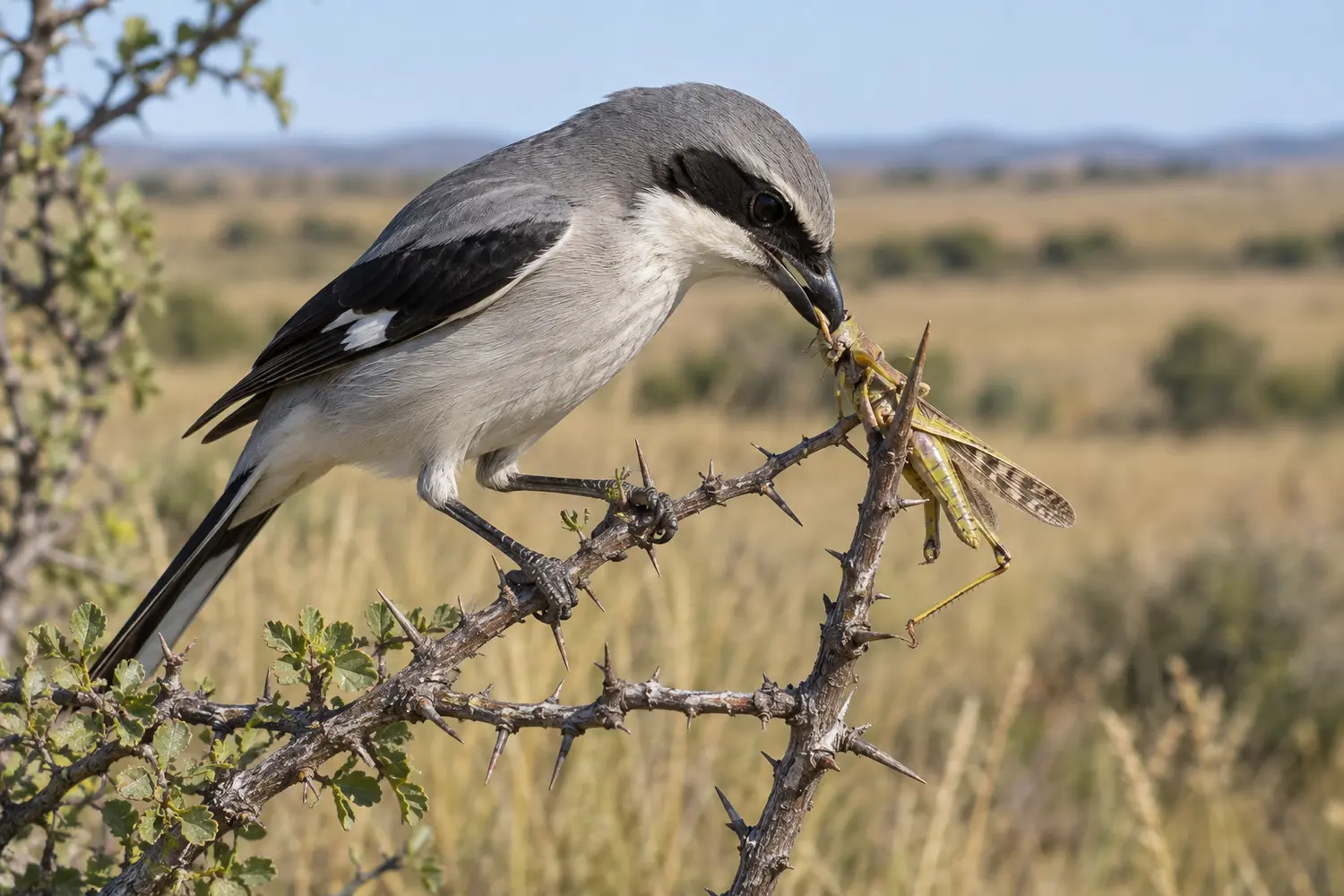
Loggerhead shrikes look modest beside birds of prey: gray back, pale underside, black wings and a bold black mask across the eyes. Up close, however, the short hooked bill reveals their predatory equipment. Its cutting edge includes pointed projections often called tomial “teeth,” structures that help the bird grip and disable vertebrate prey. The Cornell Lab of Ornithology describes the species as a songbird with a raptor’s habits.
Why do shrikes impale their prey?
The simplest answer is mechanical support. A hawk can pin a meal beneath powerful feet while pulling with its bill. A shrike’s legs and feet are comparatively slender. By pushing prey onto a thorn, branch point or barb—or wedging it into a fork—the shrike creates the resistance needed to tear off manageable pieces.
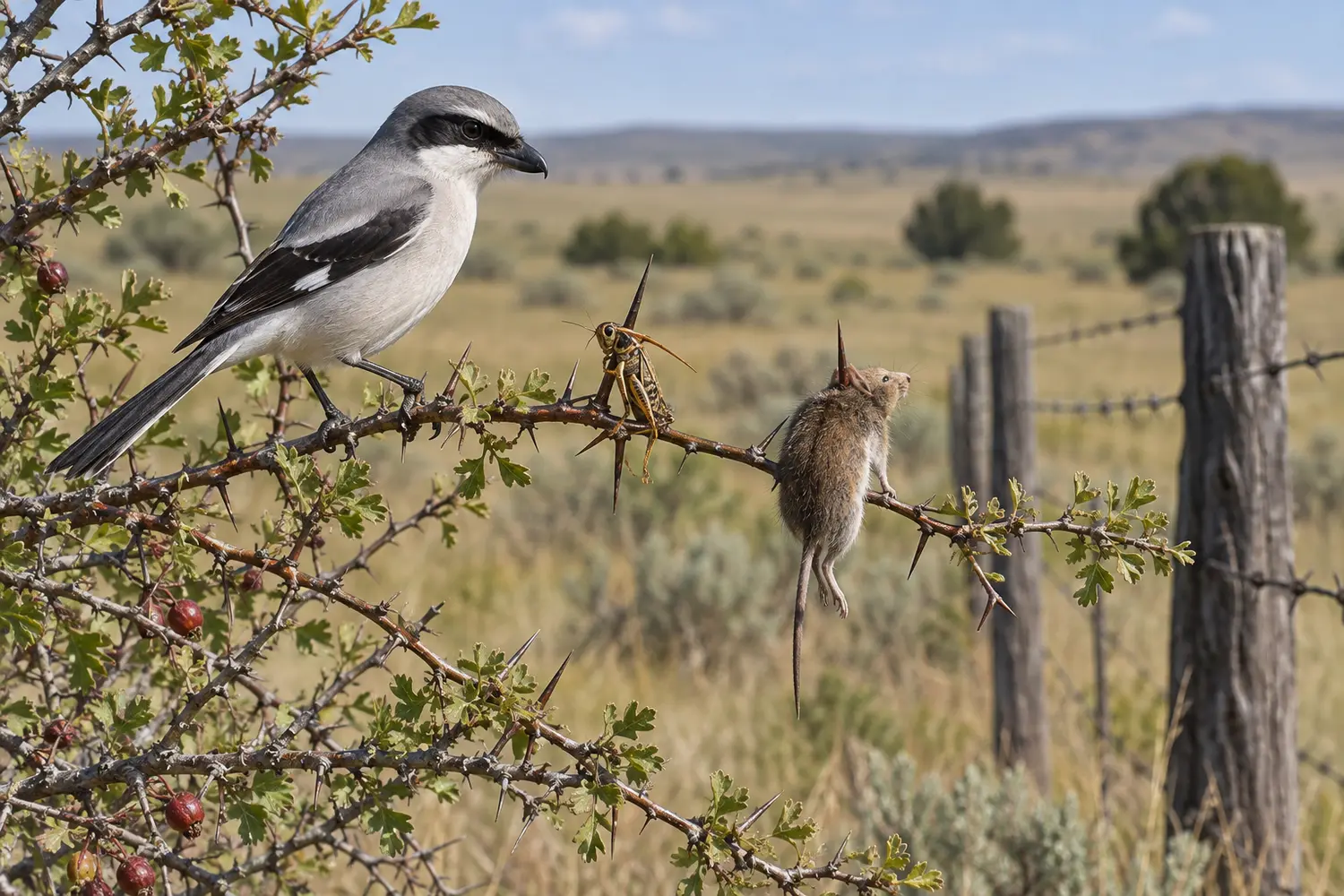
Impaling also allows a bird to save food. A collection of secured prey items is called a larder. The shrike may eat immediately, return after hunting, draw on the cache when weather limits prey activity, or use stored food while feeding a mate or young. The U.S. Fish and Wildlife Service notes that loggerhead shrikes use both natural thorns and barbed wire and that larders can be important during breeding and food shortages.
| Function | How impaling helps |
|---|---|
| Handling | Anchors prey while the bill pulls or tears |
| Storage | Keeps surplus food in a recognizable larder |
| Breeding | May provide food for a mate or young; conspicuous caches may also signal territory quality |
| Chemical defense | Delayed consumption can make some noxious prey safer or more manageable |
What animals do shrikes eat?
Diet depends on species, season and local opportunity. Large insects are especially important for many shrikes, but documented prey also includes spiders, lizards, frogs, small snakes, rodents and other birds. Loggerhead shrikes typically scan from an elevated perch, then drop or fly out to seize prey on the ground or in the air.
The queued claim that shrikes can overpower prey close to their own mass is supported for loggerhead shrikes. Cornell reports that this species can kill and carry an animal as massive as itself. That does not mean every hunt involves large vertebrates: insects can dominate the diet, particularly when abundant.
How can a small songbird kill vertebrate prey?
A loggerhead shrike does more than stab prey on a thorn. High-speed video revealed a specialized killing movement used on rodents. The bird grips near the neck and rapidly rolls or shakes its head, producing acceleration that can injure the prey’s cervical spine.
In a 2018 Biology Letters study, researchers measured oscillations of 6–17 hertz during these attacks. The work supports a “whiplash” mechanism, but it should not be simplified into a universal method for every shrike species or every type of prey.
Do shrikes wait for toxins to break down?
Sometimes. Loggerhead shrikes handle several chemically defended animals in specialized ways. Cornell reports that they may leave noxious prey such as monarch butterflies or eastern narrow-mouthed toads impaled for up to three days before eating them. With toxic eastern lubber grasshoppers, the bird may eat selected body parts while rejecting the more noxious thorax.
This is more precise than saying that all toxic prey simply becomes harmless after “drying.” The prey species, chemical defense and processing method matter. Delayed consumption is one strategy; selective dismemberment is another. It is best understood as flexible food handling, not a universal detoxification recipe.
Is a thorn really a tool?
Calling the behavior “tool use” makes a powerful headline, but scientists use several competing definitions of that term. A shrike unquestionably uses an external object as an anvil or anchor. Whether that qualifies as tool use can depend on whether a definition requires the animal to detach, carry or manipulate the object itself.
That is why “impales prey on thorns” is the safest factual description. The achievement is no less remarkable: the bird exploits a fixed feature of its environment to overcome a physical limitation.
Do all shrikes make larders?
No. Impaling is strongly associated with shrikes, but its frequency differs among species and circumstances. Some meals are swallowed or processed without being cached. Some shrike species impale often; in others the behavior is uncommon or has rarely been recorded. Even within one species, season, prey size, food abundance and available thorns can change what observers see.
Young loggerhead shrikes appear to practice components of the behavior. Cornell records fledglings carrying leaves or sticks and making rudimentary impaling gestures. Experience may therefore refine an inherited behavioral tendency.
Where should you look for a shrike larder?
Search open country with both hunting perches and sharp anchoring sites: rough grassland, pasture, desert scrub, old orchards, field edges and roadside shrubland. Hawthorns, locust trees, cacti and barbed-wire fences can all provide suitable points. A larder may reveal a shrike’s presence before the bird itself appears.
Observe from a respectful distance. Do not remove cached prey, bend branches around a nest or disturb a bird repeatedly for photographs. Stored food may be important to the resident shrike, its mate or nestlings.
Are shrikes beneficial for farms?
Shrikes consume insects and small rodents, including species people sometimes regard as agricultural pests. That makes them potentially useful predators in working landscapes. However, the broad claim that they provide “highly effective pest control” needs local, quantitative evidence. Their ecological role should not be reduced to a service measured only in pests removed.
Open habitat with scattered native shrubs, hunting perches and lower pesticide exposure can support both shrikes and a diverse prey community. This matters because loggerhead shrikes have declined sharply across much of their range, according to Cornell. Habitat change, vehicle collisions and reduced or contaminated prey have all been investigated as contributing pressures.
Frequently asked questions
Are shrikes birds of prey?
They are predatory birds, but they are not raptors such as hawks, falcons or owls. Shrikes are passerines—members of the songbird order.
Why are shrikes called butcherbirds?
The nickname refers to their carnivorous diet and habit of securing prey on thorns or wire, sometimes forming visible food larders.
Do shrikes kill animals only to display them?
No. Impaled prey is used for feeding and storage. Some conspicuous larders may also contribute to courtship or territorial signaling, but display is not the only function.
The butcherbird’s strategy
A shrike combines a hooked bill, precise attacks and features already present in the landscape. Thorns and barbs compensate for feet that were not built like a hawk’s, transforming a small songbird into an efficient predator and careful food cacher. The famous larder is not senseless violence; it is a practical solution shaped by prey, habitat and season.