
The wild cats of the Americas occupy ecological worlds that could hardly look more different. Jaguars patrol tropical rivers, pumas range from northern forests to Patagonia, jaguarundis move through dense lowland cover, and Andean cats survive on cold, rocky plateaus. Their contrasting bodies and behaviors show how one mammal family diversified across two continents.
Key takeaways
- The jaguar (Panthera onca) is the largest native cat in the Americas, but its range no longer continuously extends across every place it once occupied.
- The puma (Puma concolor) has the broadest geographic range of any native terrestrial mammal in the Western Hemisphere.
- The jaguarundi (Herpailurus yagouaroundi) is mainly associated with lowlands and dense ground cover, although records above 2,000 meters exist.
- The Andean cat (Leopardus jacobita) is a rare high-elevation specialist of the arid Andes.
- These four examples represent only part of American felid diversity; ocelots, margays, bobcats, lynx and several small spotted cats also occur in the region.
Four American wild cats at a glance
| Species | Defining build | Representative habitat | Broad range |
|---|---|---|---|
| Jaguar | Large, robust and powerfully muscled | Tropical forest, wetland and wooded savanna | Mexico through Central and South America |
| Puma | Large, long-tailed and adaptable | Forest, mountain, grassland and desert | Western Canada to southern South America |
| Jaguarundi | Small, elongated and low-slung | Dense low vegetation in open and wooded landscapes | Mexico to central Argentina and neighboring regions |
| Andean cat | Small, thick-furred, with a long ringed tail | Rocky, arid high Andes | Argentina, Bolivia, Chile and Peru |
Jaguar: the river-and-forest powerhouse
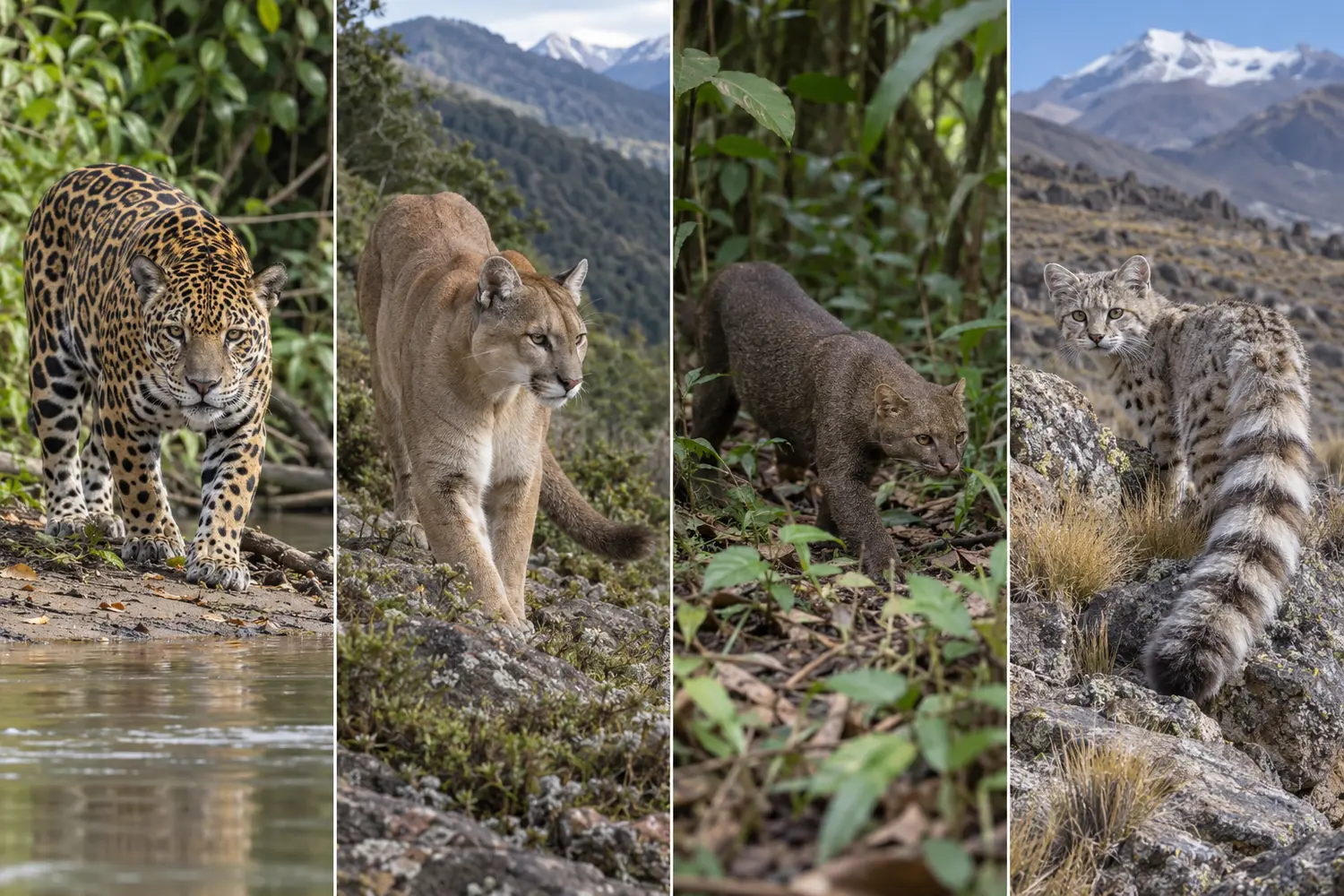
The jaguar is the largest living felid native to the Americas. Its deep chest, broad head and relatively short, muscular limbs suit an ambush predator that must overpower prey at close range. The coat usually carries large rosettes, many containing smaller central spots—one useful clue when distinguishing a jaguar from a leopard, which is native to Africa and Asia.
Jaguars are strongly associated with tropical and subtropical forests, floodplains and wetlands, although they can occupy drier woodland and scrub where cover and prey remain. They are capable swimmers and regularly use rivers and flooded landscapes rather than merely tolerating water. Their diet can include mammals, reptiles and aquatic prey.
The queued description placed jaguars from northern Mexico to Argentina. That is a useful broad summary of their modern core distribution, but not a continuous range. Populations have disappeared from much of the species’ former territory and are separated by habitat loss and human-dominated landscapes. Occasional jaguars also move into the southwestern United States, so a strict border at northern Mexico would be misleading. The National Geographic species account identifies the jaguar as the only living Panthera cat native to the Americas.
Puma: the continental generalist
The puma is known by many regional names, including cougar and mountain lion. Unlike the spotted jaguar, an adult puma has a mostly uniform tawny coat, a relatively small head and a long tail. Its build supports stalking, leaping and short bursts of acceleration across varied terrain.
Of the four cats in this comparison, the puma is the least tied to one habitat type. It lives in temperate forest, tropical woodland, desert, prairie, shrubland and mountain environments. Panthera describes its distribution across 23 countries from southern Alaska toward the southern tip of South America and calls it the widest-ranging native terrestrial mammal in the Western Hemisphere.
That superlative needs its qualifiers. It refers to native terrestrial mammals in the Western Hemisphere—not to every mammal worldwide, and not necessarily to one unbroken population. Human expansion, roads, persecution and local extirpations have fragmented puma populations even though the species remains remarkably widespread.
Jaguarundi: a low-slung cat of dense cover
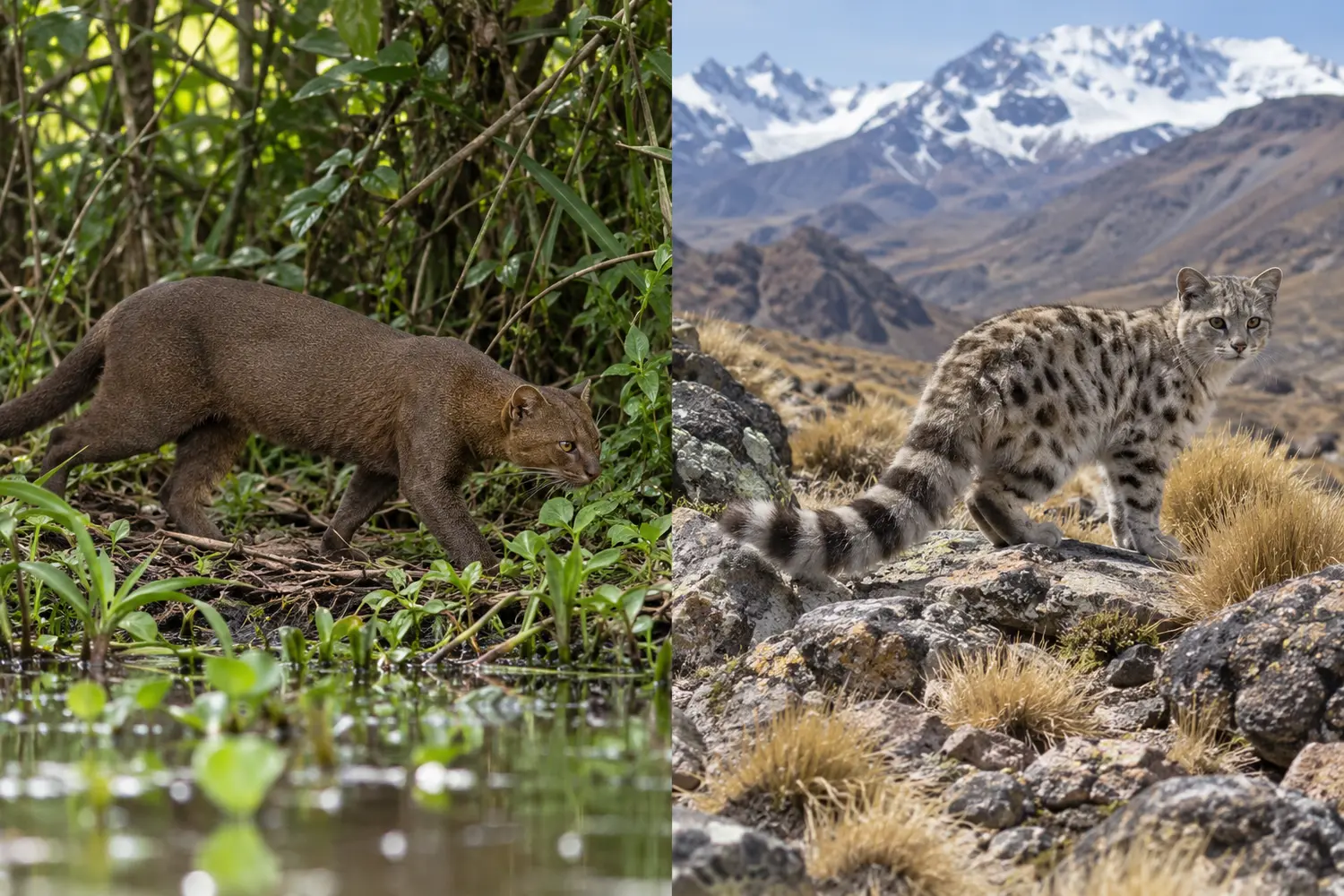
The jaguarundi looks unlike the classic spotted wild cat. It has an elongated body, short legs, small rounded ears and a long tail. Adults may be grayish, dark brown or reddish, with a largely uniform coat rather than rosettes. This shape is useful for moving beneath low vegetation, but it should not be described as an aquatic “otter cat” simply because people notice a superficial resemblance.
Jaguarundis use a range of open and closed habitats, including savanna, thorn scrub, forest edges, wetlands and secondary vegetation. Dense ground cover is often an important shared feature. They are also more active by day than many similarly sized tropical cats, although activity can shift with location and disturbance.
The IUCN SSC Cat Specialist Group describes the jaguarundi as mainly a lowland species generally occurring up to 2,000 meters. Crucially, that is not a hard ceiling: records in Colombia reach about 3,200 meters. Its distribution extends from Mexico through Central America and much of South America to central Argentina, Paraguay, Brazil and Uruguay. Current evidence for a resident population in the United States is lacking.
Andean cat: specialist of a cold, arid roof
The Andean cat inhabits one of the harshest felid environments in the Americas. It lives among rocky slopes, dry grasslands and high-elevation wetlands in the Andes of Argentina, Bolivia, Chile and Peru. Much of its known habitat lies roughly between 3,000 and 5,000 meters, though records and suitable conditions vary by region.
Dense pale fur provides insulation and camouflage among gray rock and dry bunchgrass. Dark spots and bands break up the outline, while the exceptionally long, thick, ringed tail may help with balance and warmth. The visual resemblance to the pampas cat can complicate field identification, especially in distant camera-trap photographs.
The Andean cat is rare and difficult to study, so “elusive” is justified—but it should not be used as a substitute for evidence. Its association with high, rocky terrain is documented by field surveys and records summarized by sources such as the University of Michigan’s Animal Diversity Web. Conservation concerns include mining and infrastructure development, prey changes, conflict and attacks by domestic dogs.
How can related cats occupy such different worlds?
Ecological specialization is not a ladder from “primitive” to “advanced.” Each body plan reflects trade-offs. The jaguar’s heavy frame favors close-range power but costs more energy to maintain. The puma’s generalized build and flexible diet help it use many landscapes, but adaptability does not make it immune to habitat fragmentation.
The jaguarundi’s small size and low profile open hunting opportunities in tangled vegetation. The Andean cat’s insulation, camouflage and tail suit steep, cold terrain where prey is sparse and unevenly distributed. No design is universally superior; each works within a particular ecological problem.
Do these four cats ever meet?
Parts of their ranges overlap, but habitat use and body size can reduce direct competition. Jaguars and pumas coexist in portions of Central and South America, often differing in prey selection and space use. Jaguarundis may share broader landscapes with both, while relying on smaller prey and dense cover. At high Andean elevations, pumas can occur alongside Andean cats, but they occupy very different size classes and ecological roles.
Overlap does not guarantee frequent encounters. Wild cats often partition time, terrain and prey, and their relationships change as human activity alters the landscape.
Frequently asked questions
What is the largest wild cat in the Americas?
The jaguar is the largest native cat in the Americas. Individual size varies greatly by sex and region, so one weight should not be treated as representative of every population.
Are pumas and mountain lions the same animal?
Yes. Puma, cougar and mountain lion are common names for the same species, Puma concolor.
Is a jaguarundi related to a jaguar?
Both belong to the cat family, but they are not especially close counterparts. The jaguar belongs to genus Panthera; the much smaller jaguarundi belongs to Herpailurus and is evolutionarily closer to the puma lineage.
Why is the Andean cat so hard to see?
It occurs at low density in remote, rugged highland habitat and is naturally secretive. Its camouflage and resemblance to another local small cat add to the challenge.
Four cats, four ecological solutions
Jaguars, pumas, jaguarundis and Andean cats do not form a ranking. They illustrate four solutions to life in the Americas: muscular ambush beside rivers, continental flexibility, movement through dense low cover and survival on the high Andes. Protecting that diversity requires more than saving individual animals—it requires connected forests, grasslands, wetlands, scrub and mountain ecosystems.