
The thorny devil does not absorb water through its skin. Instead, a network of microscopic channels between its scales collects liquid and moves it by capillary action toward the mouth. The Australian lizard then drinks using movements of its jaws—a precise desert adaptation often oversimplified as “drinking through its skin.”
What Is a Thorny Devil?
The thorny devil (Moloch horridus) is a small, ant-eating agamid lizard found across much of arid and semi-arid mainland Australia. It is the only living species in the genus Moloch. Its squat body, short legs and dense covering of conical spines make it one of Australia’s most recognizable reptiles.
Despite its name and intimidating armor, the animal is not venomous and is not built to attack large animals. Its unusual body is a package of adaptations for camouflage, defense, water collection and a highly specialized diet.
How Does a Thorny Devil Collect Water?
Partly overlapping scales create an interconnected network of narrow channels across the body. When water touches the surface—from rain, a puddle or sufficiently wet sand—it enters those channels and spreads by capillary action. This is the same physical effect that draws liquid through a very narrow tube.
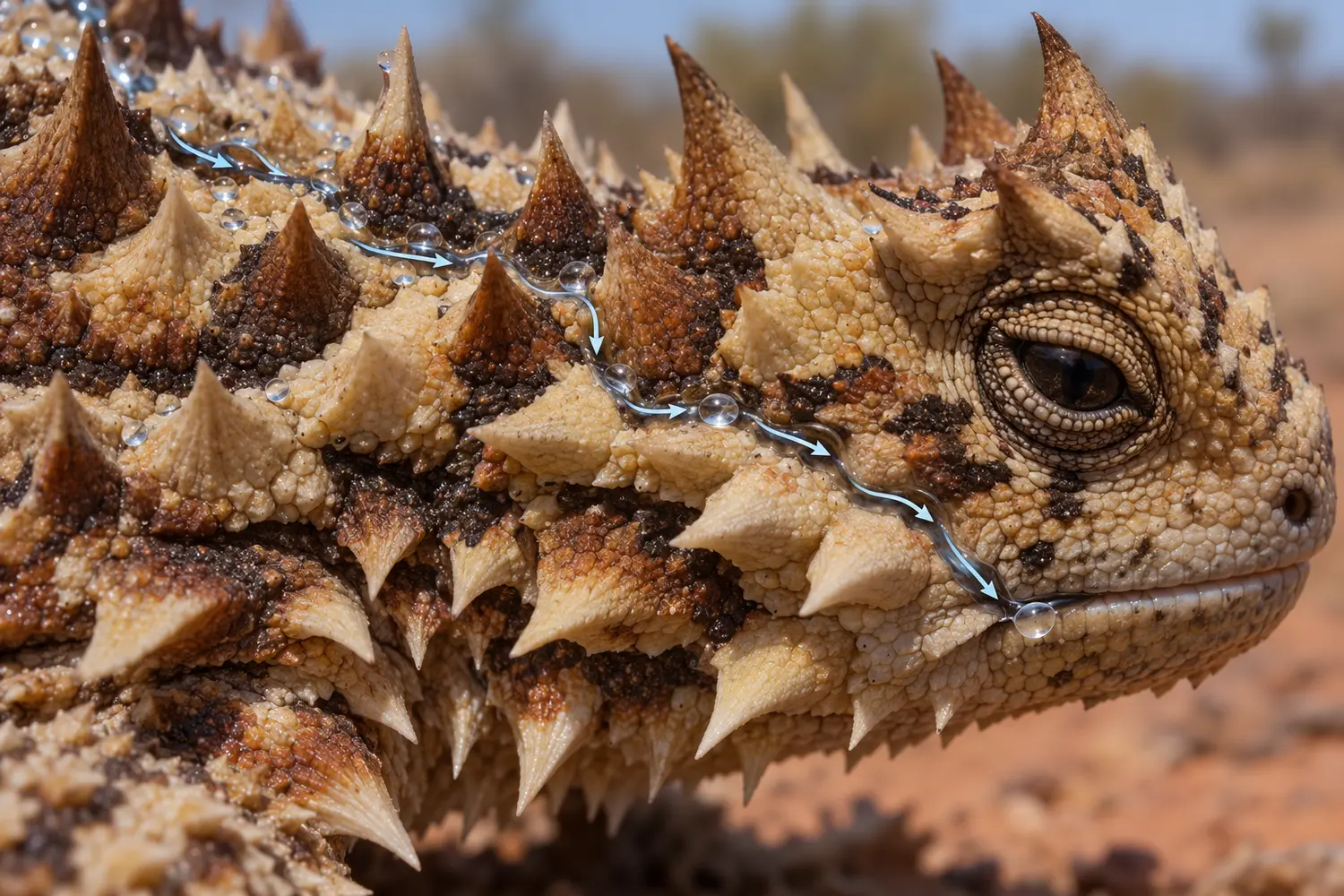
A 2017 laboratory study found that 7-microliter droplets spread radially through the channels for more than 9.2 millimeters in about 10 seconds. Larger channels accepted water quickly, while smaller subchannels extended the transport distance by an estimated 39 percent. The research showed that the water traveled between the scales rather than through the waterproof skin.
The channels do not pump water in one direction. Water can spread outward from where it lands, and the connected network eventually reaches the mouth. Active jaw movements then allow the lizard to swallow it.
Can It Really Drink Dew From the Air?
The skin system can handle droplets, but the popular image of a thorny devil passively extracting large amounts of water from dry air is misleading. Experimental work suggests that simply standing on mildly damp sand may not provide enough liquid to fill the capillary network all the way to the mouth. Wetter sand, direct contact with droplets, rain or water pooled on a surface are more plausible sources.
So the accurate version is remarkable enough: almost any part of the body can help collect available liquid and route it to the mouth, but the animal still has to swallow the water. Its skin is a transport surface, not a sponge feeding water directly into its tissues.
What Does a Thorny Devil Eat?
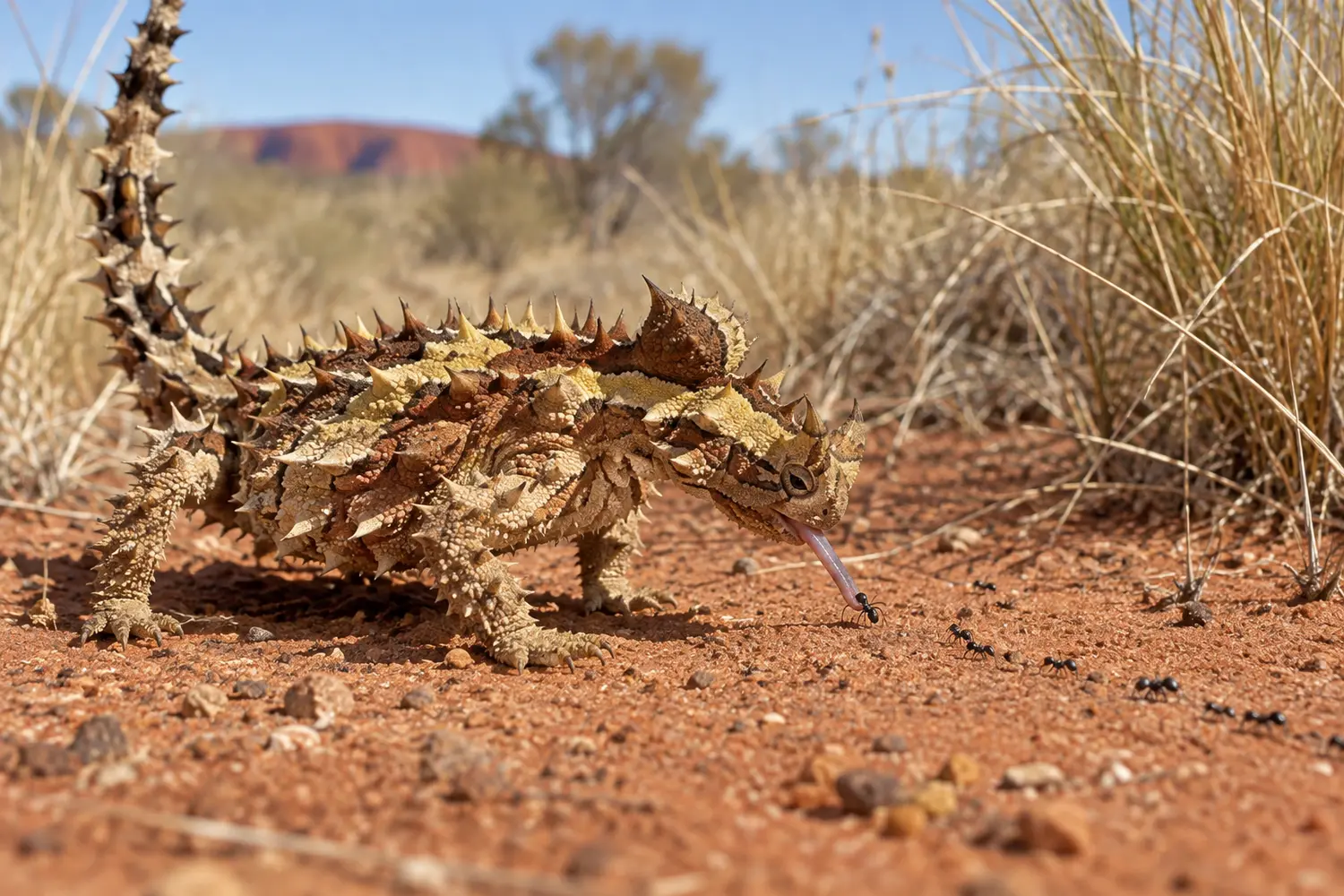
Thorny devils are extreme ant specialists. Field studies found that they feed heavily on small ants, often from the genus Iridomyrmex, while waiting beside active trails and picking off workers one by one with the tongue.
Popular accounts frequently claim that one lizard eats 1,000–3,000 ants every day. Field observations do support meals containing very large numbers of tiny ants, but a fixed daily total is not universal. Intake varies with ant size, feeding opportunity, season and the length of time observed. “Hundreds to thousands during active feeding” is more defensible than treating one number as a daily requirement.
This narrow diet helps explain several features of its life. Small ants provide limited energy and contain salt, so thorny devils spend long periods near productive trails and depend on effective water management in a dry environment.
Why Does It Have a False Head?
The rounded, spiny structure behind the real head is commonly called a false head or pseudo-head. When threatened, a thorny devil may tuck its true head down between its forelegs and present this hump toward a predator.
The structure is not a second skull and cannot see or bite. It is a soft-tissue hump covered in spiny scales. Along with the rest of the body armor, it may make the lizard harder to grasp or swallow and can redirect an attack away from the vulnerable head.
Do the Spines Actually Protect It?
The spines increase the lizard’s apparent size and create an awkward shape for predators to handle. A disturbed thorny devil may also inflate its body, making the spiny outline broader. Its slow, rocking walk and tendency to freeze can help it blend into uneven sand and vegetation.
Spines are not an invincible shield. Birds, large monitor lizards and some snakes can still prey on thorny devils. Camouflage and behavior work together with the armor; no single feature guarantees safety.
Why Does Its Color Change?
Thorny devils can shift between paler yellows and reds and darker browns or grayish tones. Temperature is an important influence: individuals are often darker when cool and become paler as they warm. Stress, activity and time of day may also affect appearance.
Calling this instant background matching goes too far. The changes can improve camouflage across the animal’s sandy environment, but they are physiological responses influenced by several conditions—not a perfect chameleon-like decision to copy any surface.
Where Do Thorny Devils Live?
The species is associated strongly with sandy and sandy-loam soils across Australia’s dry interior and parts of the west and south. It occurs in spinifex grasslands, desert scrub, dunes and some open woodland. Its distribution follows suitable soil and ant communities more closely than a single desert type.
Field research in the Great Victoria Desert found substantial seasonal changes in activity. Animals moved more during early spring, while burrow use increased later as conditions became hotter. These patterns help the lizard balance feeding, reproduction and exposure to extreme temperatures.
Frequently Asked Questions
Does a thorny devil drink through its feet?
Water touching the feet can enter channels between the scales, but it is transported externally to the mouth and swallowed. It does not pass directly through the feet into the bloodstream.
Is the thorny devil dangerous?
No. It is a small ant-eating lizard with defensive spines, not a venomous predator. Wild animals should still be observed without handling or disturbance.
Does it eat only black ants?
It specializes heavily in ants and often selects small dark-colored species, but “black ants” is not one scientific group. Research records prey from several ant taxa, with preferences varying by place and availability.
The Bottom Line
The thorny devil survives not because of one magical trick but through linked specializations. Its scale channels route water to the mouth, its body armor and pseudo-head complicate attacks, and its behavior lets it harvest tiny ants while managing desert heat. The real biology is more precise—and more interesting—than the myth that it simply absorbs water through its skin.