
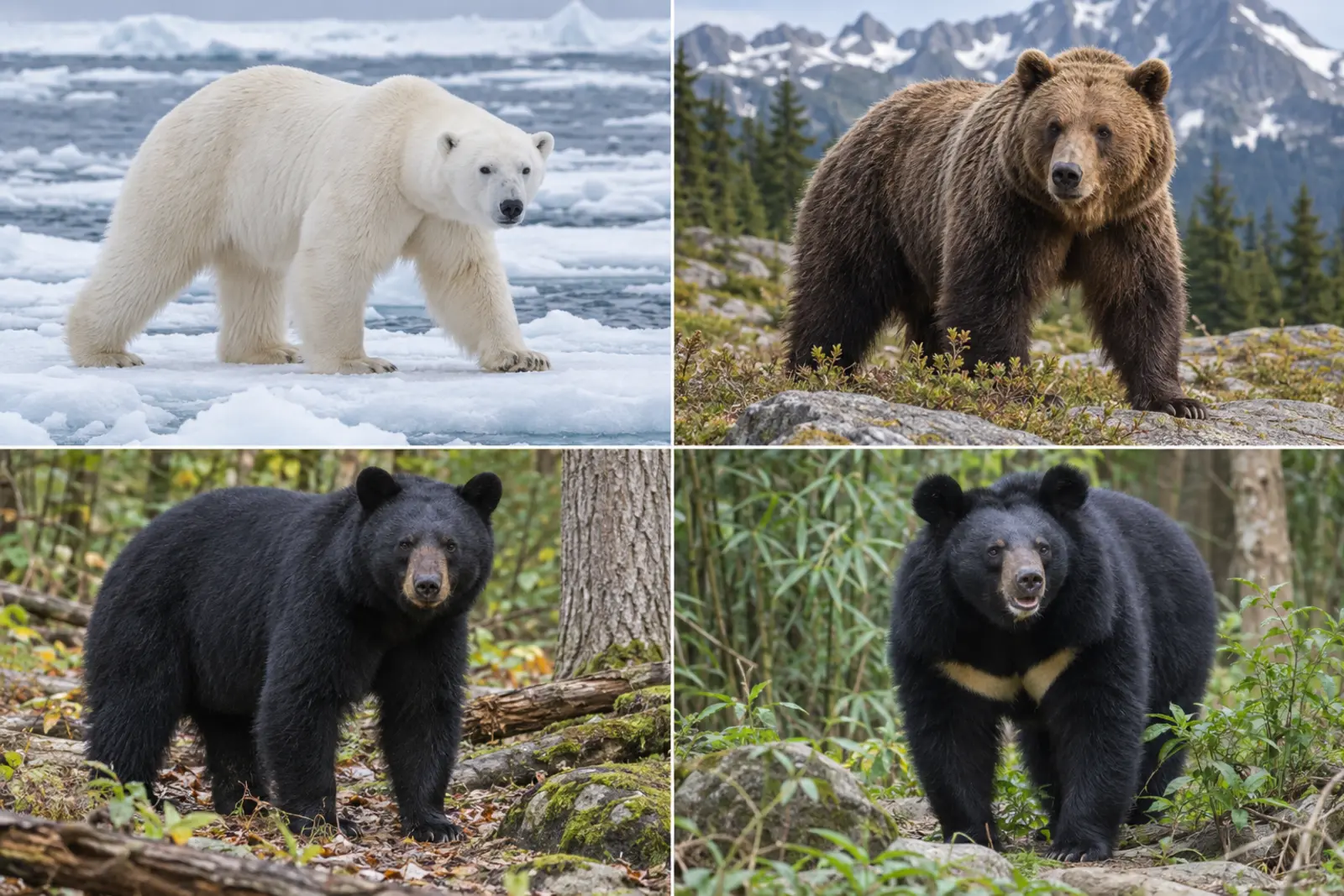
There are eight living bear species in the family Ursidae: the polar bear, brown bear, American black bear, Asiatic black bear, giant panda, spectacled bear, sun bear and sloth bear. Names such as grizzly, Kodiak and Kermode bear refer to subspecies or regional populations—not additional species. Together, these bears occupy habitats from Arctic sea ice to tropical rainforest.
The eight bear species at a glance
| Species | Scientific name | Native region | Standout adaptation |
|---|---|---|---|
| Polar bear | Ursus maritimus | Arctic | Sea-ice hunting and powerful swimming |
| Brown bear | Ursus arctos | North America, Europe, Asia | Flexible diet and strong digging muscles |
| American black bear | Ursus americanus | North America | Agile climbing and broad dietary flexibility |
| Asiatic black bear | Ursus thibetanus | Asia | Arboreal foraging |
| Giant panda | Ailuropoda melanoleuca | Central China | Enlarged wrist bone used like a thumb |
| Spectacled bear | Tremarctos ornatus | Andes | Cloud-forest climbing and plant-heavy diet |
| Sun bear | Helarctos malayanus | Southeast Asia | Long claws and tongue for insects and honey |
| Sloth bear | Melursus ursinus | Indian subcontinent | Suction feeding on ants and termites |
1. Polar bear
The polar bear is the most marine of all bears. It depends heavily on sea ice as a platform for hunting seals, although feeding and habitat use vary by season and region. Its water-repellent guard hairs look white but are translucent, while dense underfur and a thick fat layer provide insulation. Broad, partly webbed paws distribute weight on snow and propel the bear through water.
Polar bears are often called the largest land carnivores, but size overlaps with the biggest brown bears. Adult males are much larger than females, and exceptional individuals should not be treated as typical.
2. Brown bear
Brown bears have the widest distribution of any living bear. Grizzlies and Kodiak bears are forms of Ursus arctos, not separate species. Their shoulder hump is a mass of muscle that powers the forelimbs for digging, turning rocks and excavating dens. Diets range from grasses, roots and berries to insects, fish and large mammals.
3. American black bear
Despite the name, American black bears may be black, brown, cinnamon or occasionally cream-white. The white Kermode or “spirit bear” is a color form within a subspecies in coastal British Columbia. Curved claws and relatively short limbs make many black bears excellent climbers, especially when young.
4. Asiatic black bear
Also called the moon bear, this species usually has a pale crescent-shaped chest mark. It occupies forests from parts of western and southern Asia to East Asia. Asiatic black bears climb readily and eat fruit, nuts, vegetation, insects and animal matter. Calling them “mostly herbivorous” is broadly reasonable, but their diet changes with location and season.
5. Giant panda
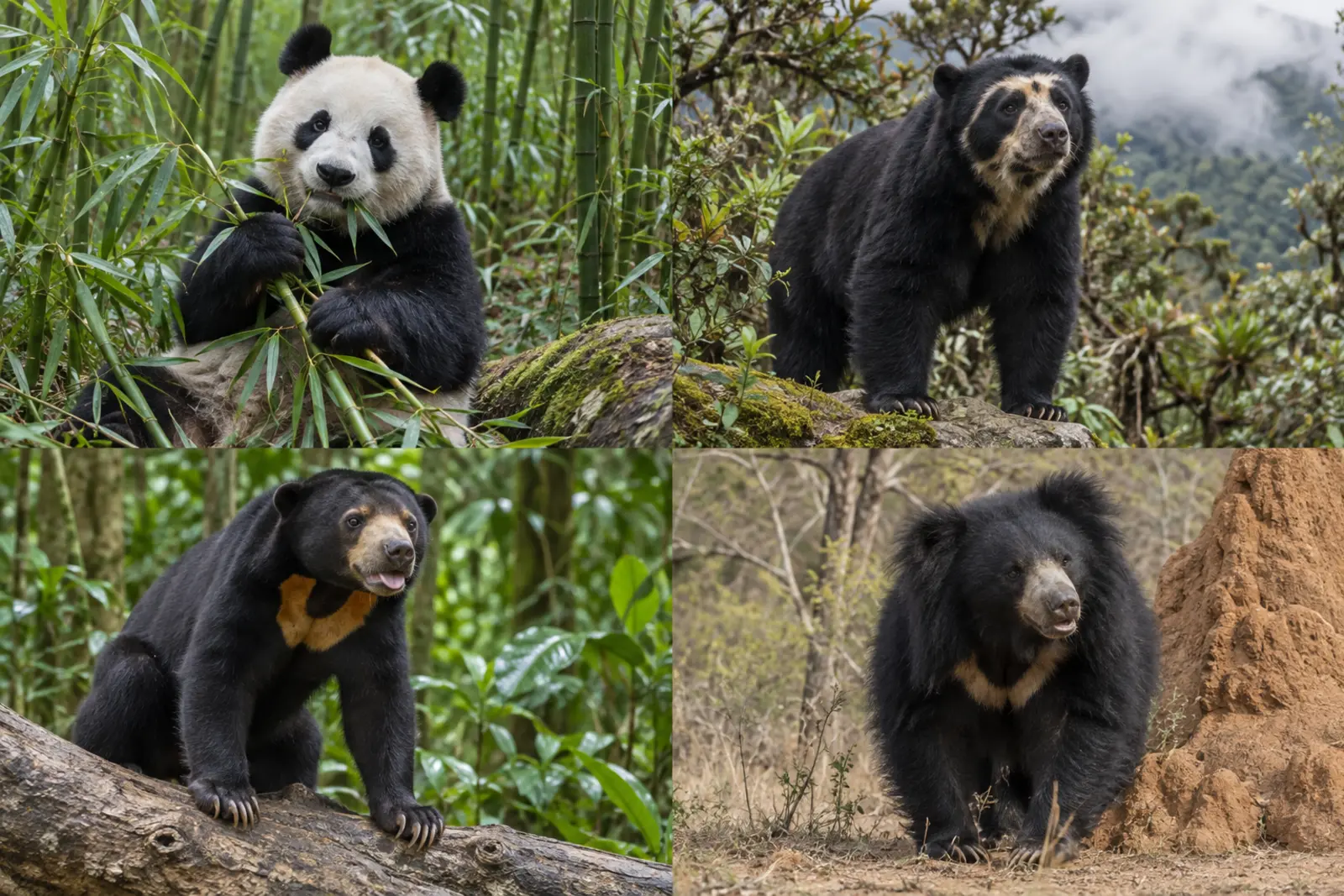
The giant panda is a true bear, not a raccoon. Bamboo dominates its diet, although “99 percent” should be treated as a rounded description rather than a rule for every individual and season. Its famous pseudo-thumb is an enlarged radial sesamoid—a wrist bone that works with the fingers to grasp bamboo. Fossil evidence suggests this grasping system has deep evolutionary roots.
6. Spectacled bear
The spectacled or Andean bear is the only living bear native to South America. Cream markings around the face and chest vary so much that they can help researchers recognize individuals. These bears inhabit Andean forests, scrub and high-elevation grasslands. They are capable climbers and often build feeding platforms in trees.
7. Sun bear
The sun bear is the smallest living bear species. Short dark fur suits humid tropical forests, while long curved claws help it open logs and climb. Its long tongue can extract termites, ants and honey. Viral descriptions often give an exact 25-centimeter tongue length, but measurements vary and are rarely accompanied by a standardized method.
8. Sloth bear
Sloth bears are adapted for myrmecophagy—feeding on ants and termites. A gap at the front of the upper jaw, mobile lips and the ability to close the nostrils help them blow away soil and suck insects from nests. They are bears, not sloths. The English name arose from early observers who thought their long claws and shaggy coat resembled those of tree sloths.
Which bear is the strongest?
There is no single scientific “strongest bear” ranking. Polar and large brown bears have the greatest body mass, but strength depends on what is measured: pulling force, bite mechanics, digging power, endurance or strength relative to body size. Internet PSI tables rarely use comparable methods, so body size and anatomy are more defensible than a neat strength leaderboard.
Species, subspecies and misleading bear names
The eight-species total counts living species recognized in the family Ursidae. A grizzly is a North American brown bear; a Kodiak bear is a brown bear population generally classified as Ursus arctos middendorffi; and a Kermode bear is an American black bear subspecies. Taxonomic revisions can change subspecies boundaries without creating a new living bear species.
Several animals with “bear” in their common name are not ursids. Koalas are marsupials, red pandas form their own family, and water bears are microscopic tardigrades. Sloths belong to the order Pilosa within Xenarthra; the sloth bear belongs to Carnivora and Ursidae.
Why bear diversity matters
Bears help move seeds, turn soil, redistribute nutrients and influence prey or scavenger communities, but their ecological roles differ sharply. Conservation must therefore fit each species: protecting sea ice for polar bears, connected forest for Asiatic black bears and sun bears, bamboo landscapes for giant pandas, and conflict-safe habitat corridors for bears living near people.