
Wild canids are the undomesticated members of the dog family, Canidae. They include wolves, foxes, jackals, coyotes, dholes, African wild dogs and several less familiar species. Their success does not come from one body plan or one social system: canids range from compact desert foxes to long-legged grassland hunters, and from mostly solitary foragers to highly cooperative packs.
Key takeaways
- “Wild canid” describes a family relationship, not a single lifestyle.
- Large ears, dense coats, long legs and compact bodies solve different climate and hunting problems.
- Canid societies range from solitary foraging and bonded pairs to complex cooperative packs.
- Habitat loss, persecution, roads and diseases shared with domestic dogs threaten many species.
What animals are wild canids?
Canidae is the mammal family that contains domestic dogs and their wild relatives. The wild branches include familiar species such as the gray wolf (Canis lupus), red fox (Vulpes vulpes) and coyote (Canis latrans), as well as the dhole (Cuon alpinus), African wild dog or painted dog (Lycaon pictus), maned wolf (Chrysocyon brachyurus) and bush dog (Speothos venaticus).
The precise number of living species can change as genetic evidence reshapes taxonomy. It is safer to describe the family as containing roughly three dozen wild species than to present one permanent total. Dingoes also need careful wording: they descend from domestic dogs but now live as free-ranging wild populations, and their taxonomic treatment varies.
| Canid | Typical habitat | Useful adaptation | Common social pattern |
|---|---|---|---|
| Gray wolf | Forests, tundra, grasslands | Endurance travel and flexible diet | Family pack |
| Fennec fox | Sahara and nearby deserts | Large ears and furred feet | Pairs or small family groups; often forages alone |
| Arctic fox | Arctic tundra | Compact ears and dense seasonal coat | Breeding pairs and family groups |
| Maned wolf | South American grasslands | Long legs for tall vegetation | Mostly solitary foraging |
| Bush dog | Neotropical forest and wetlands | Compact body and partly webbed feet | Social groups |
| Dhole | Asian forests and grasslands | Cooperative pursuit hunting | Pack |
| African wild dog | Sub-Saharan savanna and woodland | Endurance and coordinated hunting | Highly social pack |
How wild canids adapt to different habitats
Desert heat: fennec fox ears and feet
The fennec fox is built for hot, dry landscapes. Its oversized ears can detect small prey moving underground and provide a large surface through which heat can dissipate. Dense fur also covers the feet, helping protect the pads from hot sand. Yet desert nights can be cold, so its coat is insulation as well as camouflage. The ears are not simply “radiators”; they serve both sensory and temperature-related functions.
Arctic cold: compact extremities and dense fur
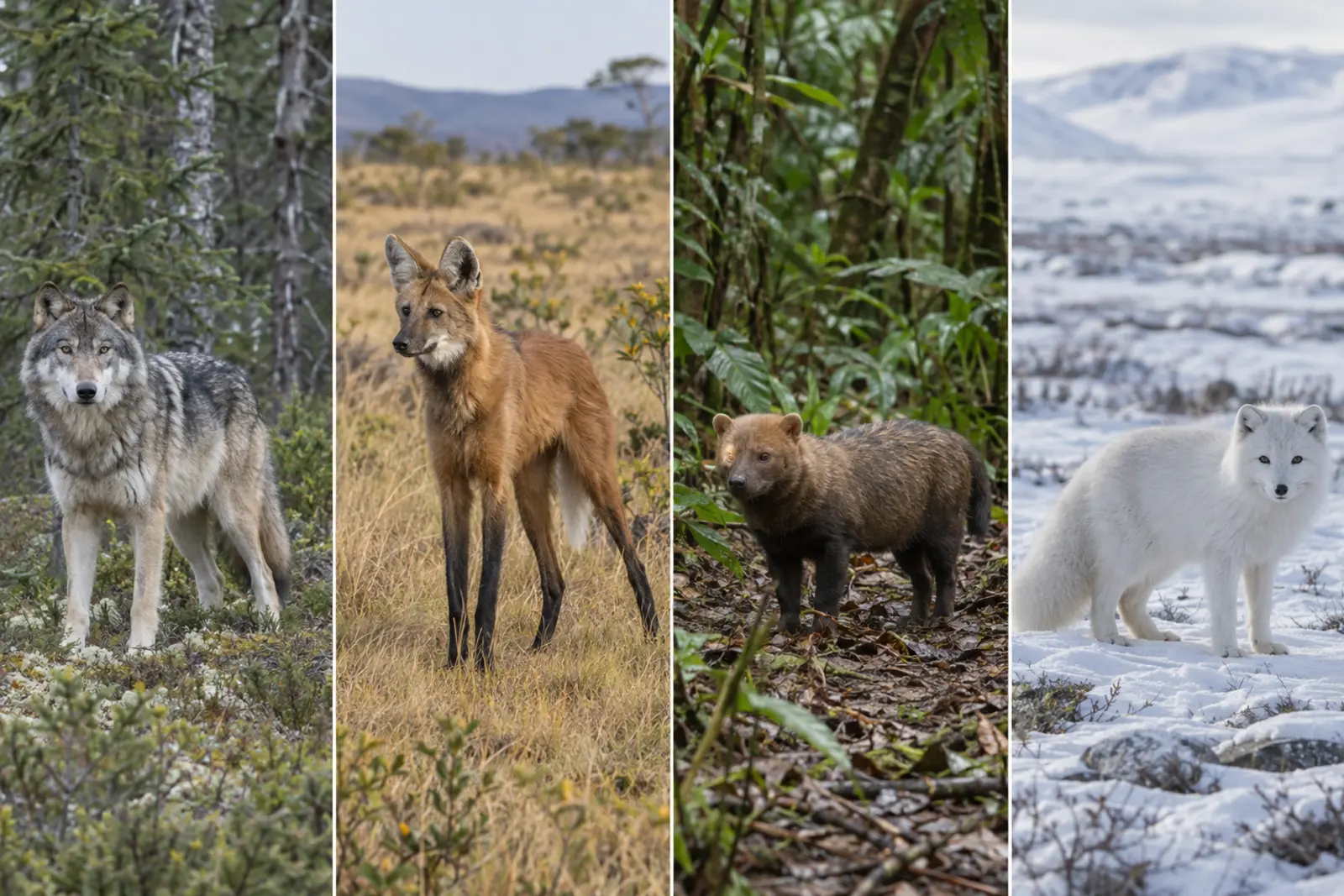
Arctic foxes show nearly the opposite silhouette. Small rounded ears, a short muzzle and a compact body reduce exposed surface area, while thick fur covers even the footpads. Seasonal coat color can improve camouflage, although not every population turns white. Gray wolves in northern regions also carry dense winter coats, but wolves remain ecological generalists across a much wider range of climates.
Grassland height and forest compactness
The maned wolf’s exceptionally long legs raise its body above tall South American grasses. Despite its name and fox-like face, it is neither a true wolf nor a fox; it is the only living species in its genus. At the other extreme, the low, sturdy bush dog moves through dense cover and uses waterways readily. These forms show why the generic “wolf shape” does not represent the whole family.
Do all wild canids live in packs?
No. Canid social systems respond to food distribution, prey size, breeding ecology and local risk. Gray-wolf packs are usually families centered on a breeding pair and their offspring, not permanent armies ruled through constant fighting. Cooperative living helps wolves defend young, hold territory and sometimes hunt prey that would be difficult for one wolf to subdue.
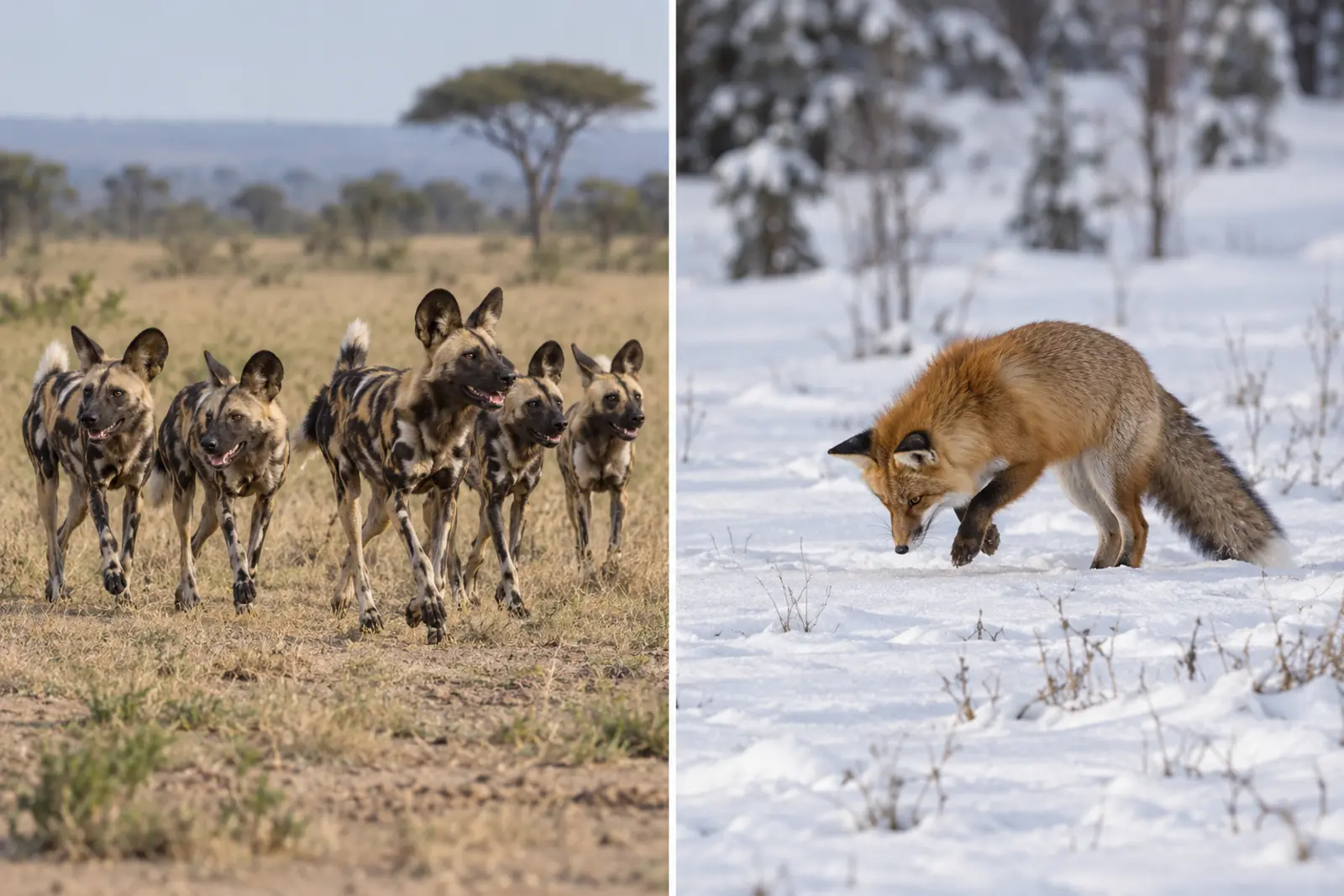
African wild dogs and dholes are also strongly social and often hunt cooperatively. Pack members share food and help care for young. This cooperation is important, but group size and hunting success vary; a large pack is not automatically successful in every landscape.
Many foxes forage alone, yet “solitary” does not mean antisocial. Red foxes may maintain pair bonds and family territories, and adults can cooperate in raising cubs. Fennec foxes may live in family groups even when individuals search for food separately. The maned wolf likewise tends to forage alone while a male and female maintain an overlapping territory and communicate by scent.
How wild canids affect ecosystems
Some wild canids influence prey numbers, animal behavior and scavenger access to carcasses. Large predators such as wolves can produce effects that spread through food webs, but those outcomes depend on prey density, competing carnivores, habitat and human activity. It is too broad to claim that every canid always “prevents overgrazing” or maintains biodiversity in the same way.
Smaller canids often consume rodents, insects and fruit. Maned wolves can disperse seeds, while foxes may affect local populations of small mammals. Canids can therefore act as predators, scavengers and seed dispersers, with the balance differing by species and place.
Why many wild canids are declining
The threats are rarely limited to one cause. Habitat conversion divides populations and reduces access to prey. Roads kill animals and isolate breeding groups. Retaliatory killing follows real or perceived livestock losses, while snares set for other wildlife can injure canids accidentally.
Contact with domestic dogs adds another layer. Rabies, canine distemper and other pathogens can spill into susceptible wild populations. Domestic dogs may also compete, harass wildlife or hybridize with closely related canids. A peer-reviewed review described wild canids as useful sentinels for emerging canine vector-borne diseases, while field studies document interfaces where domestic dogs and wild foxes can share pathogens.
What effective canid conservation looks like
Protection has to match the species and landscape. Priorities can include connected habitat, wildlife crossings, vaccination around vulnerable populations, secure waste and livestock practices, removal of indiscriminate snares, and compensation or husbandry programs that reduce retaliatory killing. Monitoring genetics and disease is especially important for small, isolated populations.
The central lesson is diversity. Wolves, foxes and wild dogs share an evolutionary family, but they do not share one diet, climate adaptation or social formula. Conserving them means preserving that range of solutions rather than treating every canid like a smaller or larger version of the gray wolf.
Frequently asked questions
Are foxes canids?
Yes. True foxes in the genus Vulpes and several other fox-like species belong to Canidae, the same family as wolves, jackals and domestic dogs.
Is the African wild dog a feral domestic dog?
No. The African wild dog is a distinct wild species, Lycaon pictus. Its name does not mean that it descended from recently escaped domestic dogs.
Are jackals one natural group?
The common name covers several medium-sized canids. Genetic work showed that the African golden wolf is closer to wolves and coyotes than to the golden jackal, illustrating why common names do not always map neatly onto evolutionary relationships.