
The Surinam toad (Pipa pipa) carries developing young in temporary chambers in the skin of the female’s back. The eggs are fertilized and placed there during an elaborate underwater mating sequence. Unlike many frogs, the embryos complete metamorphosis inside the chambers and emerge as miniature toadlets rather than free-swimming tadpoles.
Surinam toad facts at a glance
| Scientific name | Pipa pipa |
|---|---|
| Family | Pipidae |
| Animal group | Amphibian |
| Habitat | Slow-moving freshwater in northern South America |
| Distinctive feature | Temporary dorsal brood chambers in females |
| Development | Direct development to fully formed toadlets |
How do Surinam toads reproduce?
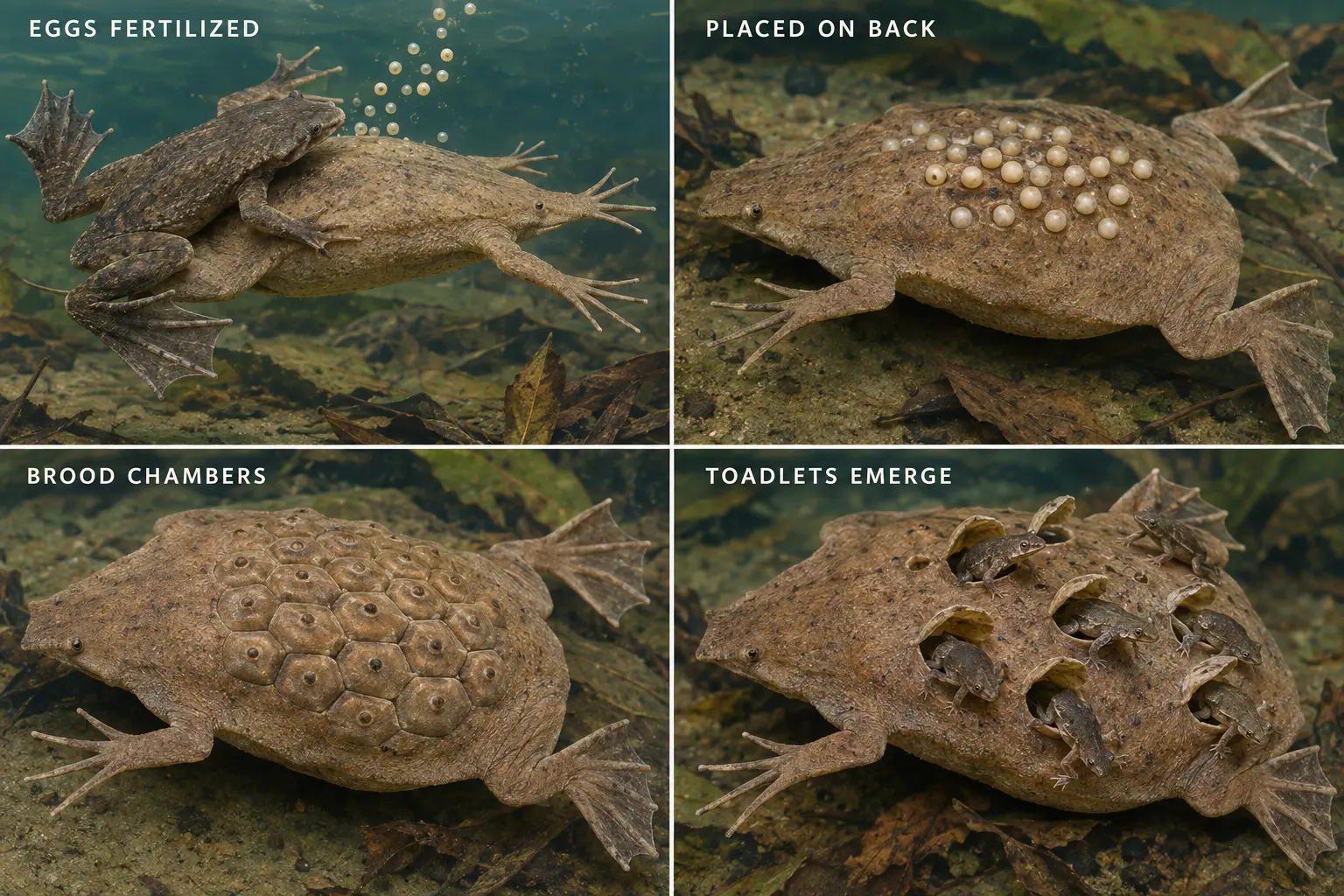
Mating takes place underwater. The male clasps the female around the rear of her body in inguinal amplexus. The pair performs repeated looping or turning movements. As the female releases eggs, the male fertilizes them and helps position them on her softened, swollen back.
The process is more coordinated than the viral phrase “the male pushes babies into her skin” suggests. At this stage they are fertilized eggs, not babies, and each becomes seated in the dorsal surface during the pair’s reproductive movements.
How do the back pockets form?
In the days around egg deposition, the female’s dorsal skin changes markedly. It thickens and grows around each egg, forming a separate temporary brood chamber. The visible honeycomb appearance comes from many chambers packed together rather than from permanent holes in an ordinary toad’s back.
Research on related Pipa species shows that tissue around these chambers becomes highly vascularized. That likely supports gas exchange and the unusual incubation environment. It does not justify claiming that embryos receive all their food directly from the mother. In P. pipa, the large yolky eggs provide the primary nutritional reserve, and direct maternal nutrient transfer has not been demonstrated well enough to describe this as amphibian pregnancy equivalent to a mammal’s placenta.
Do Surinam toads have a tadpole stage?
They undergo larval development, but not as free-swimming tadpoles in open water. Development and metamorphosis occur within the dorsal chambers. When the young leave, they already have the body plan of tiny toads, including limbs, and can begin independent aquatic life.
This is called direct development in many species accounts. It does not mean the embryo skips every developmental stage; it means the familiar externally swimming tadpole phase is concealed within the brood chamber.
Do the babies burst through the mother’s skin?
“Burst” or “rupture” makes the event sound like an injury. As development finishes, the openings or lids of the brood chambers loosen and the toadlets push and wriggle free. The process can look startling, but the chambers are specialized temporary reproductive structures.
Accounts commonly describe a brooding period of roughly three to four months, but timing can vary with temperature and husbandry conditions. The female later sheds the altered outer layer, and her dorsal surface returns toward its non-brooding condition.
Why is the Surinam toad so flat?
Pipa pipa spends nearly all its life in water. Its broad, flattened brown body resembles dead leaves on a muddy bottom. The head is triangular, the eyes are small, the hind feet are strongly webbed, and the front fingertips carry star-like sensory structures.
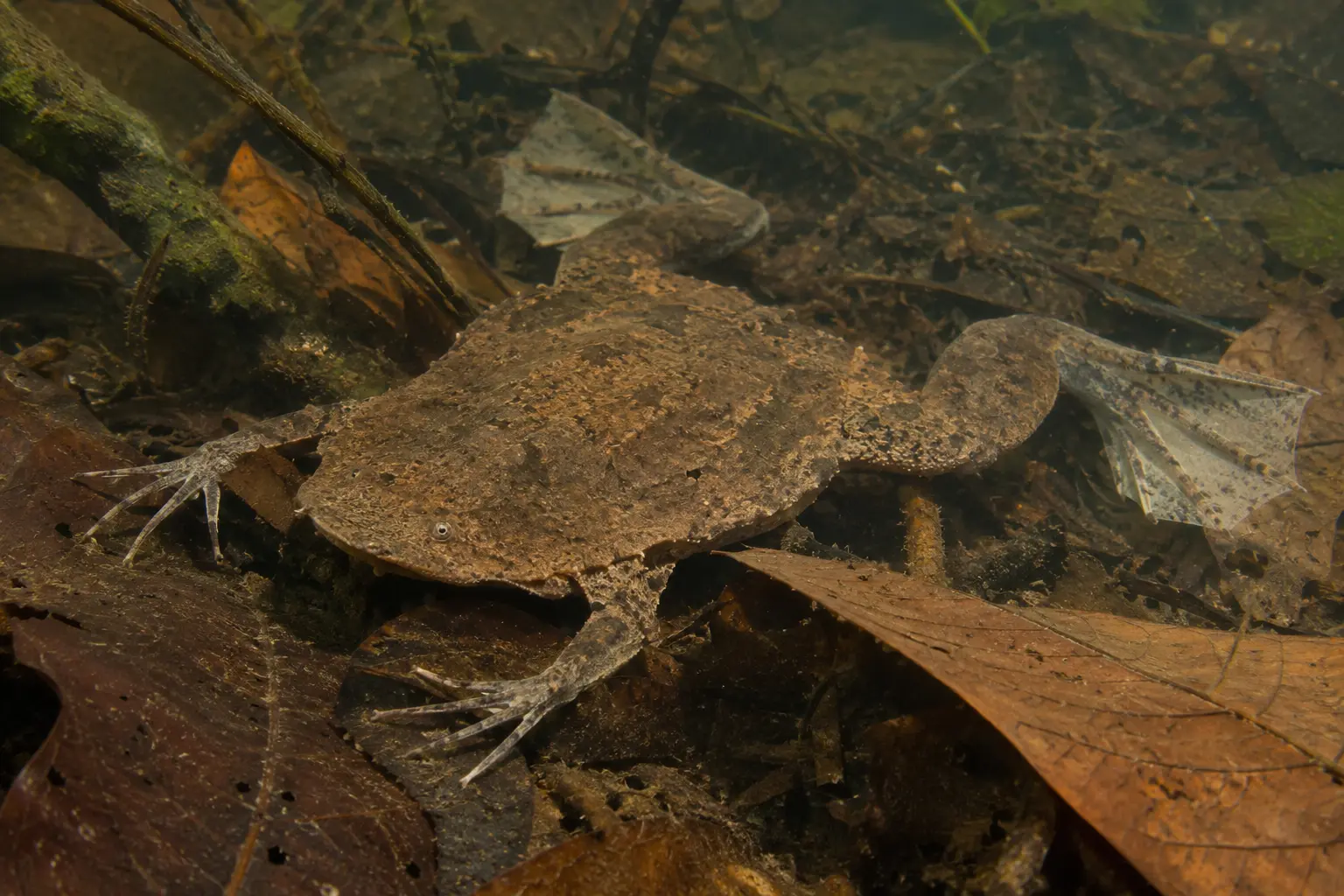
Those fingertips help the animal investigate its surroundings in turbid water. Instead of using a projectile tongue like many frogs, the Surinam toad captures small aquatic prey with rapid movements of the mouth and forelimbs. Its camouflage and low profile make it easy to overlook among submerged leaves.
Where do Surinam toads live?
The species is native to tropical northern South America, including parts of the Amazon and Guiana Shield regions. It inhabits slow rivers, creeks, flooded forests, ponds and other quiet freshwater environments with soft bottoms and leaf litter.
The common name can be misleading if interpreted too narrowly: Surinam toads are not restricted to Suriname. Records occur across several countries in the region. Their aquatic lifestyle also means that clean, connected freshwater habitat is central to their survival.
Frequently asked questions
Is the Surinam toad really a toad?
It is an amphibian in the frog order Anura. “Toad” is part of its English common name, but common frog-versus-toad labels do not always match a single formal taxonomic division.
Does carrying eggs hurt the female?
The chambers are a normal reproductive adaptation, not evidence of a parasitic infection. Scientists should still avoid assuming that the process has no physiological cost; producing eggs and remodeling skin require resources.
Are the holes permanent?
No. They are temporary brood chambers associated with reproduction. After the young emerge, the female sheds the altered outer skin.
The bottom line
The Surinam toad’s back is a temporary nursery, not a wound. Fertilized eggs become enclosed in individual chambers, where the young complete development before emerging as miniature toadlets. The real biology is remarkable enough without claiming that embryos are fed directly by the mother or violently tear through her body.