
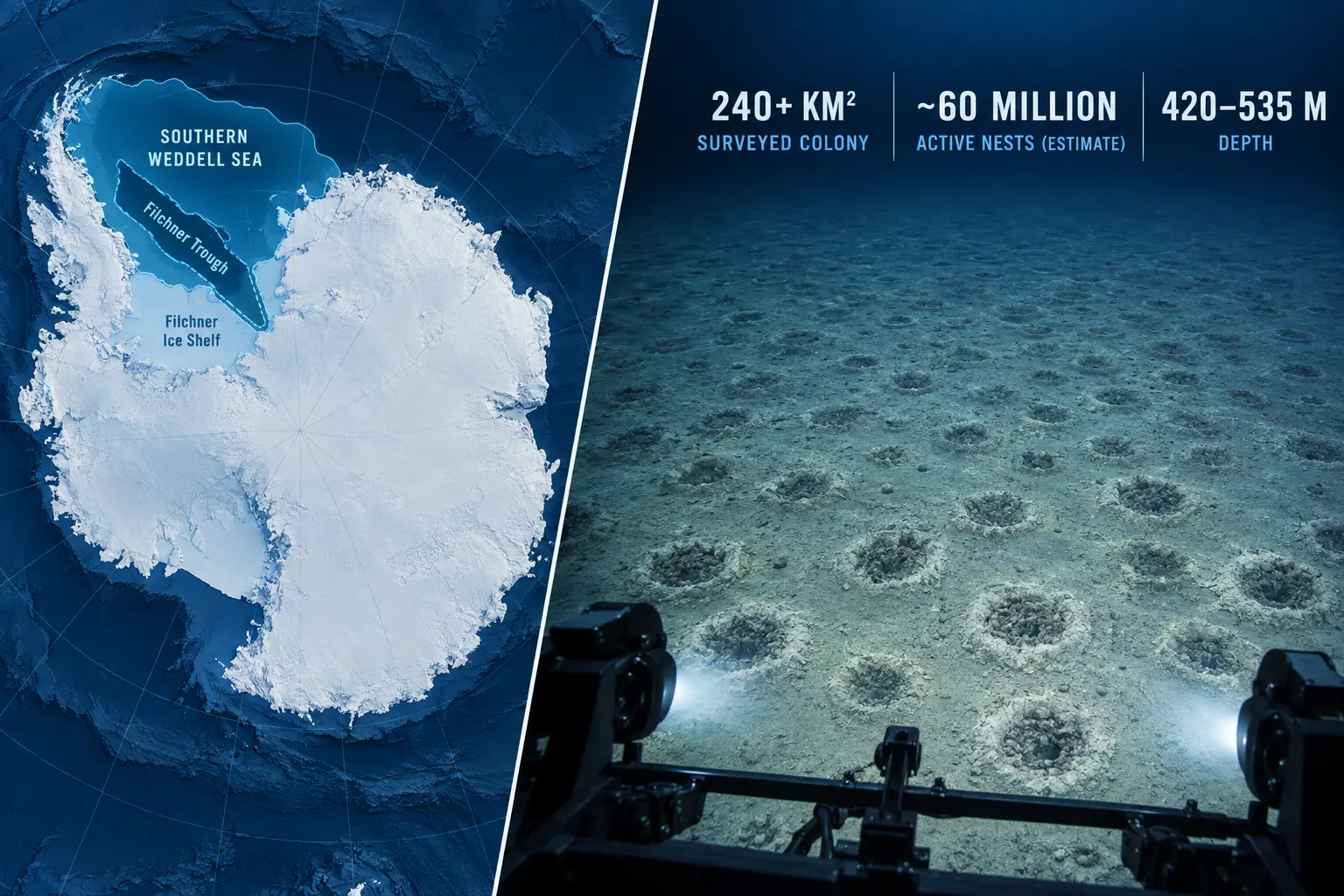
Scientists estimate that about 60 million active Jonah’s icefish nests cover at least 240 square kilometers of seabed in Antarctica’s southern Weddell Sea. The colony was mapped during a 2021 expedition and described in a peer-reviewed study published on January 13, 2022. It is the largest continuous fish-breeding colony documented so far—not a newly discovered “underwater city” from 2026.
Key findings from the icefish nursery
- The surveyed colony covered at least 240 km² near the Filchner Ice Shelf.
- Researchers estimated roughly 60 million active nests, based on nest density and mapped habitat—not a literal count of every nest.
- The nests occurred at depths of about 420–535 meters.
- Most active nests seen by the camera held eggs and were guarded by one adult fish.
- The breeding ground may support predators including Weddell seals, but the study did not show seals feeding exclusively on icefish.
How was the colony discovered?
Researchers aboard the German research icebreaker Polarstern were studying the seafloor near the Filchner Ice Shelf in February 2021. They towed the Ocean Floor Observation and Bathymetry System, or OFOBS, behind the ship. Its cameras recorded the seabed from roughly 1.5 to 2 meters above it.
Instead of an occasional nest, the video revealed circular depressions repeating across kilometer after kilometer of seafloor. The team combined camera transects with oceanographic data and habitat modeling to estimate the full extent. Their results appeared in Current Biology in 2022.
Why “60 million nests” is an estimate
No expedition photographed 60 million nests individually. Along the densest transects, researchers recorded an average density of about 0.26 active nests per square meter—roughly one nest per four square meters. They then used the observed distribution, seafloor characteristics and water conditions to estimate the colony’s area and total number of active nests.
The figure is therefore a scientifically derived population-scale estimate. It is appropriately reported as “about” or “roughly” 60 million, not as an exact census. The mapped breeding area was at least 240 km², so its boundary may extend beyond the surveyed region.
What does an icefish nest look like?
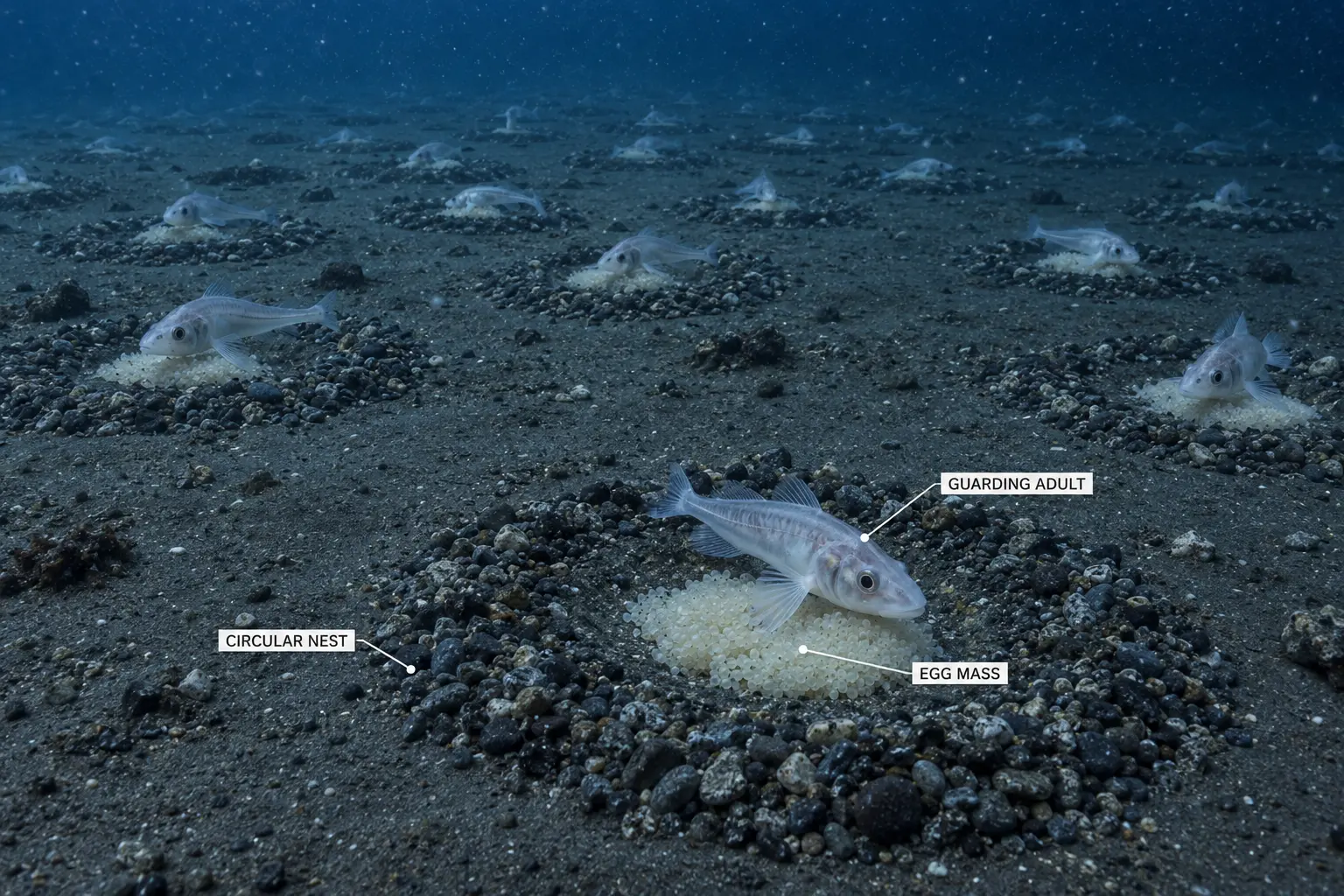
Jonah’s icefish (Neopagetopsis ionah) make circular nests in soft sediment. The photographed nests averaged about 75 centimeters across and 15 centimeters deep. A raised rim of displaced sediment surrounds a cleaner central area containing the eggs.
The researchers reported an average of about 1,735 eggs in sampled nests. That value should not be turned into a fixed maximum of “1,700 eggs per nest.” Egg counts vary, and the study’s figure represents a sample average. Most active nests viewed by camera were occupied by one guarding adult, although the images alone could not establish the sex of every guardian.
Why is the nursery in this part of the Weddell Sea?
The nest field closely followed a tongue of relatively warm deep water flowing through the Filchner Trough. “Warm” is relative in Antarctica: bottom water in the nesting area was about 0°C, while nearby water was colder. The boundary between the nest-rich and nest-poor seafloor aligned sharply with this hydrographic feature.
That association suggests water temperature and circulation help define suitable breeding habitat. The area may also provide favorable food conditions, but the discovery does not prove that hydrothermal vents or sulfur-eating bacteria feed the colony. Those details belong to other deep-sea ecosystems and should not be added to this story without evidence.
Do Jonah’s icefish really have clear blood?
Jonah’s icefish belongs to the crocodile icefish family, Channichthyidae. Members of this family lack functional hemoglobin and circulating red blood cells, so their blood is pale rather than red. Oxygen is carried dissolved in the plasma and supported by adaptations including large hearts, wide blood vessels and extensive gill surfaces.
That unusual blood is not the same thing as an invisible body. The fish seen guarding nests are pale and lightly pigmented, not glass-clear. Antarctic notothenioid fishes also use antifreeze glycoproteins that inhibit the growth of ice crystals in their body fluids, as reviewed in the scientific literature on Antarctic fish physiology.
Why does the colony matter to Weddell Sea wildlife?
The study estimated more than 60,000 tonnes of fish biomass associated with the active nests. That concentration makes the colony an important component of the local food web. Tracking data showed Weddell seals spending more time diving in the nest-field area than in nearby waters, consistent with foraging there.
However, seal tracks do not identify every item eaten. The evidence supports the breeding ground as a likely foraging hotspot, not the stronger claim that the nests are a single “critical food source” on which Weddell seals entirely depend.
Does the icefish colony have legal protection?
The discovery strengthened scientific arguments for protecting the southern Weddell Sea from destructive or extractive activities. The Alfred Wegener Institute described the site as a strong reason to establish a marine protected area.
A scientific recommendation is not the same as a completed legal designation. Conservation decisions in Antarctica involve the Commission for the Conservation of Antarctic Marine Living Resources, whose members must negotiate and adopt any large new marine protected area.
Frequently asked questions
Was the colony discovered in 2026?
No. The camera survey took place in February 2021, and the peer-reviewed paper was published on January 13, 2022. Articles circulating in 2026 are revisiting the earlier discovery.
Is it the largest fish colony on Earth?
It is the largest continuous fish-breeding colony documented by scientists so far. That wording recognizes both the scale of the evidence and the possibility that other large breeding grounds remain undiscovered.
Are all 60 million nests occupied?
The study estimated approximately 60 million active nests from surveyed densities. Camera observations showed eggs and a guarding fish in most active nests, but researchers did not inspect every nest individually.
The bottom line
The Antarctic icefish nursery is extraordinary because of its verified scale: a repeating landscape of guarded nests across at least 240 km² of the Weddell Sea floor. The numbers are estimates produced from systematic camera surveys and habitat data. Keeping that context makes the discovery more—not less—impressive.
References
- Purser et al. (2022), A vast icefish breeding colony discovered in the Antarctic, Current Biology
- Alfred Wegener Institute: World’s largest fish breeding area discovered in Antarctica
- Molecular ecophysiology of Antarctic notothenioid fishes
- Parental care and demography of Jonah’s icefish, Polar Biology