
A blue whale’s tongue is a huge, flexible muscular organ that may weigh around 2.6 metric tonnes in the largest animals. During lunge feeding, it does not simply act as a rigid hydraulic piston. Instead, the tongue deforms as the mouth and ventral throat pouch expand around prey-filled water, then helps move retained krill toward the throat after water passes through the baleen.
Blue whale tongue facts at a glance
| Animal | Blue whale (Balaenoptera musculus) |
|---|---|
| Scientific weight estimate | Up to about 2,600 kg (5,700 lb) |
| Main feeding method | Lunge feeding |
| Primary prey | Krill |
| Filter | Baleen plates hanging from the upper jaw |
| Expandable structure | Ventral groove blubber from the throat toward the belly |
How heavy is a blue whale’s tongue?
A 2022 biomechanics paper described the blue whale tongue as a muscular hydrostat that can weigh up to approximately 2,600 kilograms. That is an estimate for an exceptionally large organ, not a standard measured weight for every blue whale.
Popular sources often raise the number to 3,600 or 4,000 kg and compare it with “an elephant” or “40 people.” Those comparisons are unreliable without specifying the size and sex of the elephant or the body mass assigned to each person. Individual whales also vary enormously. A cautious scientific summary is that the largest blue whale tongues may weigh several tonnes, with about 2.6 tonnes supported in the biomechanics literature.
What happens during lunge feeding?
Blue whales are rorquals, a family of baleen whales with expandable grooves running along the underside of the throat. To feed, a whale accelerates toward a dense krill patch and opens its jaws. Water and prey enter as the ventral groove blubber stretches outward, greatly increasing the capacity of the mouth.
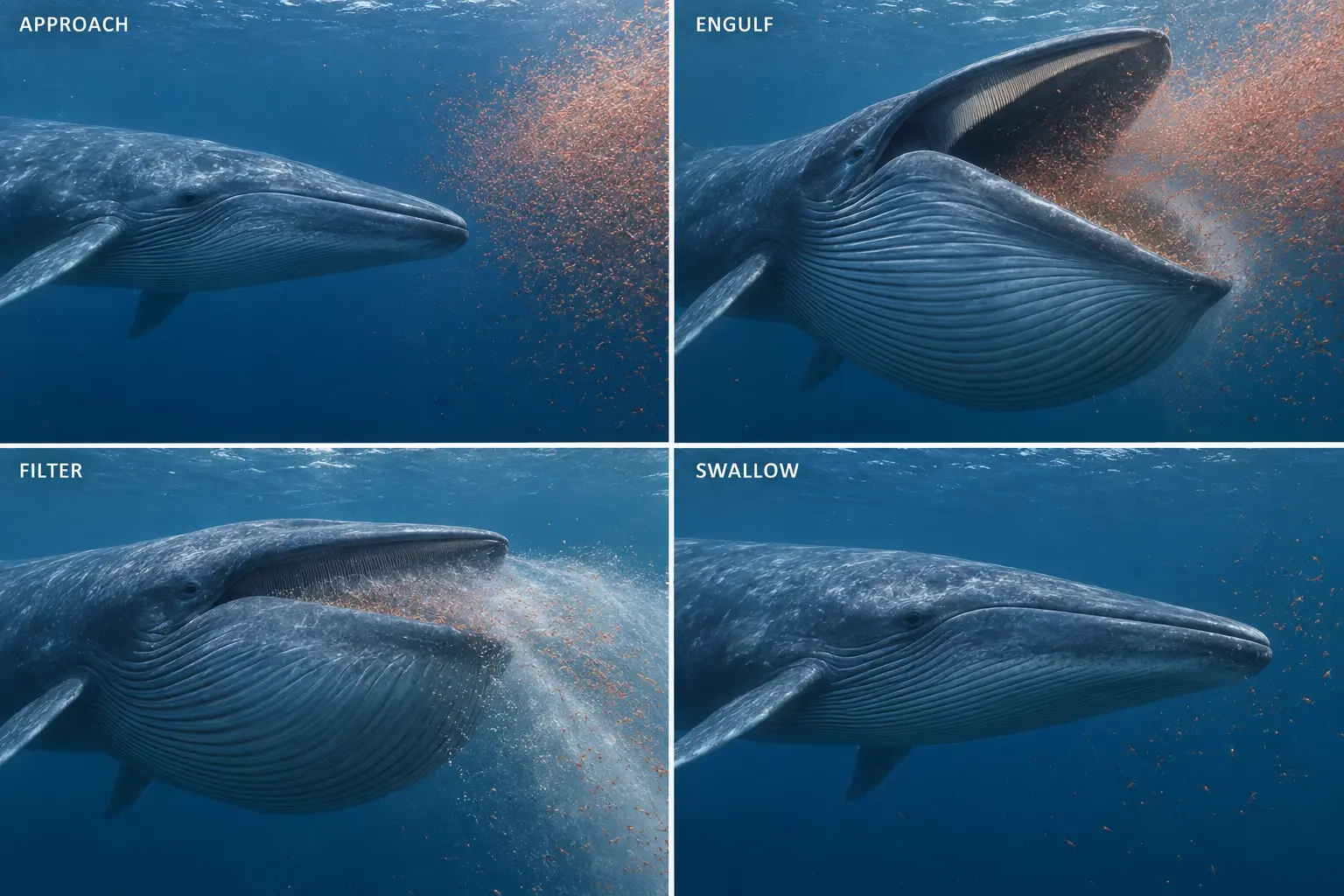
The engulfed water can impose tremendous drag, slowing the whale. Once the jaws close, elastic tissues recoil and the whale expels water through its baleen plates. The baleen’s fringed inner edges retain krill, which the tongue then helps gather and move toward the relatively narrow esophagus.
Is the tongue a hydraulic piston?
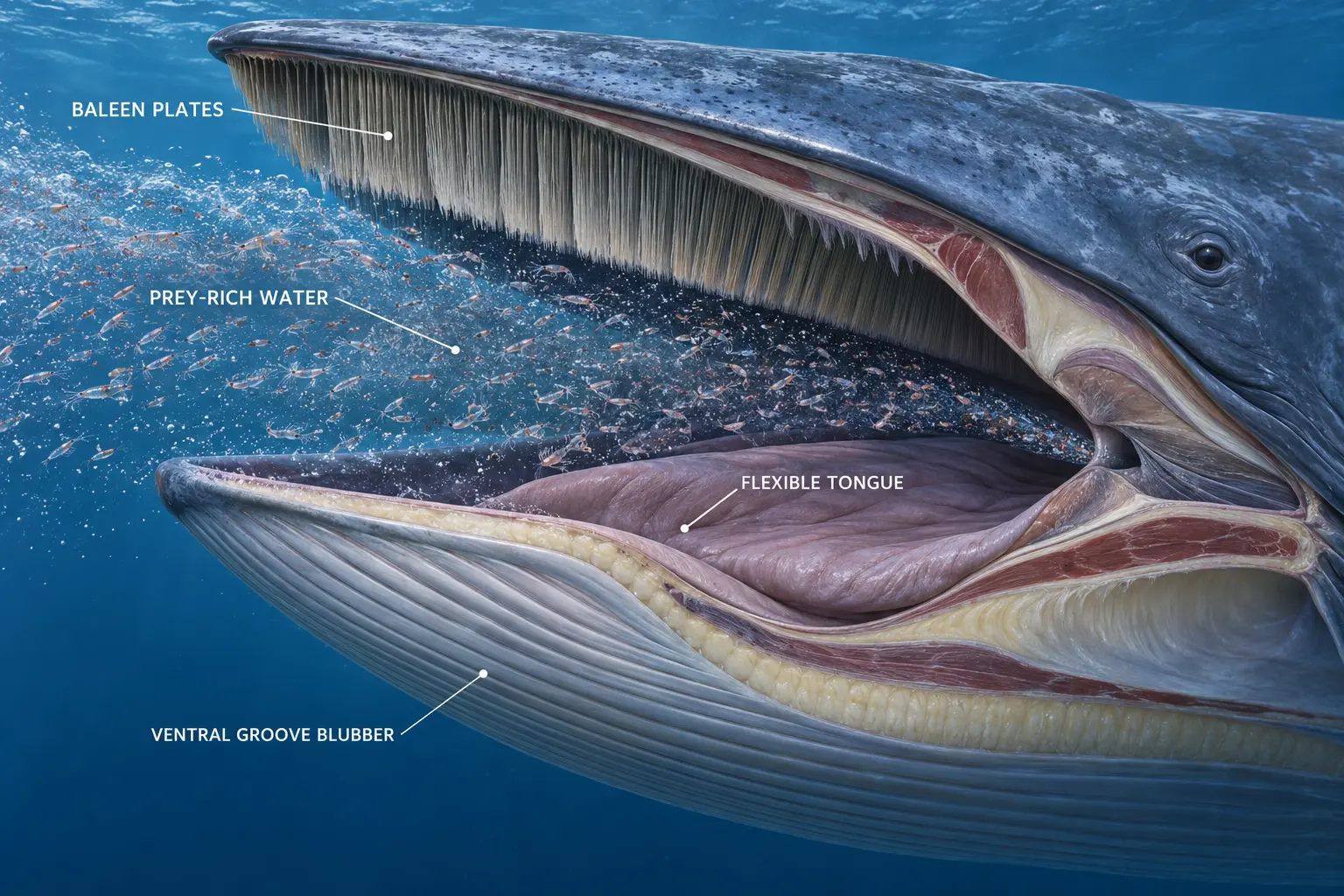
Not in the simple mechanical sense implied by many viral descriptions. The rorqual tongue is unusually soft and deformable. Comparative anatomical research indicates that it can flatten and invert into the expanding oral pouch as water rushes into the mouth. It works as one component of a coordinated system involving the jaws, ventral groove blubber, nerves, muscles, connective tissues and baleen.
Calling it a “piston” may help visualize water being forced out, but it risks suggesting a rigid organ pushing back and forth inside a cylinder. In reality, filtration involves complex tissue deformation, elastic recoil and pressure changes across a flexible mouth.
How can the mouth expand so far?
The underside of a blue whale is lined with longitudinal throat pleats. These folds allow the ventral groove blubber to unfold and stretch during a lunge. Specialized nerves embedded in this tissue can extend substantially without damage, an adaptation sometimes compared with a bungee cord.
A sensory organ located at the front of the lower jaws also helps coordinate the rapid changes in jaw position and pouch expansion. Together, these structures let a streamlined whale temporarily transform its mouth into a vast prey-capturing chamber.
Can a blue whale engulf more than its body mass in water?
Models of the largest rorquals indicate that engulfed water mass can approach or, under some assumptions, exceed the whale’s own body mass. The exact value depends on whale length, gape, speed and how the mouth’s changing geometry is modeled. It should not be converted into a single fixed number of gallons for every feeding event.
This enormous capacity helps explain how blue whales meet their energy needs by eating tiny prey. A lunge is mechanically expensive, so whales target dense krill patches where one mouthful can deliver enough food to justify the effort.
Does the hyoid bone support the whole tongue?
The hyoid apparatus anchors tongue and throat muscles, but describing it as a platform that directly carries the entire tongue like a shelf oversimplifies the anatomy. The tongue is integrated with the floor of the mouth and the expandable ventral tissues. Its motion depends on multiple muscle groups and connective structures rather than one oversized bone acting alone.
Why is baleen as important as the tongue?
Blue whales have no teeth. Hundreds of keratinous baleen plates hang from each side of the upper jaw. When the whale forces water outward, krill collect against the fringed baleen. The tongue then helps clear and consolidate the prey for swallowing.
The tongue therefore cannot be understood in isolation. The biological achievement is the entire feeding apparatus: a broad flexible skull, rotating jaws, extensible throat pouch, stretchable nerves, baleen filter and highly deformable tongue working in sequence.
Frequently asked questions
Is a blue whale’s tongue heavier than an elephant?
It can overlap with the mass of a small adult elephant, but “an elephant” is too vague for a precise comparison. Elephant body mass varies by species, sex and age, while tongue weights in living blue whales are estimates rather than routine direct measurements.
Can a human stand on a blue whale’s tongue?
Claims about dozens of people standing on the tongue are scale metaphors, not biological tests. A living tongue is soft tissue inside a whale’s mouth, not a safe load-bearing platform.
Does a blue whale chew krill?
No. Blue whales filter krill with baleen and swallow the collected prey. Their esophagus is much narrower than the fully expanded mouth, which is specialized for taking in water rather than swallowing large animals.
The bottom line
The blue whale tongue is remarkable because it is flexible enough to participate in the largest feeding events performed by any living animal. Its possible multi-tonne mass is impressive, but the real story is coordination: tongue, baleen, jaws and ventral pleats turn a cloud of tiny krill into an energy-rich mouthful.
References
- Schulz et al. (2022): Skin wrinkles and folds enable asymmetric stretch in mammalian tissue
- Werth (2023): Cetacean tongue mobility and function
- Potvin, Goldbogen and Shadwick (2012): Metabolic expenditures of lunge feeding rorquals
- Goldbogen et al. (2010): Skull and buccal cavity allometry in rorquals
- Goldbogen et al. (2011): Mechanics, hydrodynamics and energetics of blue whale lunge feeding
- NOAA Ocean Today: Whale anatomy