
Your dog is waiting at the door minutes before you arrive. It can feel uncanny, but the most likely explanation is not a sixth sense. Dogs can combine learned routines, changing household activity, familiar sounds and odor information. What remains unproven is the popular claim that every dog measures the fading strength of its owner’s scent like a precise clock.
How do dogs know when you’re coming home?
Dogs probably do not rely on one signal. A predictable return time gives them a routine to learn. Other people may begin cooking, children may return from school, daylight may change, or neighborhood traffic may follow a daily pattern. Near the end of that sequence, a dog may hear a familiar engine, footsteps, keys or a gate. Smell may also help identify who is approaching or whether a familiar person has recently been present.
This is best understood as cue integration: several ordinary signals become powerful when they repeatedly occur together.
1. Dogs learn household routines
Domestic dogs are unusually attentive to people. Repeated daily events can become predictors: an alarm sounds, a family member leaves, the mail arrives, dinner preparation begins and an owner returns. A dog does not need to read a clock face to learn that one event often follows another.
Research on pet dogs’ activity shows that human schedules shape canine rest and movement. Dogs also respond to changes in light, feeding and social activity. These influences do not prove that a dog knows the exact hour. They show why a regular household can provide many time-linked cues.
2. Familiar sounds can announce you
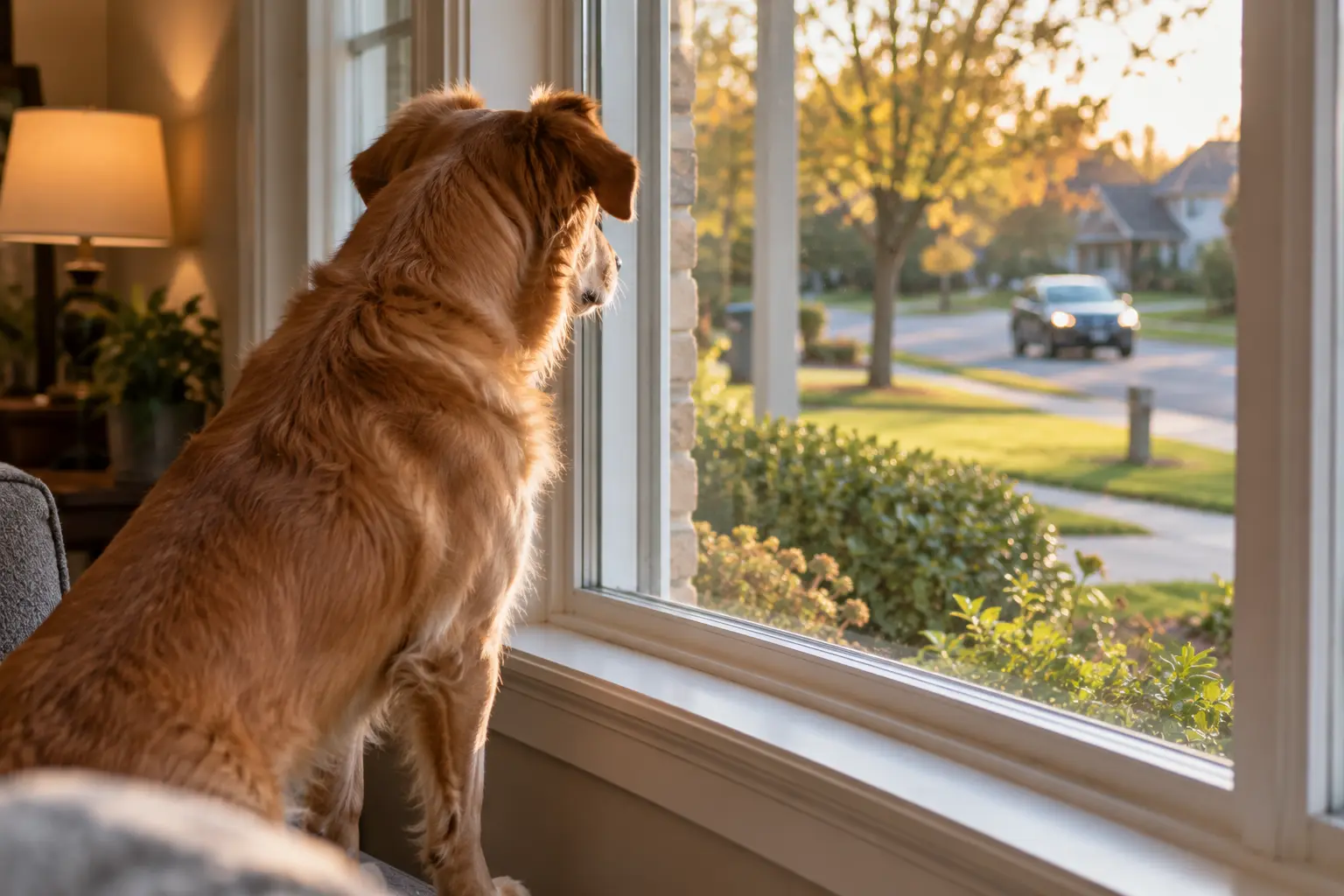
Dogs hear higher frequencies than people and can notice quiet or distant sounds that humans miss. More importantly, they can learn the acoustic signature of a recurring event: a particular vehicle, a garage door, footsteps on stairs or a key in a lock.
That does not mean every dog can identify its owner’s car from a fixed number of blocks away. Detection depends on the sound, frequency, background noise, weather, terrain and the individual dog’s hearing. Age and ear disease also matter. The defensible claim is simpler: a familiar sound may reach the dog before it reaches the people inside.
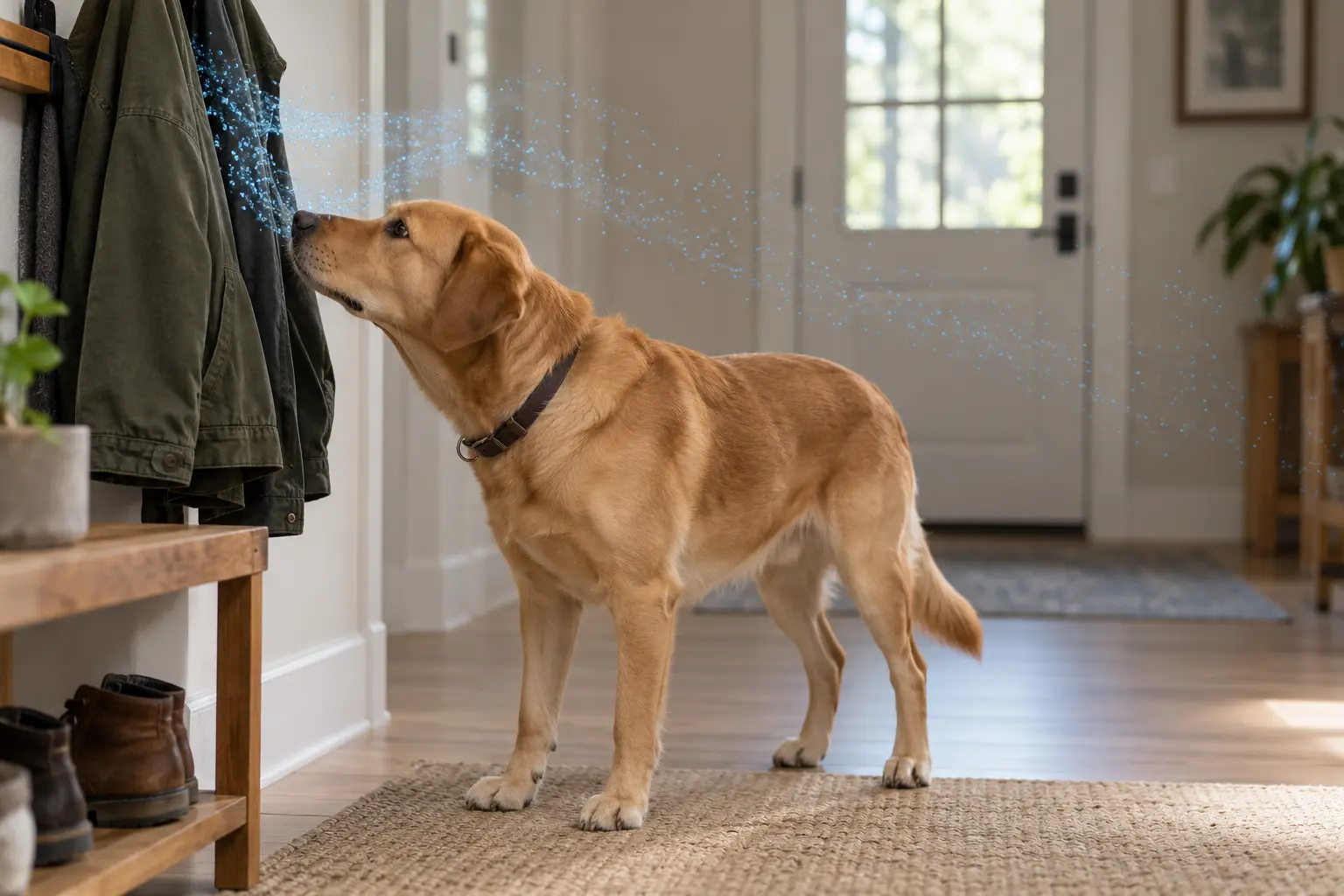
3. Smell identifies people—but is it a clock?
Olfaction is central to how dogs recognize their social world. In a controlled study, dogs formed owner-specific expectations from odor: after smelling one person, they searched for that person and reacted when the individual who appeared did not match the scent-based expectation. This supports the idea that owner odor carries meaningful identity information.
Dogs can also discriminate between different concentrations of an odor under experimental conditions. That ability makes a “scent clock” biologically plausible: perhaps the changing concentration of an absent person’s odor contributes to an estimate of elapsed time.
However, plausibility is not proof. Household odor does not necessarily decline in a smooth, universal way. Ventilation, humidity, open windows, fabrics, room size, cleaning, airflow and other occupants can all change the scent field. Controlled studies have not established that pet dogs routinely calculate an owner’s return time from a steadily fading odor concentration. The scent-clock idea should therefore be described as a hypothesis, not a settled fact.
4. Do dogs understand how long you have been gone?
A study of dogs left alone for different periods found differences in reunion behavior after longer separations. That suggests dogs are affected by the duration of an owner’s absence. It does not reveal which information they used, nor does it show that they were counting minutes or predicting the moment of return.
Animal timing can involve internal biological rhythms, memory and environmental change. In a home, those processes are difficult to separate because light, noise, human behavior and odor change together.
5. Why some “predictions” look almost psychic
Dogs may wait by a window many times when nothing happens, while people remember the striking occasions when the timing is correct. Cameras can also reveal subtle triggers that an observer missed—such as another household member moving toward the kitchen or a vehicle turning onto the street.
Claims of paranormal detection have not held up well under independent testing. In one controlled examination of a dog said to know when its owner was returning, the results did not support psychic detection. Ordinary sensory and learned explanations remain both richer and better supported.
What your dog may actually be combining
- Your usual departure and return pattern
- Changes in daylight and household activity
- Feeding, walking and school schedules
- Sounds from a familiar vehicle, gate, elevator or footsteps
- Odors associated with the owner and other people
- The behavior of family members who expect your arrival
When waiting may be a welfare concern
Quietly watching a door is not automatically a problem. Concern is warranted when waiting is accompanied by persistent barking or howling, destructive escape attempts, pacing, heavy panting, drooling, indoor elimination or inability to settle. Those signs may indicate separation-related distress rather than impressive timekeeping.
A veterinarian can first rule out medical causes, especially when behavior changes suddenly. A qualified behavior professional can then help with gradual alone-time training and environmental management. Punishment can intensify fear and should not be used for anxiety-driven behavior.
Frequently asked questions
Can dogs smell how long you have been gone?
Dogs can detect odor identity and differences in odor concentration. But there is not yet strong controlled evidence that pet dogs use fading owner scent as a precise, general-purpose timer for homecoming.
Can a dog recognize its owner’s car?
Yes, a dog may learn a vehicle’s sound and associate it with an owner. There is no universal detection distance; conditions and individual hearing vary.
Do dogs know the exact time?
Evidence supports sensitivity to routines, biological rhythms and elapsed duration, but not human-like clock reading. A dog can behave as though it knows the time by learning a reliable sequence of cues.
The bottom line
When dogs appear to know you are coming home, the safest explanation is a combination of learning and exceptional senses. Routine narrows the window; sounds may provide the final alert; smell confirms identity and may contribute information about absence. The appealing idea of a precise canine scent clock remains possible, but it has not been demonstrated as the universal mechanism behind the behavior.
Sources
- Scientific Reports: Dogs display owner-specific expectations based on olfaction
- Animals: Canine discrimination of odor concentrations
- Applied Animal Behaviour Science: The effect of time left alone at home on dog welfare
- Animals: Sleep-wake patterns and activity in domestic dogs
- British Journal of Psychology: Independent test of a dog said to know when its owner was returning
Inline visuals are educational reconstructions created to explain the sensory cues discussed in the article.