
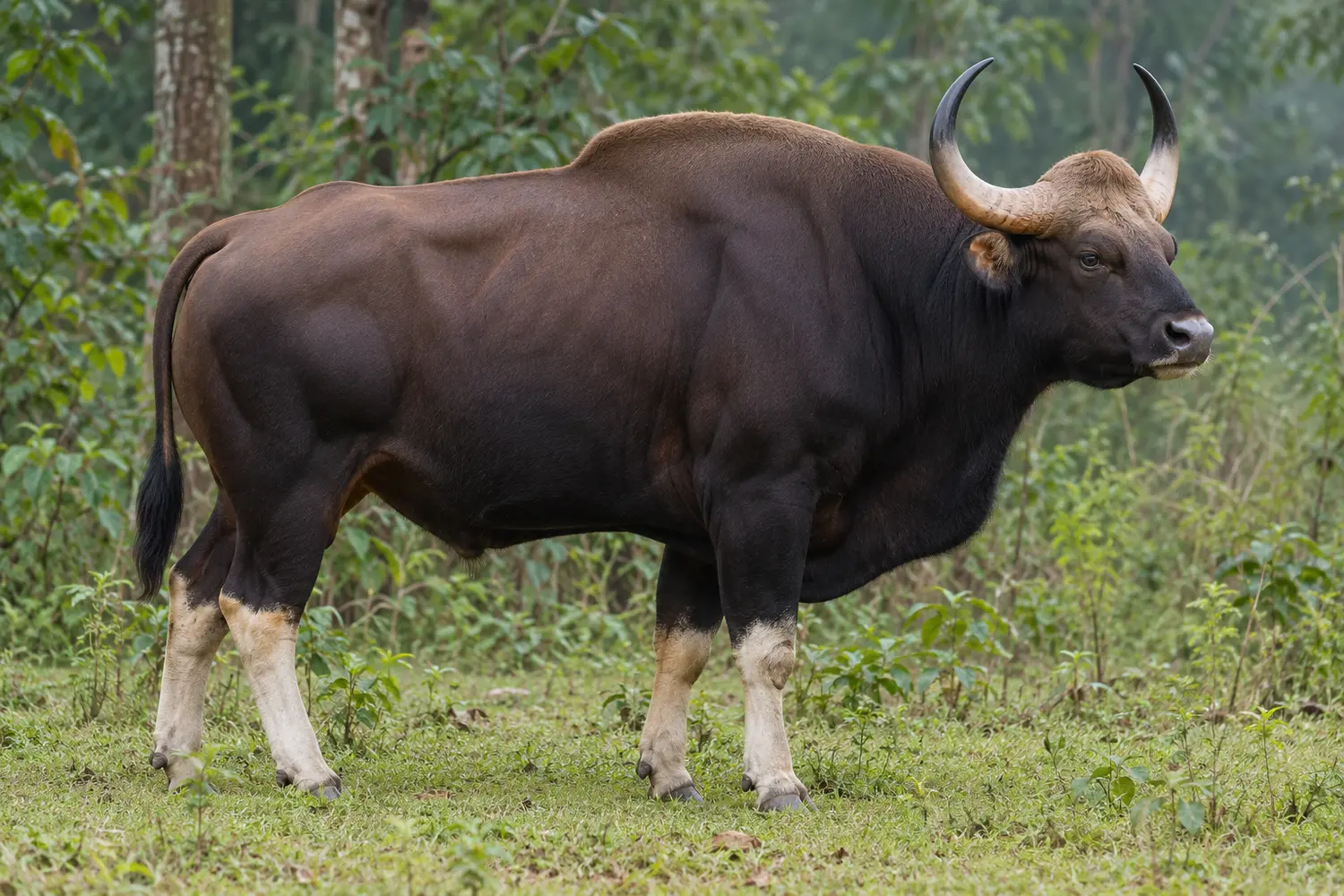
The gaur (Bos gaurus) is the world’s largest living wild cattle species. Adult males are exceptionally tall and heavy, with a prominent ridge over the shoulders that makes the front of the body look even more powerful. But “most muscular” and “strongest bovine” are not scientific rankings, and a 1,500-kilogram bull is an exceptional claim—not the normal size of a gaur.
Key takeaways
- Gaur are true wild cattle in the genus Bos, not true bison.
- Government studbook data give typical adult weights of about 600–1,000 kg for males and 450–800 kg for females.
- The high shoulder profile comes from skeletal proportions and a developed dorsal ridge, especially in mature males.
- Tigers do prey on gaur, particularly younger animals; tigers hunt alone rather than in packs.
- The species is classified as Vulnerable and is threatened by habitat loss, hunting, conflict and disease transmission from livestock.
Is a gaur the same as an Indian bison?
“Indian bison” is a familiar nickname, but it is taxonomically misleading. The gaur belongs to the cattle genus Bos, alongside domestic cattle, wild yak and banteng. True bison belong to the genus Bison. The scientific name for the wild gaur is Bos gaurus.
The distinction also matters because the domestic or semi-domestic mithun, or gayal, has often been classified as Bos frontalis. A detailed Mammalian Species review treats wild gaur and domestic mithun as closely related forms while retaining separate scientific names.
How big does a gaur get?
Gaur are widely recognized as the largest living cattle species. Size varies by sex, age and population. India’s Central Zoo Authority studbook lists a shoulder height of roughly 1.7–2.0 meters. It gives adult male weights of about 600–1,000 kilograms and female weights of about 450–800 kilograms. San Diego Zoo gives a broader shoulder-height range of 1.6–2.2 meters for gaur.
| Trait | Adult male | Adult female |
|---|---|---|
| Typical reported weight | 600–1,000 kg | 450–800 kg |
| Shoulder height | About 1.7–2.0 m in the Indian studbook | |
| Build | Larger, darker, stronger dorsal ridge | Smaller, usually browner |
Figures of 1,500 kilograms appear in popular accounts and some secondary references, but they should be understood as exceptional upper-end reports. They are not representative of most adult bulls. Exact comparisons with African buffalo, wild yak or domestic cattle also depend on whether researchers compare maximum records, averages, shoulder height or body mass.
Why are a gaur’s shoulders so high?
A mature bull’s front end rises noticeably above the hindquarters. The effect comes from the animal’s skeletal proportions, elongated vertebral processes and developed muscles along the neck and back. Males show the dorsal ridge most strongly, and their deep chest, thick neck and large forequarters add to the imposing outline.
It is tempting to describe this structure as a special “lifting machine,” but the anatomy literature does not support a single-purpose explanation. Like other large bovids, gaur use their neck, trunk and limbs for locomotion, feeding, social contests and defense. The ridge is a distinctive part of their body plan, not evidence for a measured title such as “strongest animal.”
Where do gaur live, and what do they eat?
Gaur occur in South and Southeast Asia, including India, Nepal, Bhutan, Bangladesh and parts of mainland Southeast Asia. They use forests, woodland–grassland mosaics and openings where grasses and browse are available. Their distribution is now fragmented across much of the historical range.
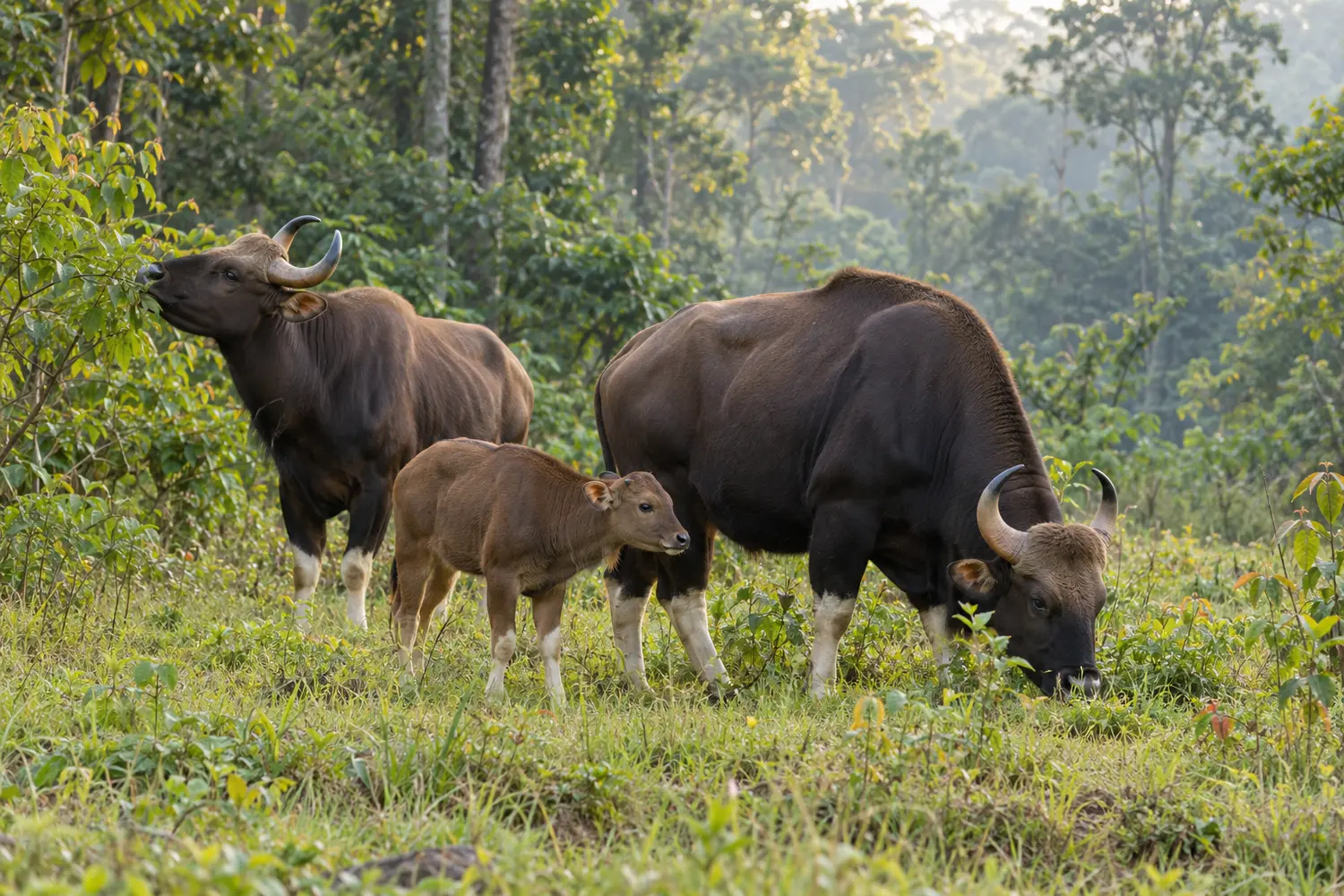
These ruminants eat grasses, leaves, shoots and other plant material. Herds commonly include adult females, young and calves, while mature bulls may be solitary or associate with herds at certain times. Habitat choice changes with food, water, season, disturbance and local predation risk.
Do adult gaur have natural predators?
Large adult gaur are formidable prey, but they are not predator-proof. Tigers can kill gaur, and multiple field studies have identified gaur in tiger diets. Research from Nagarahole found that tiger predation was biased toward young gaur. A 2020 study of tiger kills in Thailand likewise examined gaur and banteng as some of the largest prey taken by tigers.
The viral phrase “tiger packs” is wrong. Tigers are primarily solitary hunters. A single tiger may target a vulnerable calf, young animal or occasionally a larger individual, depending on opportunity and local prey conditions. Dholes can also hunt cooperatively, while leopards may threaten calves. The risk is uneven across age classes and habitats, so “virtually no natural predators” is too absolute.
Are gaur endangered?
The gaur is currently classified as Vulnerable on the IUCN Red List. The 2018 species account summarized a global population estimate of 13,000–30,000 and projected continued decline, while recent ecological research continues to identify habitat loss and fragmentation, hunting, conflict, competition with livestock and disease as major pressures.
Some populations remain substantial inside well-protected landscapes, especially in India, but the species is much rarer in parts of Southeast Asia. Protecting connected habitat, limiting poaching and reducing disease transmission at the wildlife–livestock boundary are therefore more important than celebrating unverified strength records.
Frequently asked questions
Is the gaur the largest bovine?
It is generally recognized as the largest living wild cattle species. “Largest bovid” is broader and can depend on the measurement used, so “largest wild cattle” is the clearest description.
Can a gaur weigh 1,500 kg?
That figure is best treated as an exceptional upper-end report. A more useful typical range for adult males is about 600–1,000 kg.
Can a tiger kill a gaur?
Yes. Field studies document gaur in tiger diets, with younger animals often more vulnerable. Tigers hunt alone, not in packs.
References
- Mammalian Species: Bos frontalis and Bos gaurus
- Central Zoo Authority of India: National Studbook of Gaur
- San Diego Zoo: Wild Cattle
- Ecological and anthropogenic factors influencing gaur habitat use
- Weights of gaur and banteng killed by tigers in Thailand
- Prey selection by tiger, leopard and dhole in tropical forests