
Crows mob eagles because a large raptor can threaten nests, young birds or access to food. The crows call loudly, recruit companions and make repeated close passes that may persuade the eagle to leave. Eagles often tolerate the harassment or move away, but there is no good evidence that they routinely escape by climbing into oxygen-poor air until the crows become exhausted.
Key takeaways
- Mobbing is a widespread anti-predator behavior in which smaller birds approach and harass a perceived threat.
- Crows may mob eagles most intensely near nests, fledglings or feeding sites.
- An eagle may continue flying, change direction, land, leave the area or occasionally defend itself.
- The viral claim that eagles deliberately climb into thin air to exhaust crows is not supported by established behavioral research.
- Crows are capable fliers too, so a simple “oxygen barrier” does not explain when a mobbing pursuit ends.
Why do crows attack eagles?
The behavior is called mobbing. A crow or group of crows approaches a predator, gives harsh alarm calls and may swoop close to its head or back. The usual function is to reduce immediate danger by making the predator conspicuous, recruiting other birds and encouraging it to move away.
American Crows are well known for working together to drive off predators. Cornell Lab describes mobbing as cooperative harassment of perceived threats, while broader comparative research identifies predation risk as a major factor shaping which bird species mob and how strongly they respond (Cornell Lab of Ornithology; Behavioral Ecology).
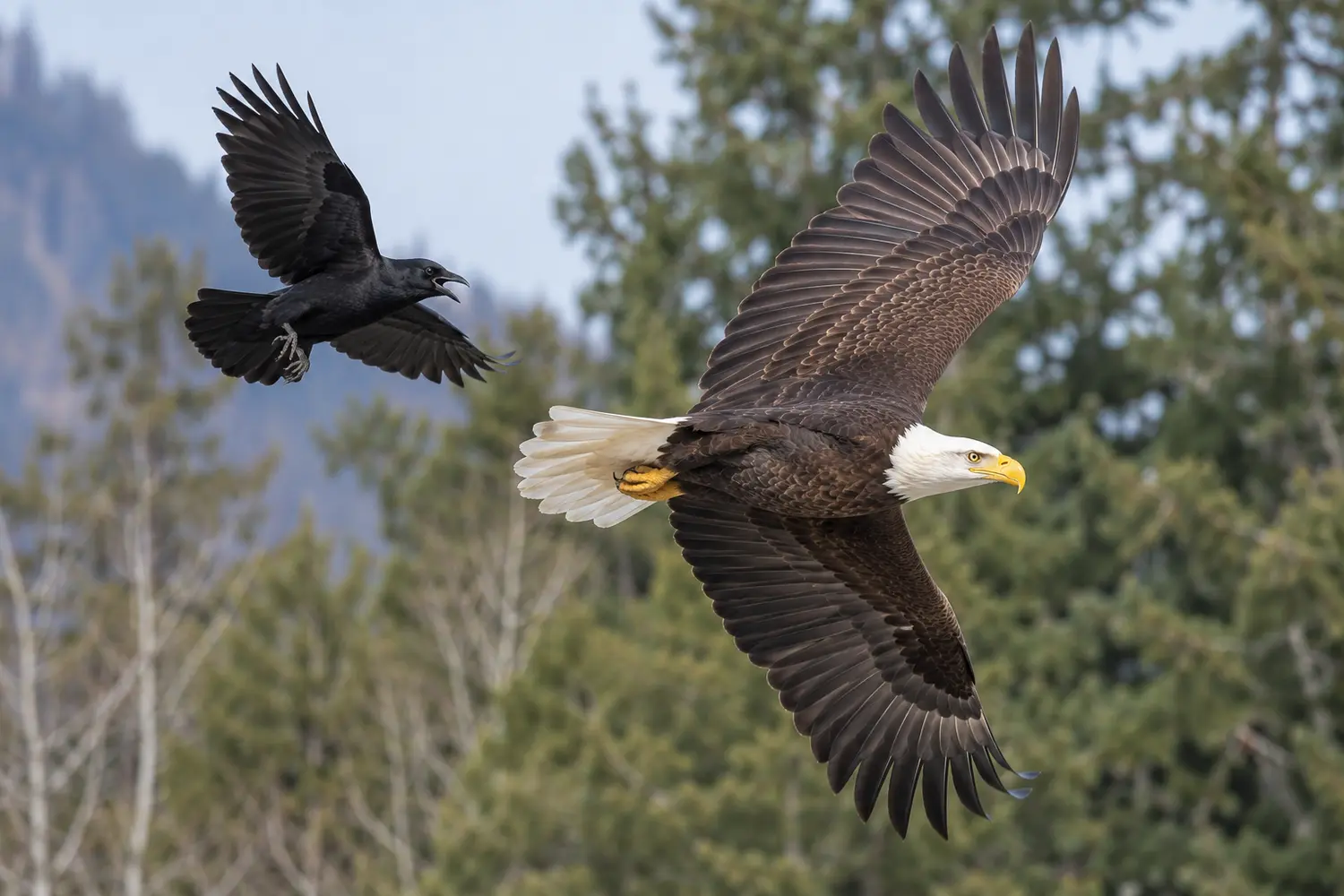
Are crows trying to kill the eagle?
Usually, the goal is displacement rather than killing. A crow is much smaller than a Bald Eagle and faces real risk if it gets too close. Mobbing therefore depends on speed, numbers, surprise and repeated passes rather than a prolonged physical fight.
Nesting season can intensify the response because eggs and chicks are vulnerable. Crows also react to eagles around carcasses, fish or other food, where harassment may involve competition as well as defense. The exact motivation cannot be inferred from a single photograph without knowing the location, season and events immediately before it.
How do eagles respond to mobbing crows?
There is no single response. An eagle may ignore the crows, continue on its route, circle, alter course, perch or leave. It may also roll, present its talons or make a defensive movement if a crow approaches dangerously close. Cornell Lab observations show that raptors sometimes turn toward pursuing crows, even though avoidance is often the less costly option.
Leaving does not mean the eagle is physically incapable of fighting. Chasing every small attacker would consume energy and could cause injury. When an eagle has no nest, prey or feeding site to defend, moving away can simply be the safest and most efficient response.
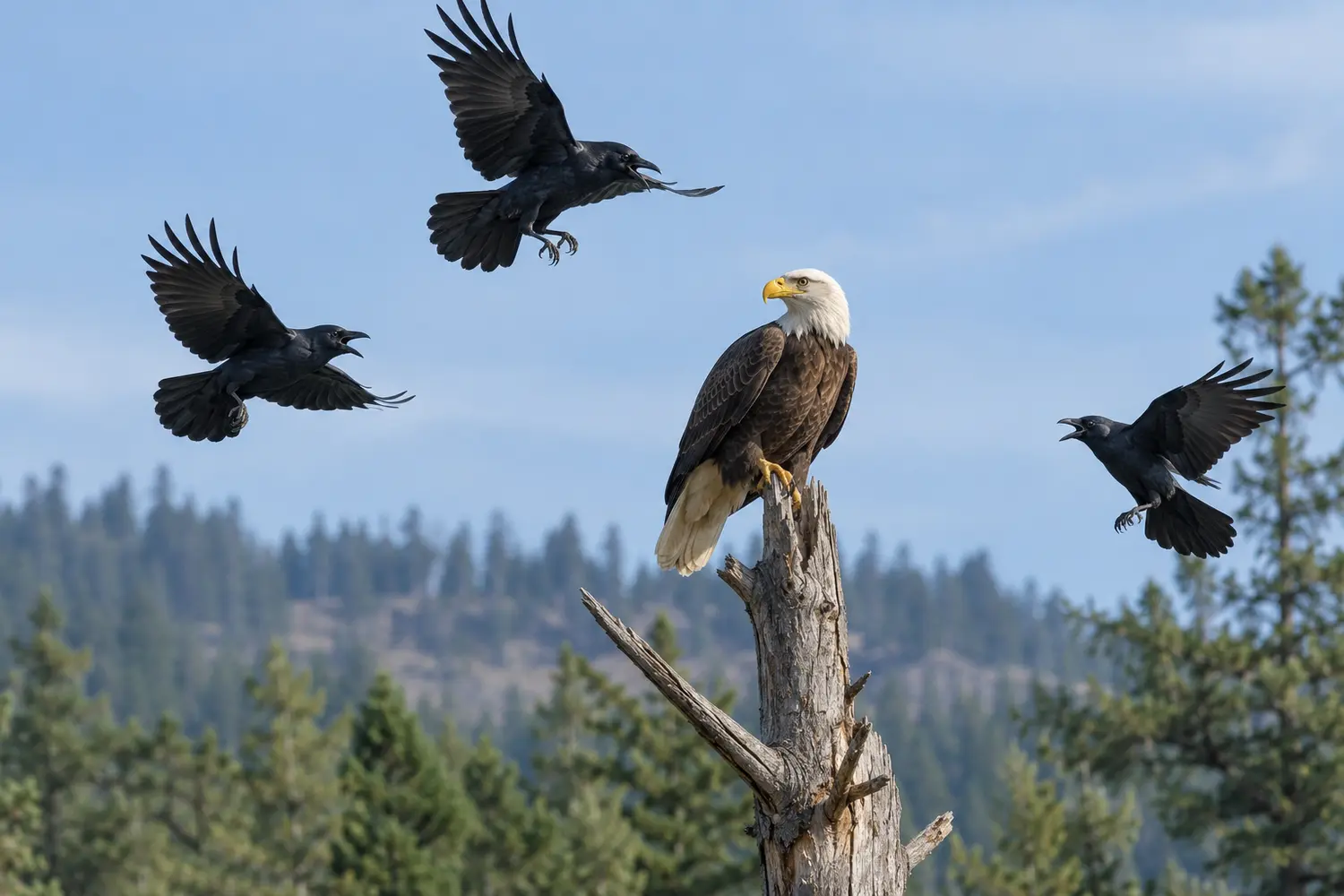
Do eagles fly higher to escape crows?
An eagle can gain altitude during an encounter, especially when it is already soaring in rising air. The unsupported part is the claim that this is a standard strategy specifically designed to reach oxygen-poor air where crows must give up.
Both eagles and crows have highly efficient avian respiratory systems and are capable of substantial flight. Oxygen becomes progressively less available with altitude; it does not form a sharp boundary that affects crows while leaving eagles untouched. Although soaring raptors can reach very high elevations, that fact alone does not demonstrate the motive behind an eagle climbing during a local mobbing event (Philosophical Transactions of the Royal Society B).
A pursuit may end because the perceived threat has left the defended area, the crows have achieved enough distance from a nest, wind conditions change, or the birds decide that further pursuit is not worth the cost. These explanations fit established mobbing behavior without assigning an unverified tactical plan to the eagle.
Why does the eagle sometimes appear calm?
A large eagle may look unbothered because its flight remains steady while smaller birds maneuver rapidly around it. That visual contrast can produce dramatic photographs. It should not be interpreted as proof that the eagle is following a calculated “rise above your enemies” lesson—a popular human metaphor layered onto normal bird behavior.
Mobbing still matters. Repeated attacks can alter a predator’s direction, reduce its hunting opportunities and alert nearby animals. At the same time, every close pass exposes the crow to danger. The interaction is a shifting risk calculation for both sides, not a guaranteed victory for either bird.
Frequently asked questions
Why don’t eagles simply grab the crows?
A crow usually approaches from behind or above and changes direction quickly. Catching it in flight would require timing and maneuvering, while exposing the eagle to more harassment. Raptors may defend themselves, but an attack is not always worth the energy or risk.
Do crows ride on eagles?
Rare photographs can make a very close crow appear to touch or briefly land on an eagle, but this is not normal transportation. The scene is generally part of an aerial mobbing encounter captured at a split second.
Do other birds mob eagles?
Yes. Blackbirds, grackles, kingbirds, gulls and many other birds mob raptors and other perceived predators. Different species may even join the same mob when they share a threat.