
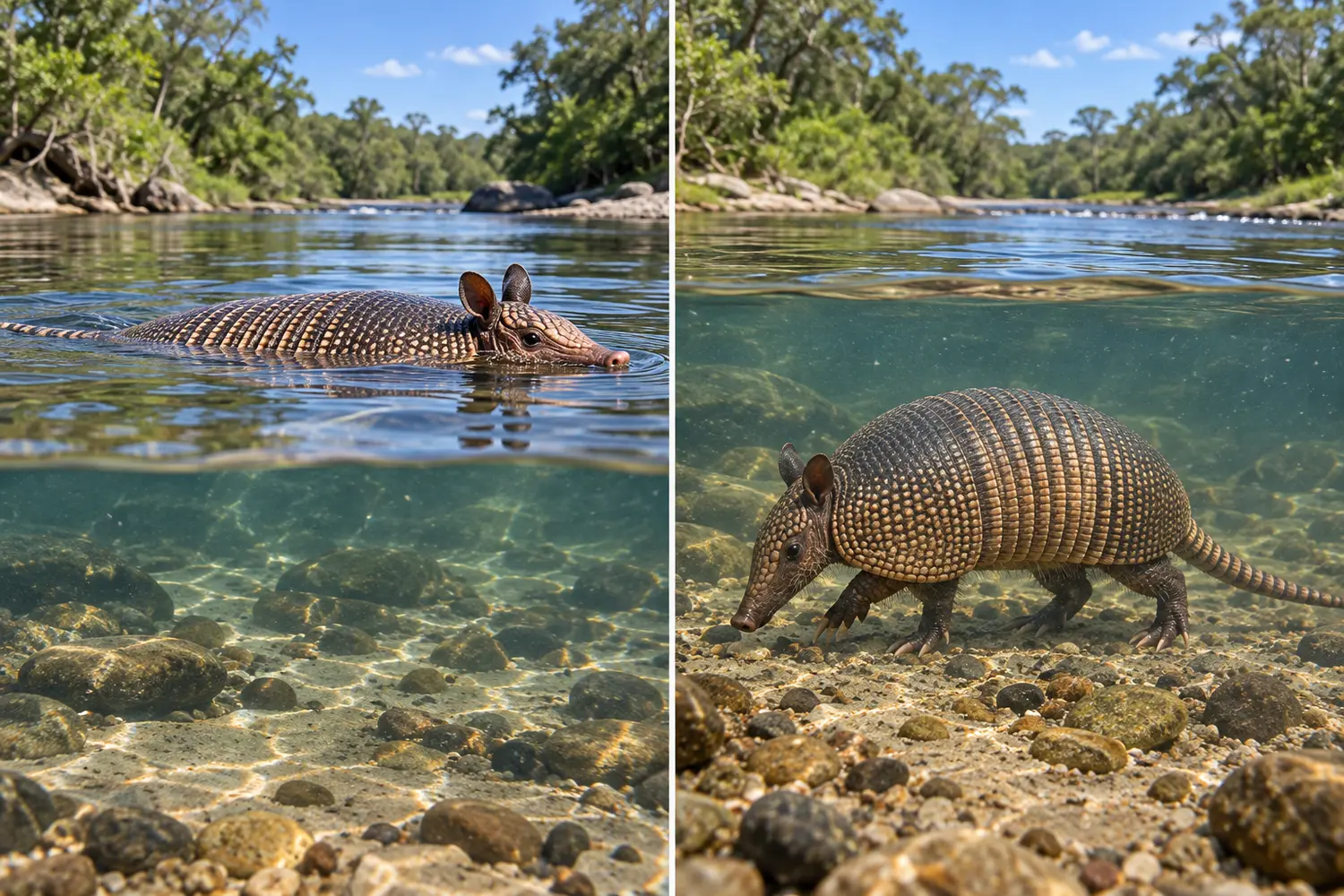
Nine-banded armadillos can cross water in two very different ways: they can paddle at the surface or hold their breath and walk along the bottom for a short distance. Their armored bodies look poorly suited to swimming, but swallowed air can increase buoyancy when a surface crossing is needed.
The familiar story is broadly true, but several viral versions exaggerate it. The best-documented observations concern the nine-banded armadillo, not every armadillo species, and reliable sources describe the digestive tract expanding to roughly twice its usual size—not four times.
How do armadillos swim?
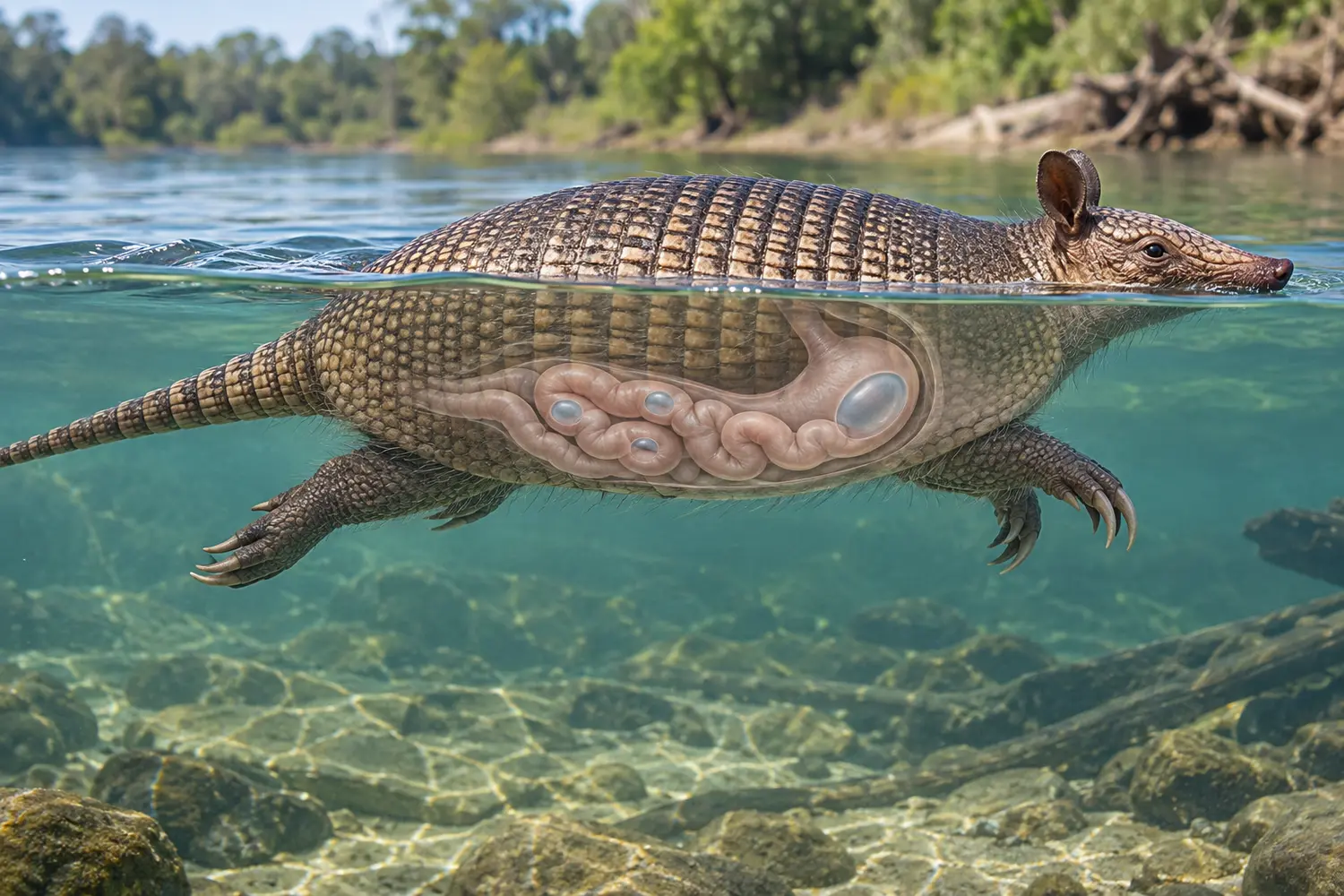
A nine-banded armadillo uses a dog-paddle motion at the surface. Its legs provide propulsion while its snout remains above water for breathing. Before or during a longer swim, it can gulp air into its stomach and intestines. The extra gas lowers the animal’s overall density and helps offset the weight of its armor.
For a narrow, shallow channel, an armadillo may choose a different strategy. It can sink, grip the substrate with its claws and walk along the bottom while holding its breath. University and National Park Service accounts commonly describe breath-holding times of up to about six minutes, but that is an upper observation rather than a guarantee for every individual or crossing.
Why does an armored mammal need extra buoyancy?
An armadillo’s shell is not a hollow metal suit. It consists of bony plates covered by keratinized skin, with flexible bands that allow the body to move. Even so, the animal is slightly denser than water. A Texas Parks and Wildlife account gives a specific gravity near 1.06 for the nine-banded armadillo, meaning it tends to sink unless movement or added internal air keeps it afloat.
Swallowed air changes the balance. Historical observations summarized by wildlife agencies describe the stomach and intestines expanding to approximately double their normal volume. That does not turn the armadillo into a balloon or make the shell itself float. It simply increases displaced volume without adding much mass, improving buoyancy enough to make surface swimming easier.
Surface swimming versus walking underwater
The two behaviors solve different crossing problems.
- Surface swimming is useful when the water is too deep or the crossing is too wide to remain submerged.
- Bottom walking may work across a narrow stream or ditch where the animal can reach the opposite bank before it must surface.
The idea that armadillos always walk underwater when currents are swift is not well established. Current speed, depth, substrate, distance and escape routes all matter. A strong current could make either strategy risky, so the behavior should not be presented as a rigid decision rule.
Can armadillos really hold their breath for six minutes?
Multiple wildlife references report that a nine-banded armadillo can remain underwater for up to about six minutes. Its ability to tolerate temporary oxygen debt may also be useful while digging with its snout close to or beneath loose soil.
“Up to six minutes” should not be interpreted as a routine dive duration. Temperature, exertion, stress and individual condition affect breath-holding. BioKIDS notes that the animals tire quickly and are not unlimited-distance underwater travelers.
Does every armadillo swim this way?
The armadillo family contains roughly 20 living species with different sizes, shells and habitats. The nine-banded armadillo is especially well documented because it is the only armadillo established widely in the United States. Claims about gulping air, dog-paddling and walking underwater are therefore safest when attached specifically to this species.
Other armadillos can swim, but evidence about distance, buoyancy control and breath-holding is not equally detailed for every species. A general statement such as “armadillos can swim” may be fair; a pre