
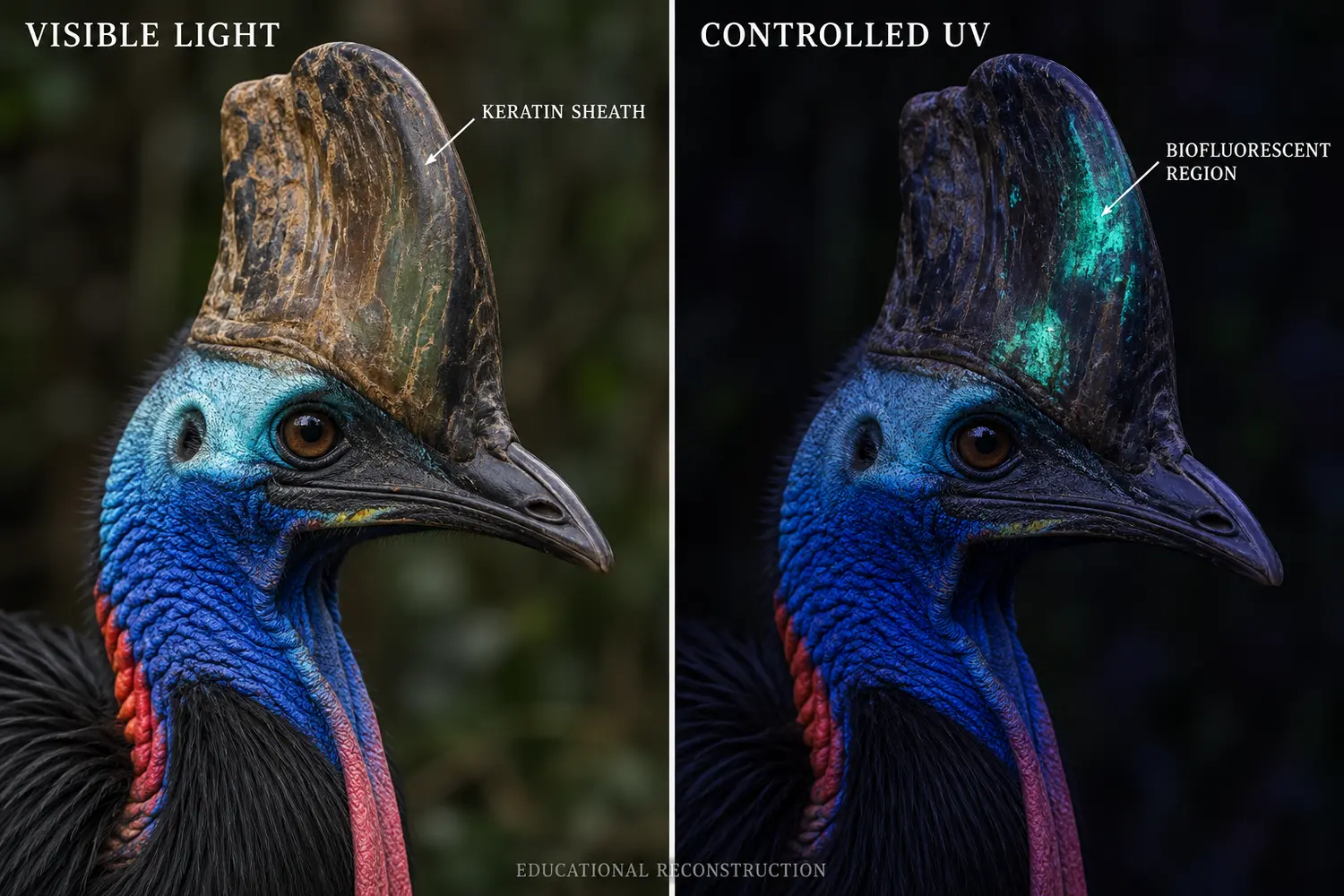
A southern cassowary already looks extraordinary in visible light: glossy black plumage, vivid blue skin, two red wattles and a tall helmet-like casque. Under controlled ultraviolet illumination, parts of that casque can reveal another feature—a blue-green biofluorescent pattern in its keratin covering.
The finding is real, but the viral version runs ahead of the evidence. The study was published in Scientific Reports on February 24, 2026, not in PLOS ONE. It demonstrated cassowary casque fluorescence and ultraviolet reflectance across three cassowary species. It did not prove that the casque acts as a secret communication beacon in a dark rainforest.
What did the 2026 cassowary study discover?
Researchers examined the heads of living cassowaries and museum specimens under ultraviolet light at 365 nanometers and 385–395 nanometers. They found that the keratin sheath covering the casque could absorb UV energy and re-emit some of it as visible blue or green light. That process is called biofluorescence.
The team also used a UV-sensitive camera to test reflectance. Casque keratin reflected 365-nanometer UV—a wavelength within the visual sensitivity range attributed to cassowaries and many other birds. Fluorescence and reflectance are related to ultraviolet light, but they are not the same phenomenon:
- Biofluorescence occurs when a material absorbs shorter-wavelength light and re-emits it at a longer wavelength.
- UV reflectance means ultraviolet light bounces from the surface without being converted in the same way.
Both findings make the casque more visually complex than it appears to human eyes. Whether a wild cassowary perceives that complexity as a social signal remains an open question.
Which cassowaries were tested?
The genus Casuarius contains three living species: the dwarf cassowary (Casuarius bennetti), southern cassowary (Casuarius casuarius) and northern cassowary (Casuarius unappendiculatus). The study included all three.
For its main statistical analysis, the research team used 86 preserved specimens: 32 dwarf cassowaries, 46 southern cassowaries and eight northern cassowaries. Living birds were photographed separately because different camera equipment prevented those images from being pooled into the same quantitative analysis.
The patterns differed among species. Dwarf cassowary casques were generally nonfluorescent, apart from a minimal patch in one tested specimen. Southern cassowaries tended to show fluorescence toward the rear of the casque. Northern cassowaries showed more forward or extensive patterns, with variation between subspecies and individuals.
This species-level difference is one reason researchers are interested in possible visual roles. It may also help identify incomplete museum specimens or assist field surveys. Neither use requires assuming that cassowaries consciously send coded messages with their casques.
Does the casque glow naturally in the rainforest?
The laboratory observation does not mean a cassowary shines like a neon sign in ordinary forest light. The vivid experimental images were produced using controlled UV sources, selected camera settings and, for some published figure images, a yellow filter and adjusted contrast or color balance to depict the fluorescence clearly.
Natural visibility depends on more than whether a material can fluoresce. Researchers would need to measure the UV spectrum and intensity reaching birds in different habitats and at different times—direct sun, closed canopy, dawn, dusk and overcast conditions. They would also need visual models based on cassowary eyes and behavioral tests showing that birds respond to the patterns.
The 2026 authors explicitly said their observations could not confirm whether cassowaries detect the species-specific casque patterns under natural lighting. Describing the feature as a proven “secret beacon” therefore turns a plausible hypothesis into an established fact.
Can cassowaries see ultraviolet light?
Bird vision often extends into wavelengths that humans cannot see. Cassowaries belong to the palaeognath lineage, which also includes emus, ostriches, rheas, kiwis and tinamous. Evidence about their retinal pigments supports sensitivity into the ultraviolet range.
That makes UV reflectance biologically relevant: the birds potentially have the sensory equipment needed to perceive it. But sensory capacity alone does not demonstrate communication. A signal also needs to be available in the environment, detectable against its background and connected to a receiver’s behavior.
In other words, “can perceive UV” and “uses casque UV patterns to communicate” are different scientific claims. The first has supporting visual physiology; the second still requires field and behavioral evidence.
What is a cassowary casque made of?
The casque is not a solid horn or a hollow plastic-like cap. It combines an internal bony core with an external keratinous sheath. Keratin is the structural material found in bird beaks, claws and feathers, as well as mammalian hair and nails.
Under visible light, southern cassowary casque keratin can appear brown, green, dark gray or black in different regions. The 2026 work linked some of those visible colors with areas that fluoresced under the tested UV wavelengths. It also detected variable fluorescence in parts of the beak covering.
Casque shape varies between species and substantially among individual southern cassowaries. Earlier anatomical work found frequent left-right asymmetry, so an idealized perfectly straight casque should not be treated as the universal form.
What does the casque do?
Scientists have proposed several roles over many decades, including display, sound-related functions, protection while moving through vegetation and thermoregulation. Evidence is not equally strong for every proposal, and the casque may perform more than one task.