
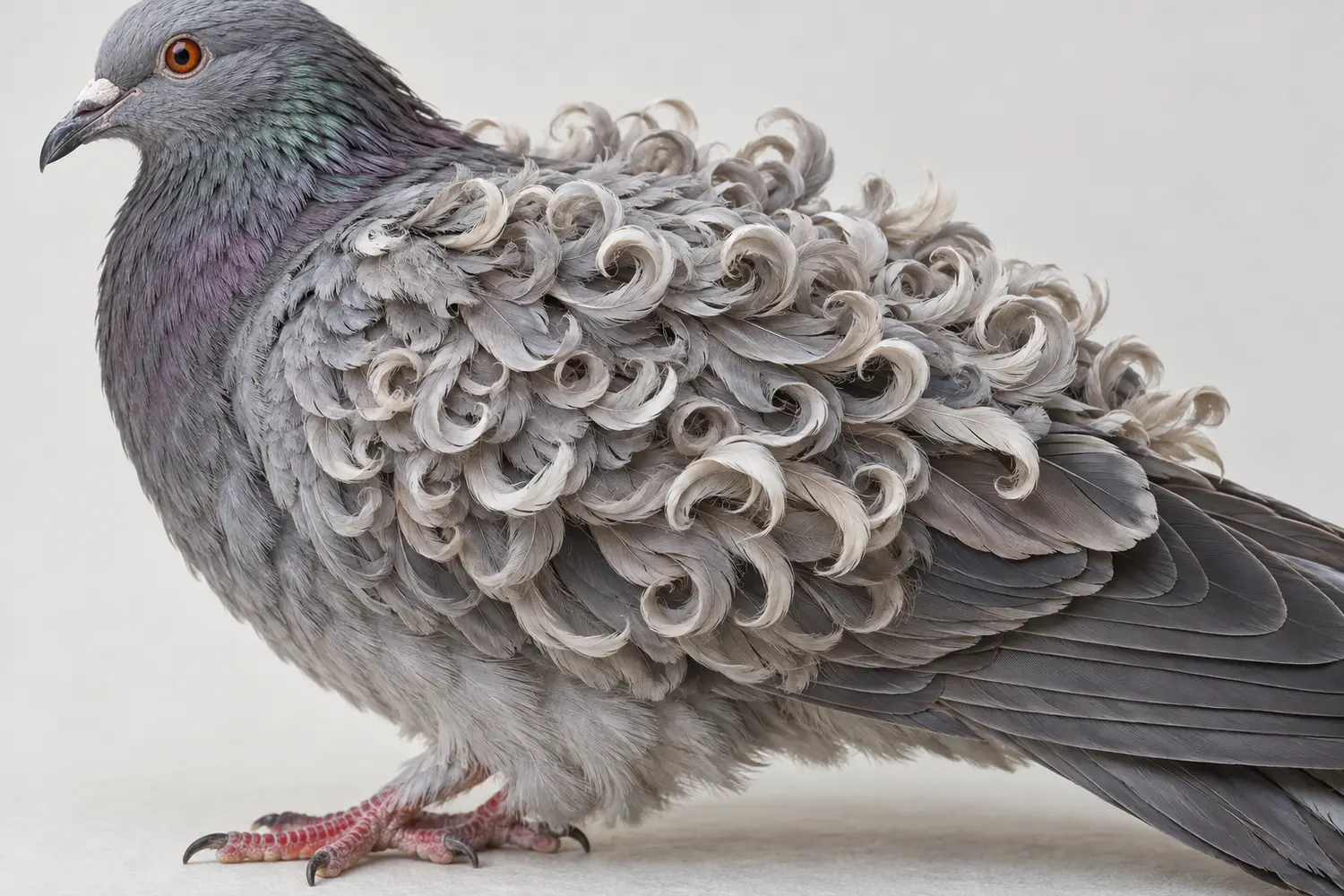
The Frillback pigeon looks as though its feathers have been carefully curled by hand. Across the wing shields and back, many contour feathers turn upward and end in open curls or ringlets. The effect is real, inherited and maintained through generations of selective breeding—not a separate species and not a hairstyle created after the bird hatched.
Frillbacks are domestic pigeons descended from the rock pigeon, Columba livia. Their appearance makes them popular exhibition birds, but the biology behind the curls is still not fully resolved. Historic breeding experiments suggest a complex inherited trait, while the precise molecular genes have yet to be identified.
What is a Frillback pigeon?
A Frillback pigeon is a fancy domestic pigeon breed selected for curled plumage. It belongs to the same species as racing pigeons, homing pigeons, city pigeons and hundreds of other domestic breeds. The differences among those breeds arose through human selection acting on inherited variation.
Breed standards place the greatest emphasis on the frill: the curled feathers should cover the wing shields and continue across the back in an orderly pattern. Frillback pigeons also normally have feathered feet, called muffs, with a wave or curl toward the feather ends.
The long primary flight feathers and tail are not supposed to become a mass of tight ringlets. Good examples retain recognizable pigeon wing and tail structure beneath the ornamental contour feathers.
Why do Frillback feathers curl?
A feather grows from a follicle, with a central shaft called the rachis supporting paired vanes. In Frillbacks, the developing feather curves so that its tip lifts away from the body. Differences in growth across the feather can produce the upward bend and ringlet-like ending.
The trait is inherited, but claims that one named gene has already been proved responsible should be treated cautiously. Breeding work reported in the 1930s suggested that two non-allelic factors, historically called Cu1 and Cu2, contribute to the phenotype and show incomplete dominance. Modern reviews still describe the molecular identity of those factors as unknown.
This distinguishes Frillback pigeons from Frizzle chickens. A mutation in the keratin gene KRT75 has been functionally linked to feather curvature in Frizzle chickens, but that result cannot simply be transferred to pigeons. Similar-looking feather forms can evolve through different genetic and developmental routes.
Are Frillbacks a different pigeon species?
No. A Frillback is a breed of domestic rock pigeon. Breed names describe selected populations within a domesticated species; they do not automatically represent species or subspecies.
Domestic pigeons demonstrate how much anatomical variation can accumulate without speciation. Selective breeding has produced crests, feathered feet, enlarged crops, unusual tail numbers, distinct beak shapes and many color patterns. The Frillback’s contribution to this diversity is feather structure.
Where are the curls located?
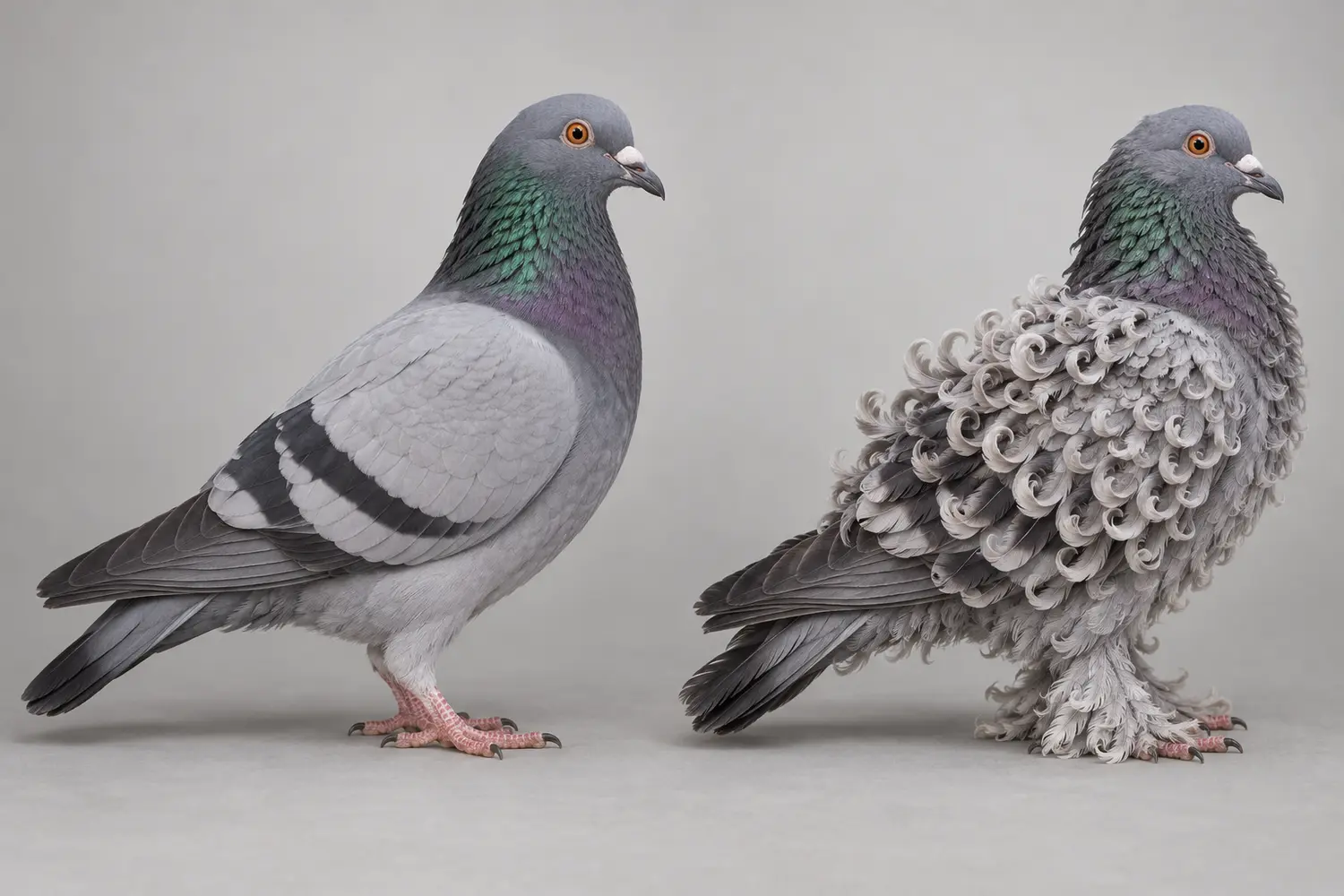
The most prominent curls lie on the shield—the broad outer surface of the folded wing—and across the saddle or back. These are largely contour feathers rather than the main feathers that generate lift and thrust during flight.
Standards also call for curled or waved feathering around the hocks and feet. The exact distribution, tightness and regularity vary among individuals. It is reasonable to say that curl patterns are individually variable, but the popular claim that no two birds can ever share the same pattern is not a scientifically tested identification rule.
Some Frillbacks are plain-headed, while others have a shell crest at the rear of the head, depending on the variety and standard. A crest and the curled body feathers are separate traits.
What colors can Frillback pigeons have?
Frillbacks occur in multiple recognized colors and patterns, including white, black, blue, red, yellow, silver and grizzle combinations. Exact recognition differs among national breed organizations.
Color does not create the curl. Pigmentation and feather structure are distinct biological features even though breeders select both when producing exhibition birds. A dramatically colored pigeon without the characteristic curled contour feathers is not a Frillback simply because it looks ornate.
Can Frillback pigeons fly?
Frillbacks can fly. Their primary flight feathers remain much less altered than the curled contour feathers of the wing shields. However, they are ornamental birds rather than racing athletes, and flight performance varies with breeding, body condition, feather quality, housing and individual health.
It would be inaccurate to say the curls make every Frillback flightless. It would also be unsafe to assume that every individual has the speed, endurance or predator avoidance skills of a free-living feral pigeon. Secure housing remains important.
Where did the breed originate?
The exact origin is uncertain. Historical accounts document curled pigeons in Europe centuries ago, with breeding activity reported in England, Germany, Belgium, the Netherlands, Hungary and Austria. Different sources have proposed broader Asian or Middle Eastern connections, but there is no singl