
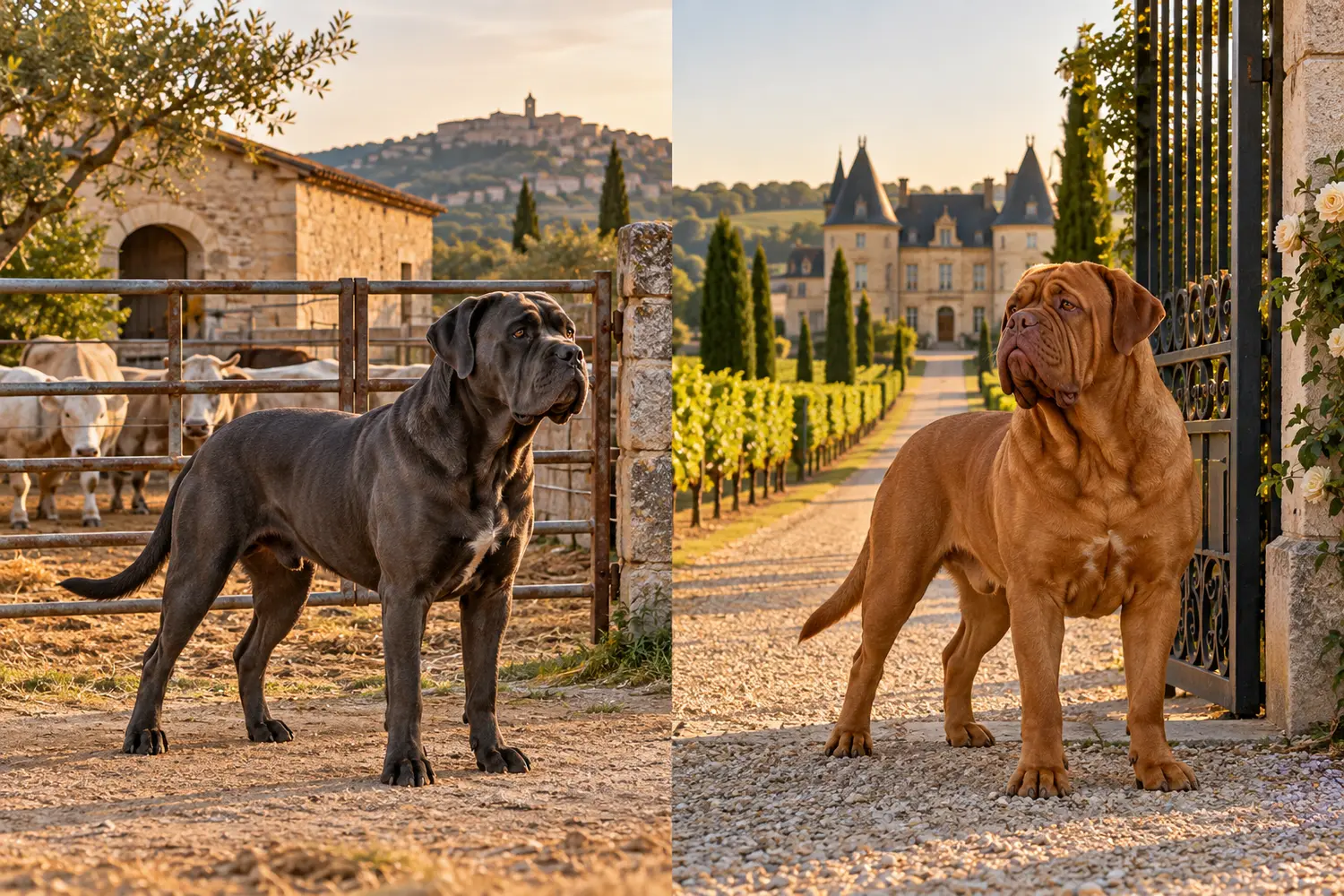
Cane Corso vs. Dogue de Bordeaux comparisons often reduce two historic mastiffs to a fictional fight. In reality, both breeds were developed for demanding work, but their bodies and temperaments reflect different priorities. The Cane Corso is a comparatively athletic Italian utility dog. The Dogue de Bordeaux is a lower-set, heavier French guardian with an exceptionally broad head.
Neither breed has a scientifically proven fixed “PSI” score, and no responsible comparison can predict a universal winner. A useful comparison asks how they differ in size, movement, training needs, health and suitability for everyday ownership.
Cane Corso vs. Dogue de Bordeaux at a glance
| Trait | Cane Corso | Dogue de Bordeaux |
|---|---|---|
| Origin | Italy | France |
| Traditional role | Versatile farm, livestock, family and property guardian | Guard, defence and deterrence; historically also hunting and cattle work |
| FCI male height | 64–68 cm, with a 2 cm tolerance | 60–68 cm, with limited tolerance outside the range |
| FCI male weight | 45–50 kg | At least 50 kg |
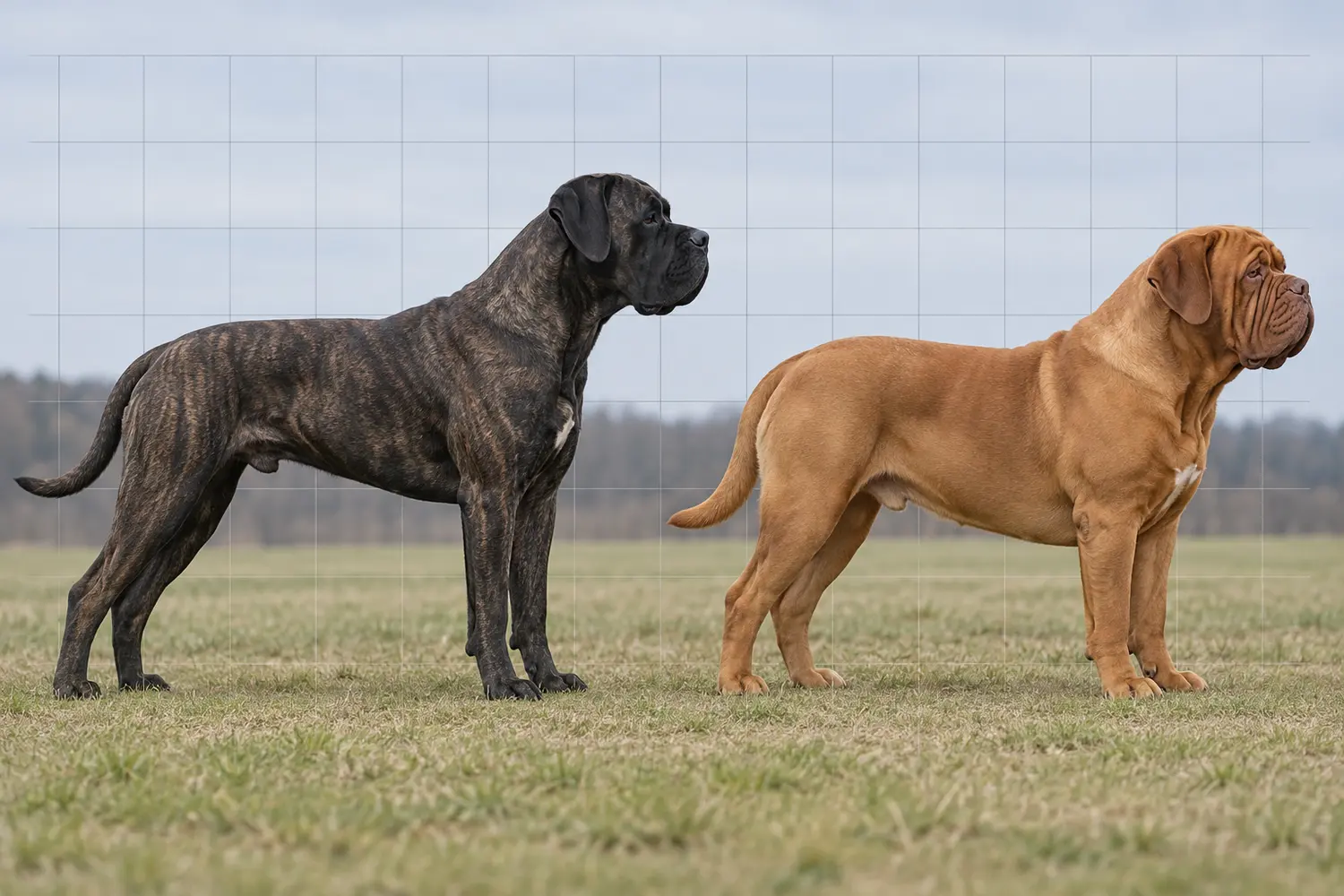
| Build | Longer-legged, leaner and more agile | Stocky, deep-chested and closer to the ground |
| Coat | Short; black, grey, fawn or brindle varieties | Short, fine and fawn, with several permitted mask types |
| Typical character | Responsive, vigilant and handler-oriented | Calm, affectionate and imposing, with a high stimulus threshold |
Breed standards describe an ideal rather than every individual dog. Sex, lineage, health, conditioning, socialization and learning history can produce substantial variation.
What is a Cane Corso?
The Cane Corso Italiano is classified by the Fédération Cynologique Internationale as a molossoid, mastiff-type working dog. The current FCI standard describes it as a polyvalent utility dog and a guardian of property, family and livestock. It was also historically used for herding cattle and hunting big game.
A correct Cane Corso should be robust without becoming cumbersome. The standard calls for lean, powerful muscle, a body slightly longer than tall and an extended trot as the preferred gait. Those features help explain why the breed is generally more agile and quicker to respond than heavier mastiffs.
That athleticism does not make every Corso a high-endurance sport dog. Heat, age, joint health, airway function and conditioning all affect performance. Nor does responsiveness remove the need for experienced handling: Corsos are strong guardians that require early socialization, secure management and reward-based training.
What is a Dogue de Bordeaux?
The Dogue de Bordeaux, sometimes called the French Mastiff, is one of France’s historic molossoid breeds. Its FCI standard lists guard, defence and deterrence as its modern utilization. Historical accounts also associate the breed with hunting large game, guarding houses and cattle, and work alongside butchers.
The breed’s outline is distinctive: stocky and imposing, with a body longer than tall, a chest deeper than half the dog’s height and an enormous but proportionate head. The muzzle is short, and the skull perimeter of an adult male roughly corresponds to his height at the withers under the standard.
Despite the intimidating appearance, the FCI temperament description emphasizes vigilance without aggressiveness. It calls the Dogue calm, balanced, affectionate and strongly attached to its owner. Individual temperament still depends on responsible breeding and development.
Size and body structure
The breeds overlap in height, but they distribute mass differently. FCI Cane Corso males are 64–68 cm tall and weigh 45–50 kg; females are 60–64 cm and 40–45 kg. Height may vary by 2 cm above or below the stated range.
Dogue de Bordeaux males stand 60–68 cm and weigh at least 50 kg. Females stand 58–66 cm and weigh at least 45 kg. The Dogue standard gives minimum weights rather than a maximum, but more mass is not automatically better. Exaggerated heaviness can reduce mobility and worsen orthopedic, cardiac or respiratory strain.
The Corso is typically taller on the leg and more efficient in an extended trot. The Dogue has a lower center of mass, deeper chest, heavier front and shorter muzzle. These are breed-type differences—not proof that one dog can “absorb force” or defeat another.
Temperament and training differences
Both breeds were selected to deter threats and can be reserved with strangers. However, their working styles often feel different in daily life.
- Cane Corso: often quicker, more responsive and more interested in structured interaction with the handler.
- Dogue de Bordeaux: often steadier and less hurried, but still powerful, watchful and capable of independent decisions.
These are tendencies, not guarantees. A fearful, impulsive or poorly socialized dog is not a superior guardian. Owners should reward calm observation, teach reliable handling skills and prevent uncontrolled rehearsal of fence running, charging visitors or conflict with other dogs.
Are the viral bite-force numbers accurate?
No standardized peer-reviewed evidence establishes a fixed