
Camouflaged venomous animals are often portrayed as invisible killers waiting to attack anyone who comes close. The biology is less theatrical—and more useful. Stonefish, stingrays, cone snails, puff adders and Gaboon vipers use concealment mainly to catch prey, avoid predators or both. Human injuries usually happen through accidental contact, defensive reactions or handling.
These animals are not equally dangerous, and a bite or sting does not automatically cause death. The outcome depends on the species, where the injury occurs, the amount of venom delivered, the depth of penetration, the victim’s health and how quickly appropriate medical care is available.
Five camouflaged venomous animals at a glance
| Animal | Where it hides | How venom is delivered | Typical human contact |
|---|---|---|---|
| Stonefish (Synanceia spp.) | Reef rubble, sand and shallow tropical seabeds | Dorsal fin spines | Stepping on or handling the fish |
| Stingray | Sandy or muddy shallows | One or more serrated tail spines | Being stepped on or closely approached |
| Cone snail (Conus spp.) | Reef crevices, rubble and sand | A harpoon-like radular tooth | Picking up a live snail |
| Puff adder (Bitis arietans) | Grass, scrub and dry leaf litter | Hinged front fangs | Walking close to a motionless snake |
| Gaboon viper (Bitis gabonica) | Humid forest leaf litter | Long hinged front fangs | Accidental close contact |
Calling these species “the world’s deadliest” creates a ranking that science cannot support. Exposure rates vary enormously by country and behavior, while fatalities are rare for some of the animals on this list.
1. Stonefish: venomous spines hidden in the reef
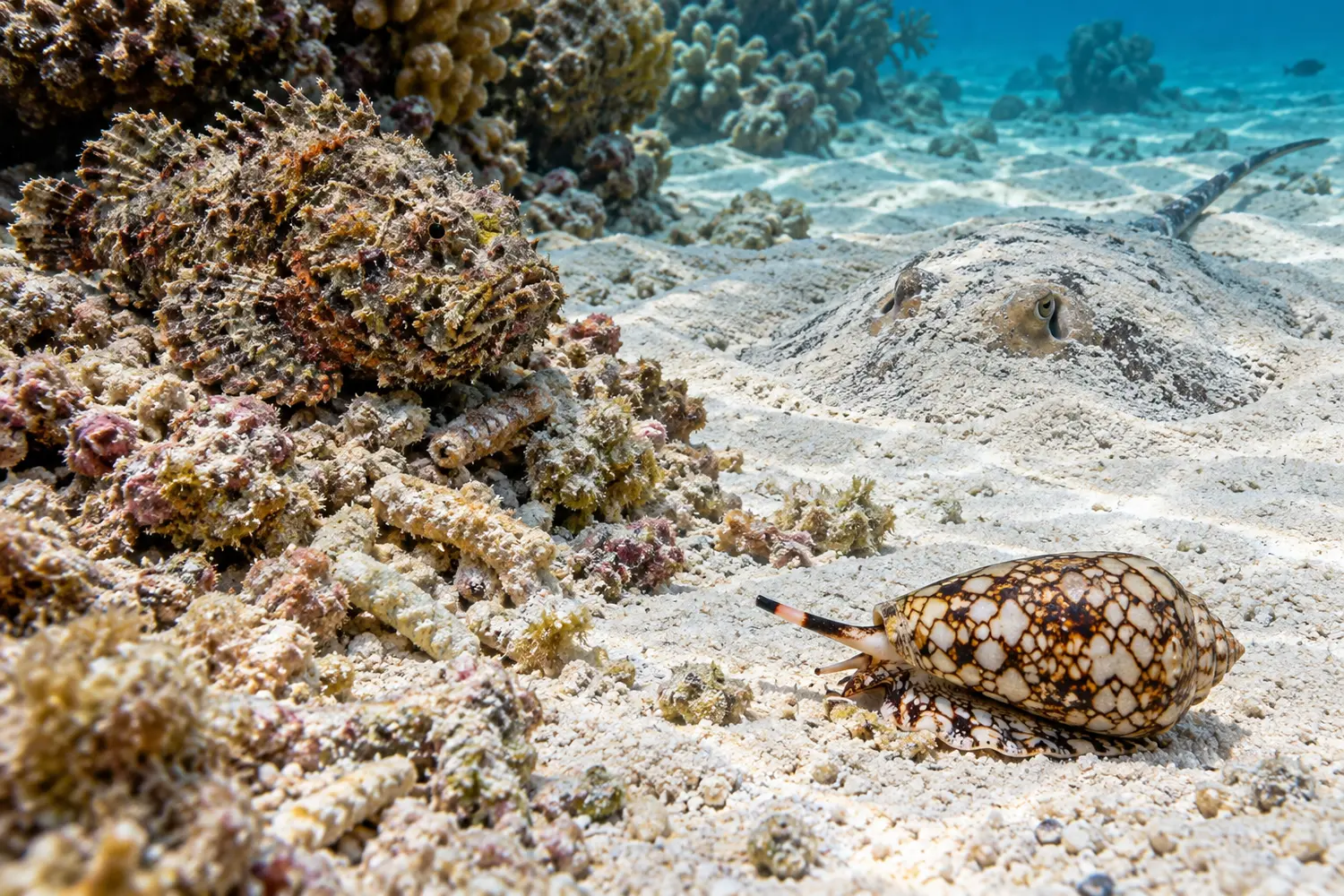
Stonefish are bottom-dwelling fish in the genus Synanceia. Their irregular bodies, mottled colors and algae-like skin texture break up their outline among coral rubble, rocks, mud and sand. They generally remain still and rely on camouflage rather than chasing people.
The venom apparatus is associated with dorsal fin spines. When pressure drives one or more spines into tissue, venom can be forced into the wound. Reviews describe extreme local pain, swelling and tissue injury; serious cases can involve cardiovascular, respiratory or neuromuscular effects. Severity tends to increase with the number of spines involved and the depth of penetration.
“Thirteen spines” is commonly quoted because reef and estuarine stonefish often have about that number, but the genus is better described as having up to roughly 15 dorsal spines rather than giving every species and specimen one fixed count. Stonefish venom is also a complex mixture of proteins—not simply one generic “neurotoxin.”
2. Stingrays: a defensive tail strike
Many stingrays rest partly buried in sediment, sometimes leaving only the eyes and spiracles visible. This behavior helps them remain concealed from predators and prey. A wader who steps directly onto or very close to a ray may trigger a defensive tail movement.
The spine can create a puncture or laceration, and venom contributes intense pain. The mechanical wound, retained fragments and infection are also important clinical concerns. Most ordinary injuries involve the foot or lower leg and are not fatal. Penetration of the chest, abdomen or major blood vessels is much more dangerous but uncommon.
In sandy shallows known to hold rays, sliding the feet instead of taking high steps—the “stingray shuffle”—can disturb the sediment and give a ray an opportunity to move away. It reduces risk; it does not make wading completely safe.
3. Cone snails: danger comes mainly from handling
Cone snails are predatory marine gastropods, not fish. They use a modified radular tooth like a tiny harpoon to inject venom into prey. Venom composition differs substantially among species and can also differ between predatory and defensive use.
Human envenomation is rare, but some fish-hunting species—especially the geography cone, Conus geographus—have caused paralysis and death. Reviews of documented incidents show that this species accounts for a disproportionate share of known fatalities.
Unlike a buried stingray, a cone snail is more likely to injure someone who picks it up. A beautiful patterned shell may still contain a living animal. The safest rule is simple: do not handle live cone snails, and never assume a small shell is harmless.
4. Puff adder: camouflage beyond color
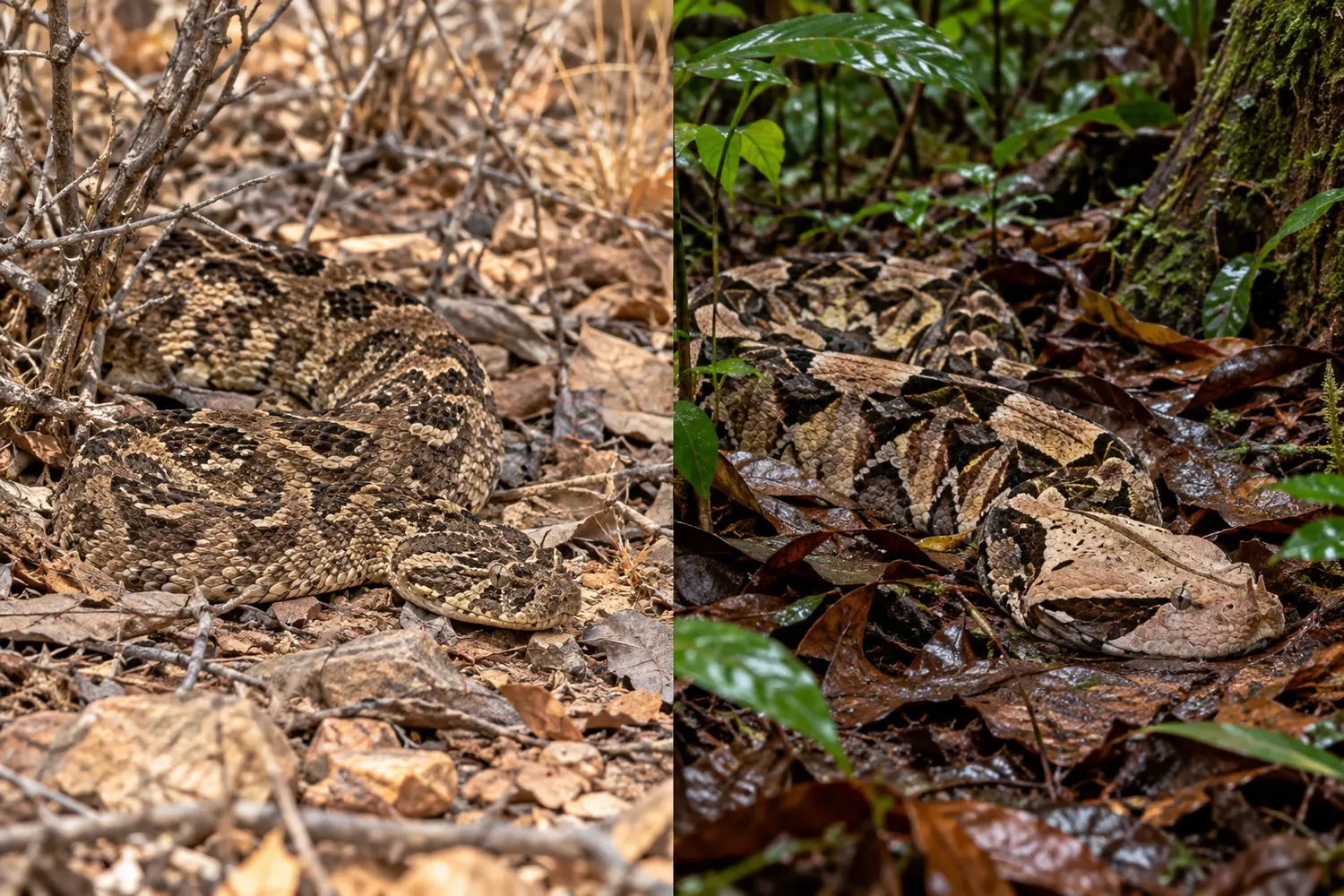
The puff adder is a heavy-bodied African viper that hunts by ambush. Its brown, tan and black pattern blends with grass, soil and leaf litter. Field experiments also found unusually effective chemical crypsis: trained scent-detection dogs had difficulty locating puff adders compared with several active-foraging snake species.
Remaining still is part of the snake’s hunting strategy and can also delay detection by people. Yet it is misleading to say puff adders automatically bite whenever they are stepped on. Defensive behavior depends on the distance, nature and intensity of the disturbance. A threatened snake may hiss, inflate the body, adopt a defensive posture or strike.
Puff adder bites can cause severe pain, swelling, tissue injury, bleeding abnormalities and systemic illness. The species is medically important across a wide range, but casualty totals reflect distribution, human exposure and access to treatment—not merely “the fastest strike.”
5. Gaboon viper: forest-floor concealment
The Gaboon viper has a broad head, heavy body and striking geometric pattern that dissolves visually among wet leaves and forest shadows. It is an ambush predator of forested parts of sub-Saharan Africa.
Gaboon vipers possess exceptionally long fangs and can deliver a substantial venom