
Tiger vs. lion canines are often reduced to dramatic length and PSI rankings. Both cats possess large, conical teeth built to grip and puncture, but tooth measurements vary among individuals and bite-force numbers depend heavily on the method used.
Tiger vs. lion canines at a glance
| Feature | Tiger | Lion |
|---|---|---|
| Scientific name | Panthera tigris | Panthera leo |
| Canine pattern | Relatively long canines for mandibular length in comparative skull samples | Large, robust canines with substantial overlap in absolute size |
| Typical hunting context | Usually solitary ambush hunting | Solitary or cooperative hunting, often by lionesses |
| Reliable PSI value? | No universal direct value | No universal direct value |
What canine teeth actually do
A big cat’s canines are not crushing molars. They are tapered teeth used to penetrate tissue and maintain a grip while the jaws, head, neck and forelimbs help control prey. Behind them, premolars and blade-like carnassial teeth slice meat. The complete killing system matters more than one tooth or one headline number.
Canines must balance reach with strength. A longer, narrower tooth may penetrate deeply but faces greater bending stress. A shorter or broader tooth can resist bending differently. Comparative research across large felids found that canine shape reflects both feeding ecology and evolutionary history, while estimated strength relative to bite force is more constrained than simple appearance suggests.
Are tiger canines longer than lion canines?
Tigers are frequently credited with canines “up to 10 centimeters,” while lions are assigned a smaller fixed number. Those figures may mix total tooth length with exposed crown length, exceptional specimens and measurements from different anatomical landmarks.
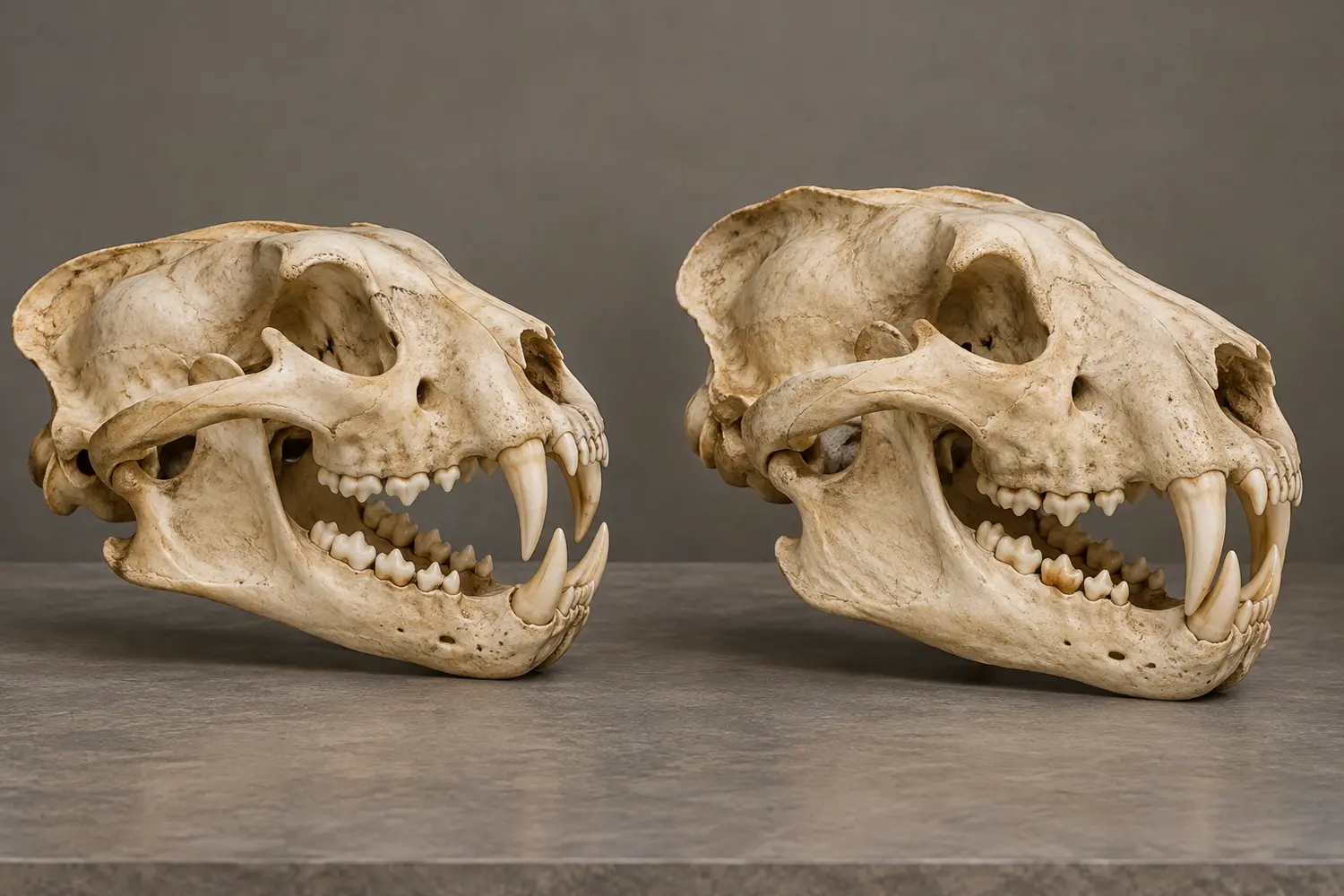
A large skull study found that lower-canine length relative to mandible length was significantly greater in tigers than in lions, with only slight overlap in the sampled ratios. That supports the statement that tigers tend to have proportionally longer lower canines. It does not mean every tiger canine exceeds every lion canine, nor does it establish 10 cm versus 8 cm as universal values.
Age, sex, subspecies, skull size, wear, periodontal disease and whether the tooth is measured inside or outside the socket all affect the result. Captive and wild cats can also differ in oral health and cranial shape, making isolated museum specimens poor stand-ins for an entire species.
Why viral bite-force PSI rankings mislead
The familiar claims of roughly 1,050 PSI for a tiger and anywhere from 650 to 1,000 PSI for a lion do not come from a single standardized set of direct tests on representative living animals. Bite force can be reported as force in newtons, pressure, model output or a body-size-adjusted quotient. These quantities are not interchangeable.
Many influential comparisons use “dry skull” estimates. Researchers measure skull geometry, estimate jaw-muscle cross-sectional area and apply lever mechanics to calculate force at a particular tooth position. Such models are useful for comparing species under the same assumptions, but they are not pressure-gauge readings from every tiger or lion.
Bite position also matters. Force at the canine differs from force farther back at the carnassials. Body mass, gape, motivation, muscle condition and specimen selection add more variation. For that reason, a precise PSI ranking creates more certainty than the evidence supports.
Tiger skulls and lion skulls are not identical
Tiger and lion skulls overlap enough that casual identification can be difficult, yet morphometric studies find consistent proportional differences. One large comparison reported a greater lower-canine-to-mandible ratio in tigers. Other work has found lions tend toward a longer muzzle while tigers have a broader rostrum.
A 2024 craniometric study of captive carnivores also examined canine bending strength and estimated bite force, but the sample included only five lion skulls and three Bengal tiger skulls. Its results are informative about those specimens, not final species-wide rankings. The study illustrates why sample size and measurement definitions must accompany any anatomical claim.
Different hunting styles, shared felid tools
Tigers generally hunt alone. They rely on concealment, a short approach and rapid contact, using the forelimbs and jaws to control prey. Depending on prey size and position, a tiger may bite the throat or nape. It is too absolute to say every successful tiger attack “instantly crushes vertebrae.”
Lions can hunt alone, but cooperative hunting is common, especially among lionesses. Group members may approach from different directions or help restrain large prey. Even so, the canines themselves do not become “team-force” weapons; they perform the same basic gripping and puncturing roles found across large cats.

Does either cat have the better canine weapon?
There is no single biological score for “better.” Tigers tend to have proportionally longer lower canines in measured skull samples, while lion and tiger canine dimensions overlap and both species possess teeth capable of subduing large prey. Tooth durability, jaw mechanics, body size, neck musculature, forelimb use and hunting circumstances all contribute.
Predicting the outcome of a lion–tiger fight from canine length or PSI is scientifically weak and encourages an artificial scenario. The two species evolved in different ecological and social settings; anatomy is better understood by asking how each cat captures its normal prey.
Frequently asked questions
Do tigers have the longest canines of any living cat?
Tigers have very large canines and tend to exceed lions proportionally in some measurements. However, “longest” de