
For years, the scimitar-horned oryx existed only under human care. Today, free-ranging herds are again breeding in central Chad. Their return is one of conservation’s clearest recent examples of how captive breeding, careful reintroduction, long-term monitoring and local protection can restore a species that had vanished from the wild.
The story is genuinely hopeful, but it is not a simple tale of nature recovering on its own. The population remains dependent on continued protection, scientific management and cooperation with the people who share this vast Sahel landscape.
Why the scimitar-horned oryx disappeared
The scimitar-horned oryx (Oryx dammah) once ranged across the grasslands and semi-deserts of North Africa’s Sahel. It is adapted to heat and drought, with a pale coat that reflects sunlight and long, curved horns that give the species its name.
During the twentieth century, uncontrolled hunting, drought and habitat pressures drove a steep decline. The animals disappeared from the wild by the end of the 1990s, and the species was assessed as Extinct in the Wild on the IUCN Red List in 2000. Captive populations in zoos and specialist breeding centers prevented total extinction and ultimately supplied founders for a return to Africa.
The return to Chad began in 2016
The recovery program is a partnership led by the Government of Chad and the Environment Agency–Abu Dhabi, with field implementation and scientific support from Sahara Conservation and other partners. The project selected the Ouadi Rimé–Ouadi Achim Faunal Reserve, a huge protected area within the species’ former range.
After years of planning, the first group of 25 captive-bred oryx arrived from Abu Dhabi in 2016. They spent time in acclimatization enclosures before release. The first calf was born in Chad in December of that year, an early sign that the animals could reproduce under free-ranging conditions.
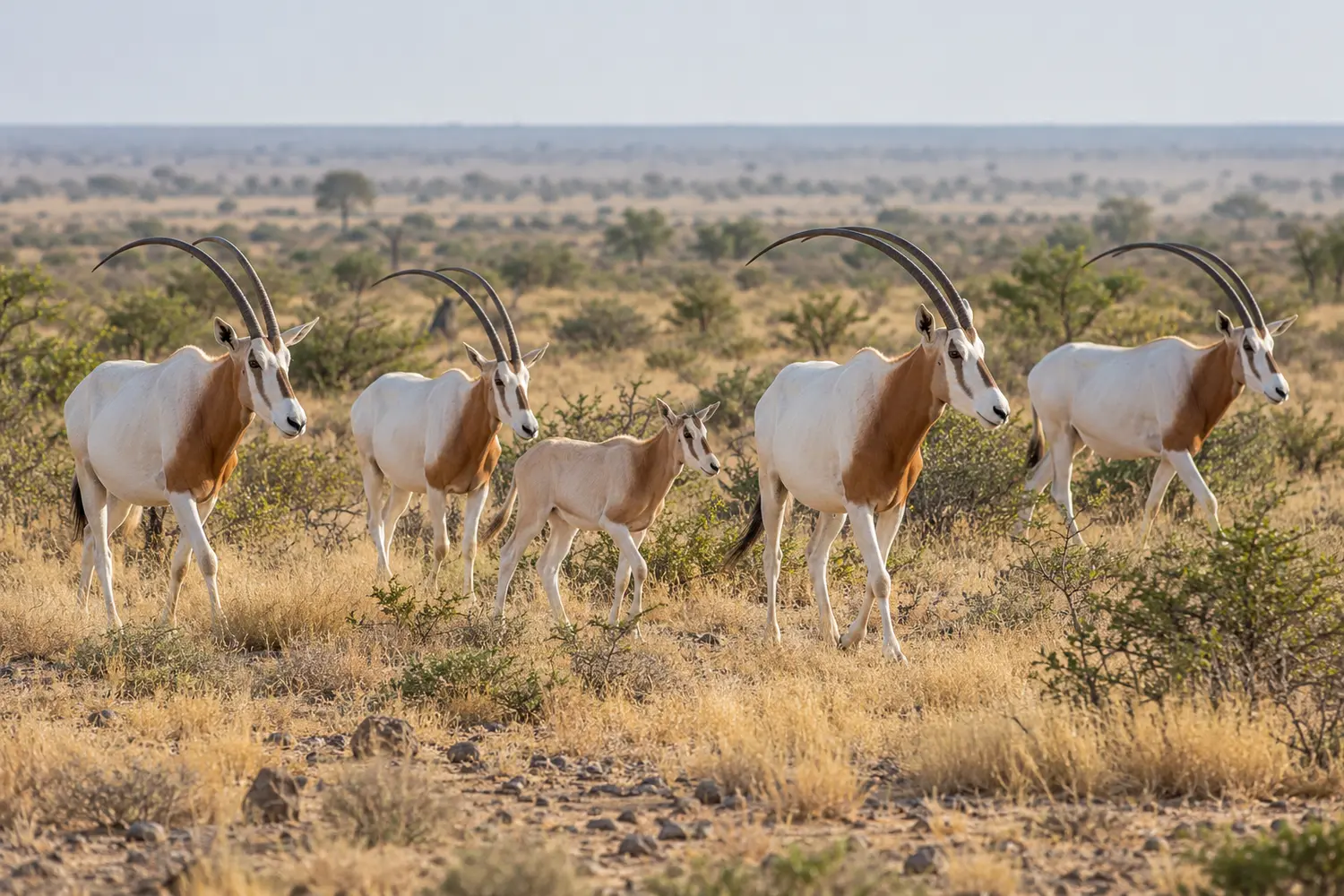
Releases continued in later years, while wild births steadily enlarged the population. Sahara Conservation reported that the free-ranging population exceeded 600 animals by the end of 2023. Its current project page reports more than 650 individuals by mid-2026, including over 500 calves born in the wild. These figures are encouraging, but they should be read as dated program estimates rather than a permanent population count.
A landmark IUCN status change
On December 11, 2023, the IUCN announced that the scimitar-horned oryx had moved from Extinct in the Wild to Endangered. The Red List assessment cited at least 140 mature animals ranging freely in the reserve and 331 calves born there by 2021.
This was more than a change in label. An animal can leave the Extinct in the Wild category only when a viable population is established outside captivity. The decision therefore recognized years of breeding, releases, field monitoring and protection in Chad.
It does not mean the species is safe. Endangered remains a high-risk category. The IUCN noted that poaching is still a threat and that the population’s survival depends on continuing protection by national authorities and local communities.
Wild breeding does not mean no intervention
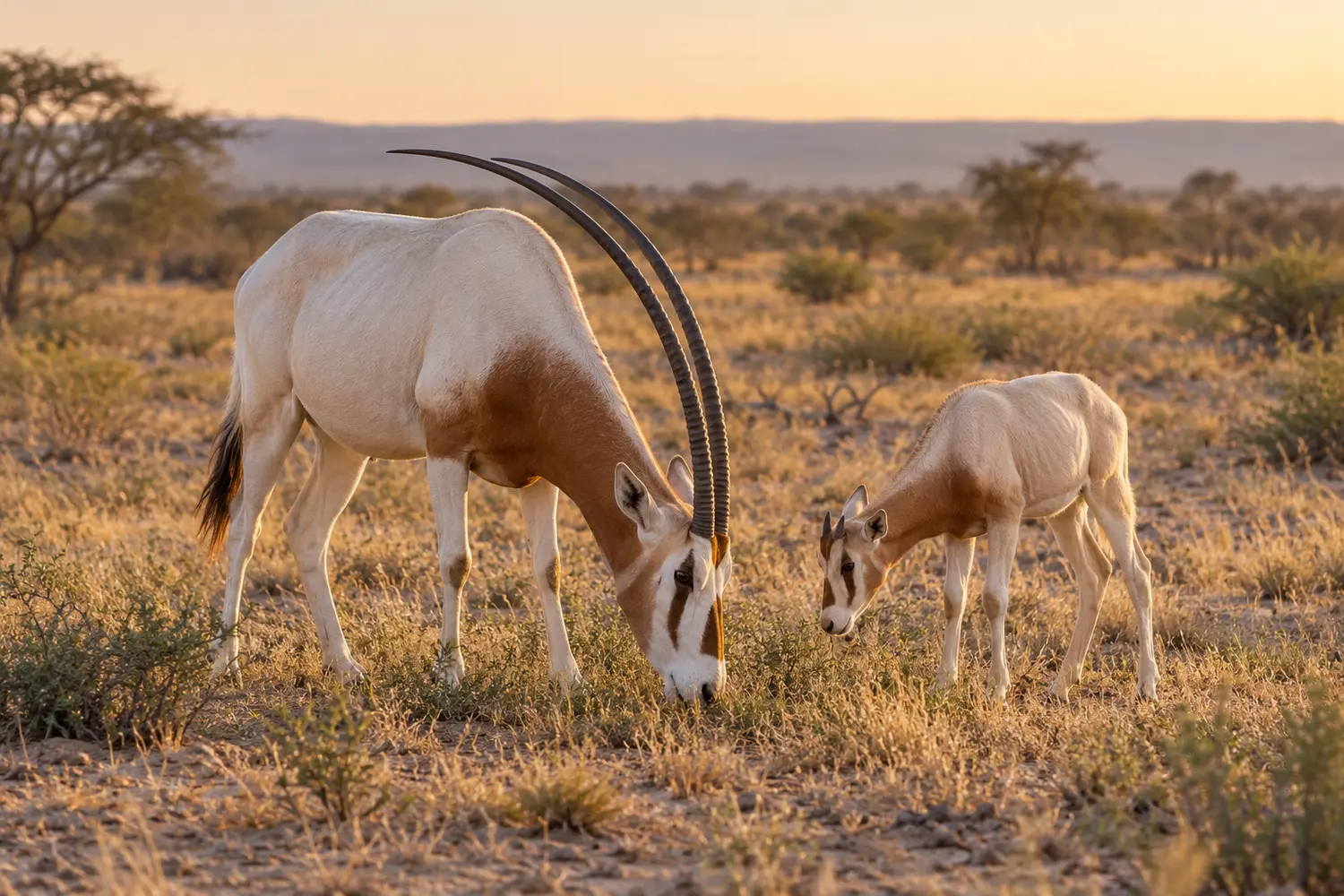
The oryx now mate, give birth and forage in the reserve, rather than being fed or bred as a zoo herd. But describing the recovery as happening “without direct human intervention” would be misleading.
Teams continue to monitor movements, survival, reproduction and feeding through satellite collars and field observations. Conservationists also manage genetics, conduct health checks, reinforce the population with carefully selected animals and work with local communities. In November 2024, another 50 oryx were transported to Chad, bringing the reported total reintroduced since 2016 to 361.
Do returning oryx restore the desert ecosystem?
Large native herbivores can influence vegetation, nutrient cycling and seed movement. Restoring them may help rebuild ecological interactions that were lost when wildlife populations collapsed. However, the available project and IUCN sources do not demonstrate that the reintroduced oryx are already reversing desertification.
That distinction matters. Desertification is driven by interacting forces that include climate, rainfall variability, land use and grazing pressure. The best-supported claim is that the program is restoring a native grazer and a missing component of the Sahel fauna—not that one antelope species can “heal” the Sahara by itself.
Why this recovery matters
The scimi