
Africa’s wild pigs are not one interchangeable group. The continent supports several living suids with different ranges, diets and body plans. This guide focuses on four representative species: the common warthog, red river hog, giant forest hog and bushpig. Together they show how closely related mammals can succeed in habitats ranging from open savanna to humid rainforest and montane woodland.
Which wild pig species live in Africa?
Modern taxonomy recognizes more African suids than the four highlighted here. A 2023 genomic study lists six extant members of the African suid lineage: common warthog (Phacochoerus africanus), desert warthog (P. aethiopicus), giant forest hog (Hylochoerus meinertzhageni), red river hog (Potamochoerus porcus), bushpig (P. larvatus) and wild boar (Sus scrofa). The last species also occurs far beyond Africa.
That distinction matters because viral graphics often mix common and desert warthogs, or use “bushpig” as another name for the red river hog. Current evidence treats red river hogs and bushpigs as separate species, although genomic research also shows that their evolutionary boundary is more complex than older field guides suggested.
| Species | Scientific name | Representative habitat | Notable adaptation |
|---|---|---|---|
| Common warthog | Phacochoerus africanus | Savanna, grassland and open woodland | Long legs, tusks and carpal pads for kneeling |
| Red river hog | Potamochoerus porcus | West and Central African forests | Forest camouflage, sensitive snout and flexible omnivory |
| Giant forest hog | Hylochoerus meinertzhageni | Forest edges, montane forest and wooded mosaics | Large body and robust grazing anatomy |
| Bushpig | Potamochoerus larvatus | Woodland, riverine cover, montane forest and farm edges | Broad diet and mostly nocturnal activity |
Common warthog: built for open country
The common warthog is the best-known African wild pig. It occupies non-forested habitats across much of sub-Saharan Africa. Its long-legged body, broad muzzle, curved tusks and prominent facial “warts” are adaptations to life in open landscapes. Those warts are thick pads of fibrous tissue rather than true growths, and they are especially developed in adult males.
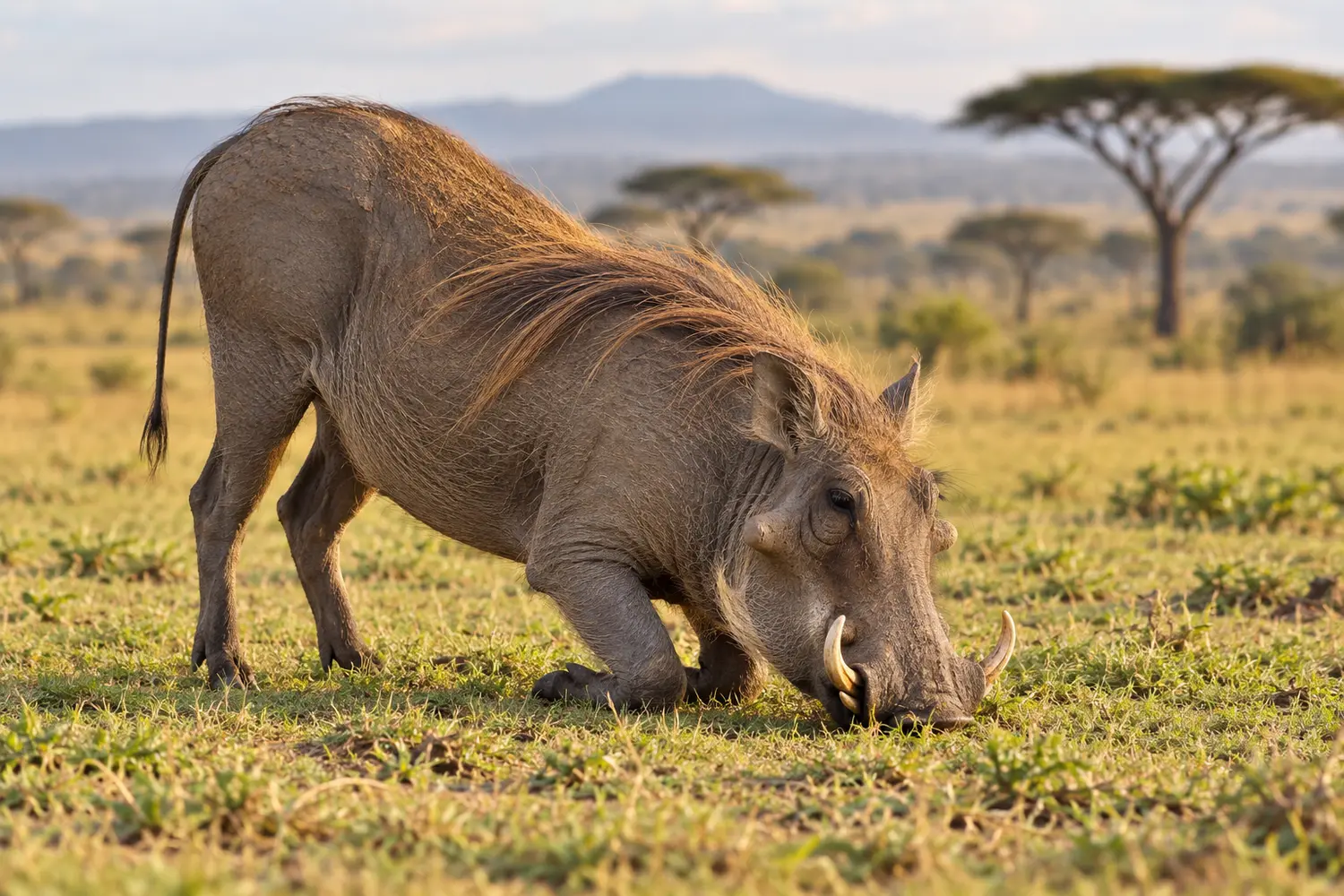
Warthogs often lower themselves onto their front carpal joints while grazing or rooting. The behavior compensates for a relatively short neck, and the joints develop protective pads. Grass is important, but warthogs also consume roots, berries, bark and occasional animal matter. They commonly use burrows for shelter and may enter backward, leaving the tusks and head facing the opening.
Red river hog: the colorful forest forager
The red river hog is among Africa’s most visually distinctive pigs. Many individuals have a reddish coat, a pale dorsal crest, dramatic black-and-white facial markings and elongated ears tipped with hair. Color varies geographically, however, so not every individual matches the brightest photographs.
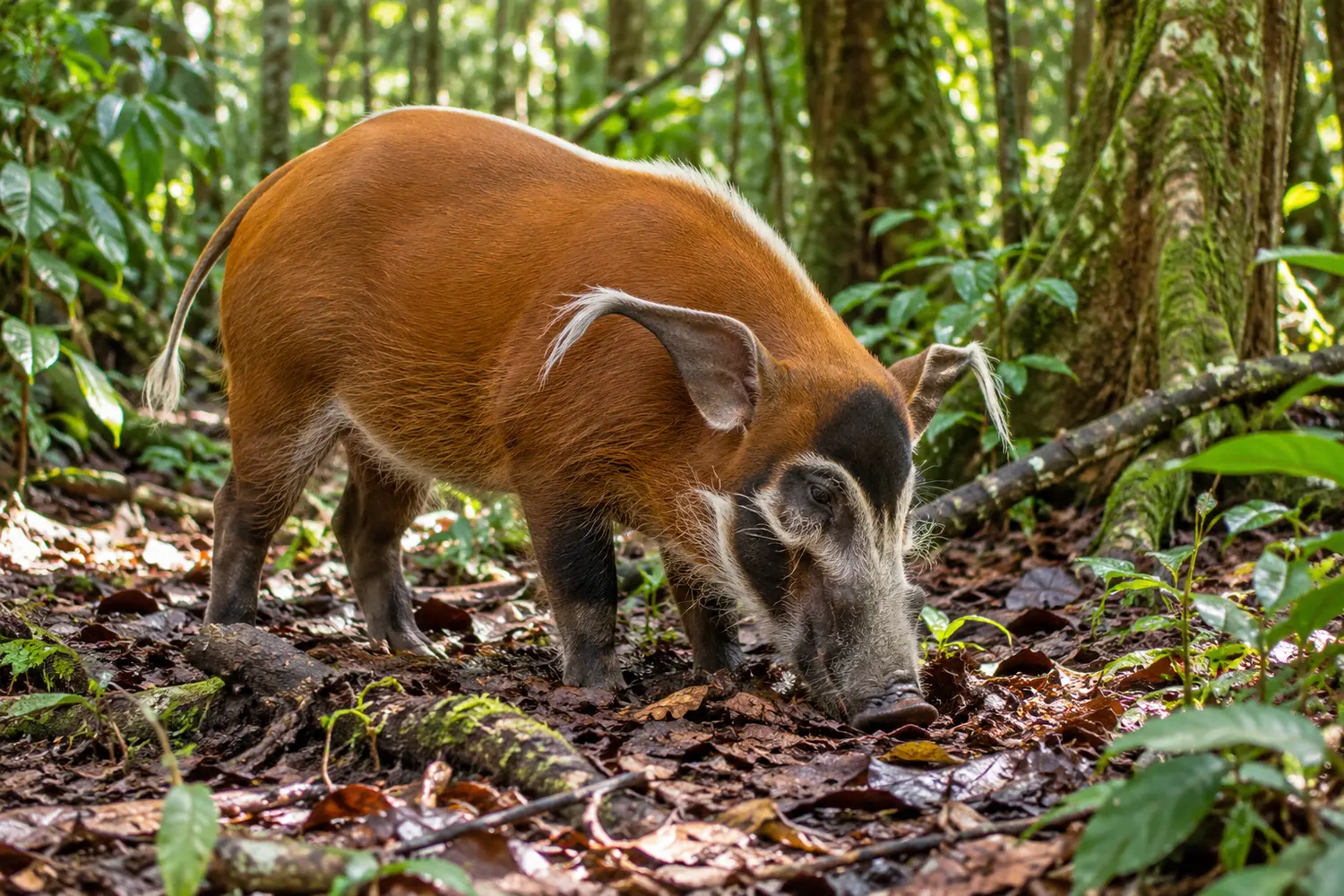
Red river hogs are forest-associated omnivores. Smithsonian’s National Zoo reports a broad diet that includes roots, fruit, seeds, grasses, nuts, invertebrates, eggs, reptiles and carrion. They usually forage at night, although shaded forest can allow activity around dawn and dusk. Their snouts help them investigate leaf litter and soil, while social groups can coordinate movement through dense cover.
Giant forest hog: large, but not equally giant everywhere
The giant forest hog is generally regarded as the largest living wild pig. The IUCN Wild Pig Specialist Group gives adult males a broad range of about 140–275 kilograms (309–606 pounds), with females usually smaller. That upper figure should not be applied to every population: western forms may be little larger than bushpigs, while East African populations include the true giants.
Its name can also create an overly simple picture of habitat. Giant forest hogs use rainforest and montane forest, but they can favor edges, clearings and mosaics where wooded cover meets grassland or bushland. Their massive head, robust legs and broad muzzle suit a diet with a strong plant component. Contrary to the claim that they rely on “armor” to bulldoze jungle, their success is better explained by body size, powerful feeding anatomy and flexible habitat use.
Bushpig: adaptable and often nocturnal
Bushpigs range through eastern and southern Africa and occupy an unusually wide spectrum of wooded habitats. They can live from sea level to montane forest, often favoring dense vegetation and soft soils. Their coat is highly variable—blond, reddish, dark brown or nearly black—so color alone is not a reliable way to identify them.
They are predominantly nocturnal in many regions, resting in thick vegetation during the day, but activity can shift with temperature and disturbance. Bushpigs eat roots, tubers, fungi, fruit, crops, invertebrates, eggs and small vertebrates. That flexibility helps them persist near altered landscapes, but it also brings them into conflict with farmers when family groups raid crops.
Do African wild pigs dominate every habitat?
No. These species are resilient, but “dominate nearly every habitat” is an exaggeration. Their distributions are limited by water, vegetation, temperature, disease, hunting pressure and competition. Some adapt to agriculture, while others depend much more heavily on intact forest or protected habitat.
The IUCN reported in 2026 that specialists were reassessing five African wild pig species because their global Red List assessments were about a decade old. Experts suggested that the giant forest hog may warrant a higher level of concern, illustrating why broad labels such as “common” or “adaptable” should not obscure local declines and data gaps.
Why these pigs matter
Wild pigs move seeds, disturb soil, consume fallen fruit and influence plant regeneration. They also support predators and scavengers as part of African food webs. Rooting can create small patches of disturbed ground, but its ecological effects vary by species, habitat and population density. Near farms, the same behavior may damage crops and intensify human–wildlife conflict.
The most useful lesson is not that one species is stronger or more “advanced.” Each represents a different solution to the same challenge: finding food, avoiding danger and raising young in a changing landscape.
Frequently asked questions
Are red river hogs and bushpigs the same species?
No. They are currently recognized as Potamochoerus porcus and Potamochoerus larvatus. They are close relatives, and recent genomic work found evidence of porous species boundaries, but they remain distinct taxonomic species.
Why do warthogs kneel while eating?
Their relatively short neck makes it easier to reach low vegetation by resting on padded front wrist joints. This is a normal feeding posture, not an injury.
Is the giant forest hog always 275 kilograms?
No. That is near the upper end reported for large males. Females are smaller, and western populations may be much smaller than the largest East African animals.
References
- Nature Communications: African bushpig genomics and suid taxonomy
- IUCN Wild Pig Specialist Group: Common Warthog detailed profile
- Smithsonian’s National Zoo: Red River Hog
- IUCN Wild Pig Specialist Group: Red River Hog detailed profile
- IUCN Wild Pig Specialist Group: Giant Forest Hog detailed profile
- IUCN Wild Pig Specialist Group: Bushpig detailed profile
- IUCN: Experts call for more attention to African wild pigs