
The Amazon river dolphin (Inia geoffrensis), often called the boto, is a large freshwater dolphin adapted to the Amazon and Orinoco river systems. Its long beak, flexible neck and broad flippers help it forage in complex floodplain habitat. Adults vary from gray to mottled pink, but the familiar claim that every boto simply “turns pink with age” leaves out important individual and sex differences.
Key takeaways
- Amazon river dolphins are born gray, but adults range from gray to strongly pink-mottled.
- Accumulated scarring is strongly associated with pink coloration in adult males; a single universal cause for every pink patch has not been established.
- Unlike many oceanic dolphins, botos have unfused cervical vertebrae and a highly mobile neck, but “exactly 90 degrees” is not a dependable species-wide measurement.
- The IUCN assessed Inia geoffrensis as Endangered in 2018.
- Fishing mortality, dams, habitat degradation, boat traffic, drought and mercury contamination all compound the risk.
What is an Amazon pink river dolphin?
The boto is a toothed whale found in freshwater rivers, channels, lakes and seasonally flooded forests across much of the Amazon and Orinoco basins. “Pink river dolphin” is a useful common name, but it can imply that all animals are uniformly bubble-gum pink. In reality, coloration varies greatly.
Its body is stockier than that of many marine dolphins. A rounded forehead, a long narrow rostrum, large paddle-like flippers and a low dorsal ridge suit slow, controlled movement in cluttered water. Adult males can exceed females in length and mass, so descriptions of the boto as the largest river dolphin should be understood as a general comparison, not a fixed size for every individual.
Why are Amazon river dolphins pink?
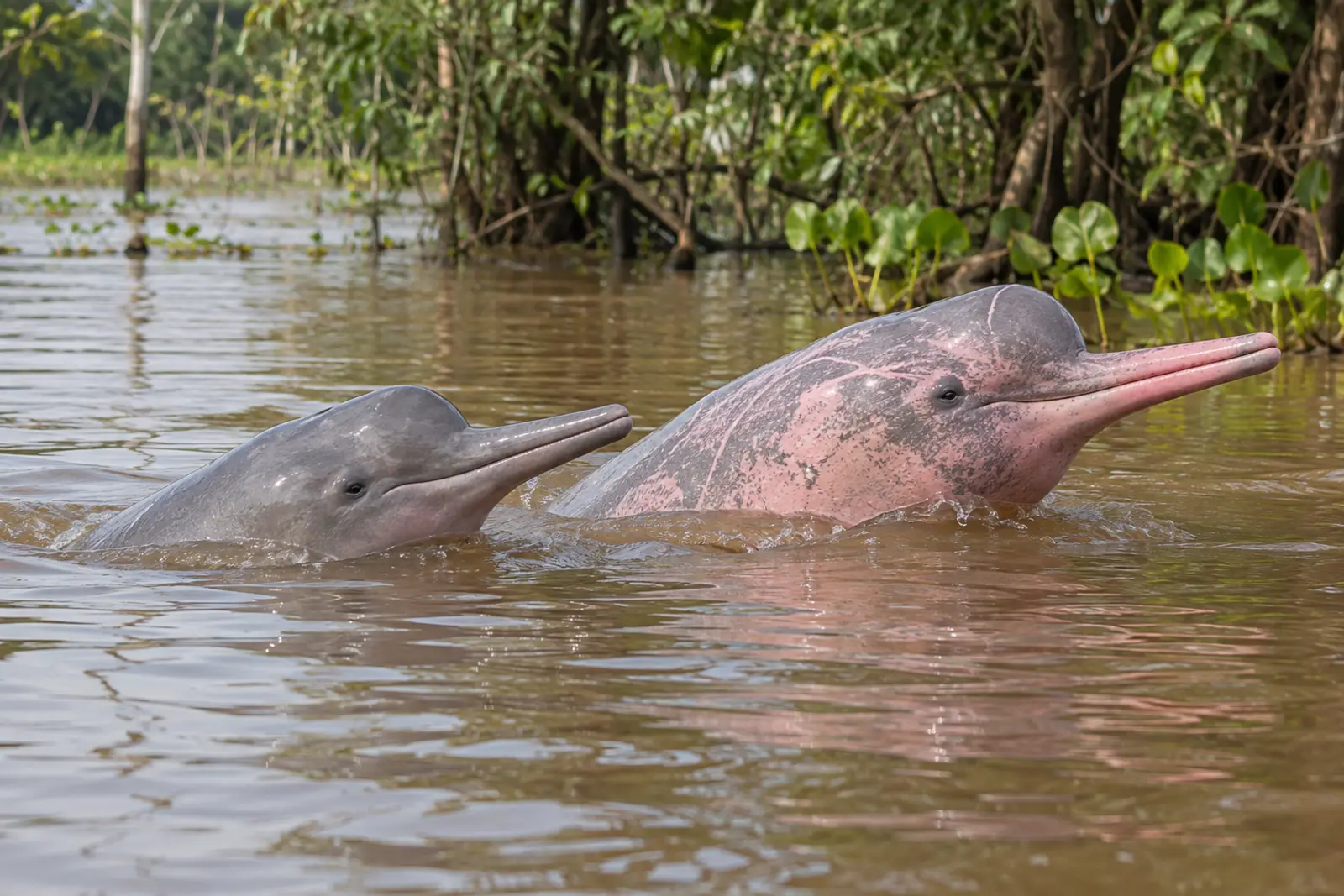
Calves and young animals are generally dark gray. As botos mature, some become paler or develop extensive pink areas. A study of sexual dimorphism and body scarring found that mature males were much more heavily scarred than females and proposed that intense male-to-male aggression explains much of their conspicuous pink appearance. Older, large males can therefore look far pinker than females or younger dolphins.
Scarring is an important part of the answer, but it should not be turned into a rule that every boto follows. Blood flow near the skin may make color appear stronger during activity, and background pigmentation varies between individuals. Evidence does not support presenting genetics, capillary flow, age and scarring as four equally proven causes of a predictable transformation.
How does a flexible neck help in flooded forest?
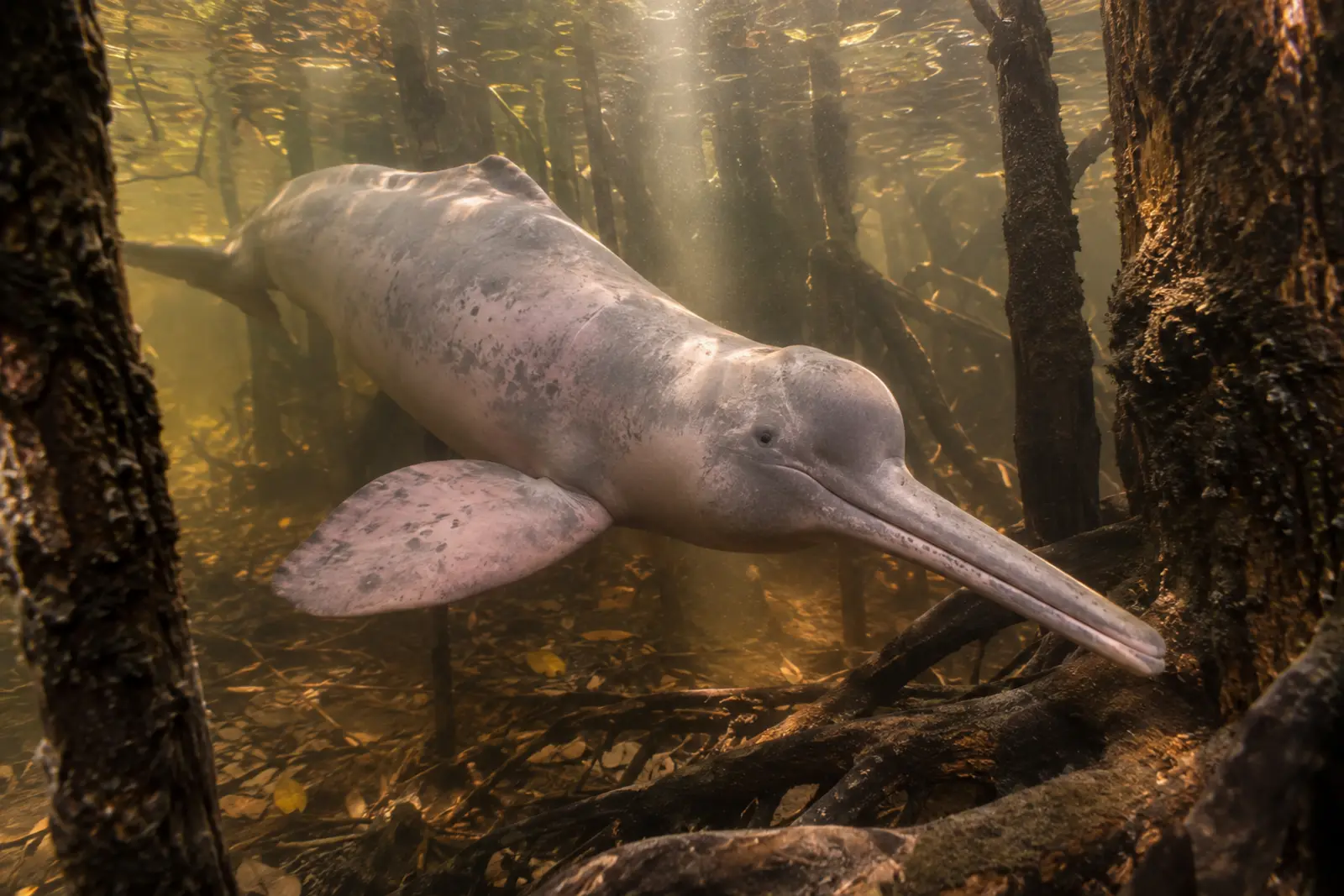
Many fast-swimming oceanic dolphins have neck vertebrae that are partly fused, creating a relatively rigid connection between head and torso. In the boto, the cervical vertebrae are not fused in the same way. This gives the animal unusual head and neck mobility for a cetacean.
That flexibility is useful when water rises into forests and floodplains. A boto can angle its head around roots, branches and submerged trunks while probing for fish. Its broad flippers and low dorsal ridge also favor maneuverability over sustained high-speed travel. Popular accounts often assign the neck an exact 90-degree rotation, but anatomy supports the broader point—greater mobility—more securely than that precise number.
What do botos eat?
Amazon river dolphins eat a varied fish diet and may also take crustaceans and turtles. Their conical front teeth help seize prey, while broader rear teeth can crush tougher items. Echolocation is essential in sediment-rich water where vision is limited, although their small eyes are functional.
Calling the boto an “apex predator” can be useful shorthand, but river food webs are dynamic. Likewise, dolphins can act as sentinels of river health because long-lived predators accumulate contaminants from prey. Their presence alone does not prove an ecosystem is healthy; abundance, reproduction, survival, contaminant loads and prey conditions must be measured.