
Animal tongue adaptations can turn a familiar organ into a projectile, a grasping tool or an insect-catching probe. Chameleons, giraffes, giant anteaters and pangolins all use highly specialized tongues, but several popular claims about them need qualification.
Four animal tongue adaptations at a glance
| Animal | Main tongue adaptation | What it helps the animal do |
|---|---|---|
| Parson’s chameleon | Elastic-powered projection and an adhesive tongue pad | Capture prey beyond biting distance |
| Giraffe | Long, mobile, darkly pigmented front portion | Select leaves among woody and thorny branches |
| Giant anteater | Slender, sticky tongue with unusual muscular support | Collect ants and termites rapidly |
| Pangolin | Elongated tongue apparatus extending into the torso | Probe insect nests without chewing |
Parson’s chameleon: an elastic-powered projectile
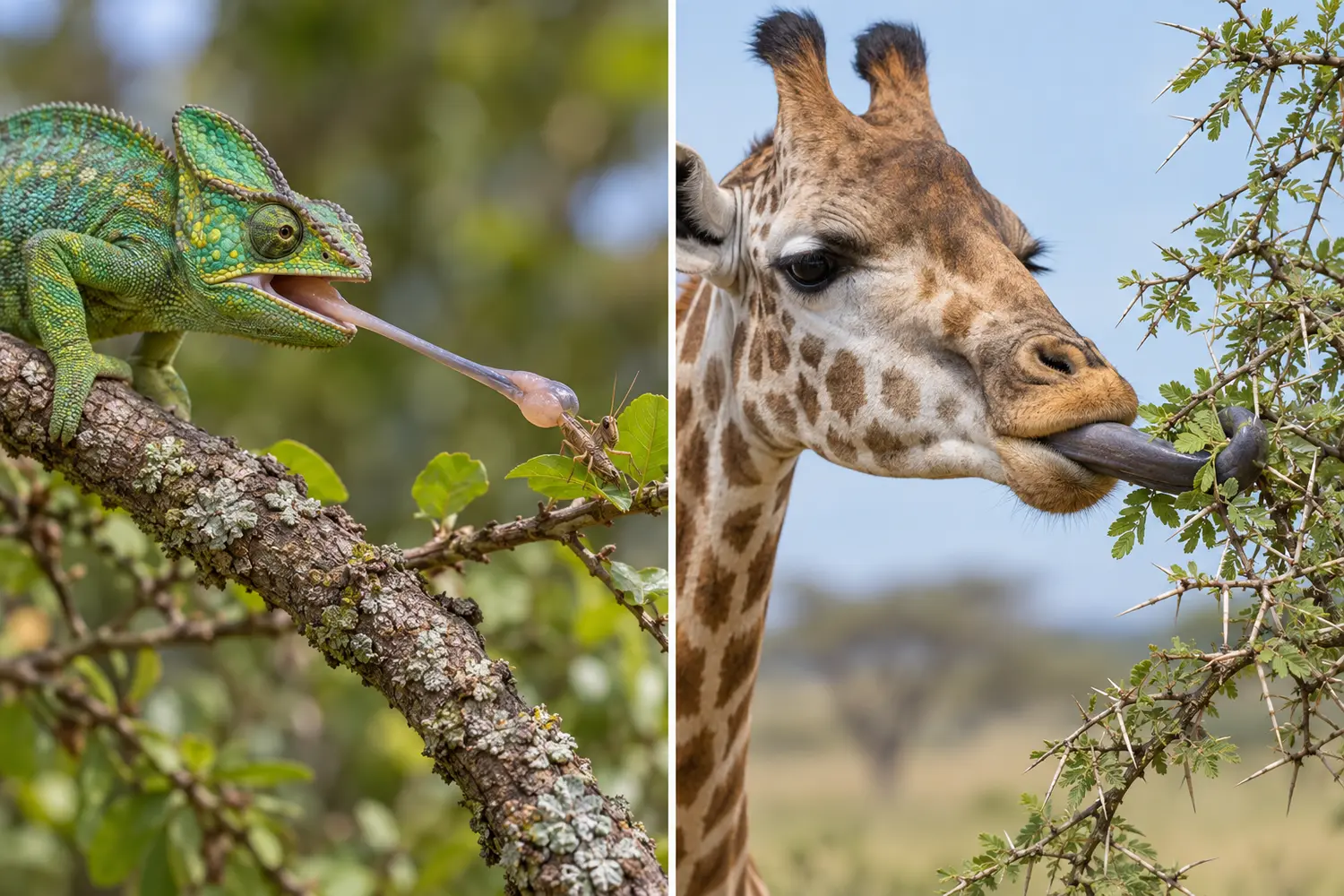
The Parson’s chameleon (Calumma parsonii) is one of the largest living chameleons. Like other members of its family, it can project its tongue far beyond the mouth to seize prey. Calling this a “biological missile” is colorful but incomplete: the action depends on elastic tissues that store energy around the tongue skeleton and then release it quickly.
High-speed studies across chameleon species show that projection performance varies with body size. Smaller chameleons tend to launch their tongues farther relative to body length and can achieve especially high acceleration. One comparative study included a Parson’s chameleon, but that does not make a single speed, distance or timing value universal for every individual.
The tip is also not a simple suction cup. Chameleons use a broad tongue pad, close contact and unusually viscous mucus to hold prey. The pad deforms around the target while the mucus creates strong viscous adhesion. After contact, specialized retractor muscles pull the tongue and prey back into the mouth.
Giraffe: precision browsing among branches
A giraffe’s tongue is commonly described as about 45–50 centimeters (18–20 inches) long. Its mobile front portion can curl around leaves and work with the lips, dental pad, cheek structures and saliva while the animal browses. That flexibility helps a giraffe select food among woody twigs and thorns; it does not make the mouth injury-proof.
The exposed front of the tongue is often dark blue, purple or blackish, while areas farther back can be pinker. A 2012 anatomical study confirmed dark pigmentation in the front portion, especially on the underside. However, the familiar claim that this pigmentation is proven “natural sunscreen” goes beyond the direct evidence. Melanin can protect tissues from ultraviolet radiation, so the idea is plausible, but a measured sunscreen function in giraffe tongues has not been demonstrated.
For a closer look at the color claim, see our guide to giraffe tongue color.
Giant anteater: fast feeding without teeth
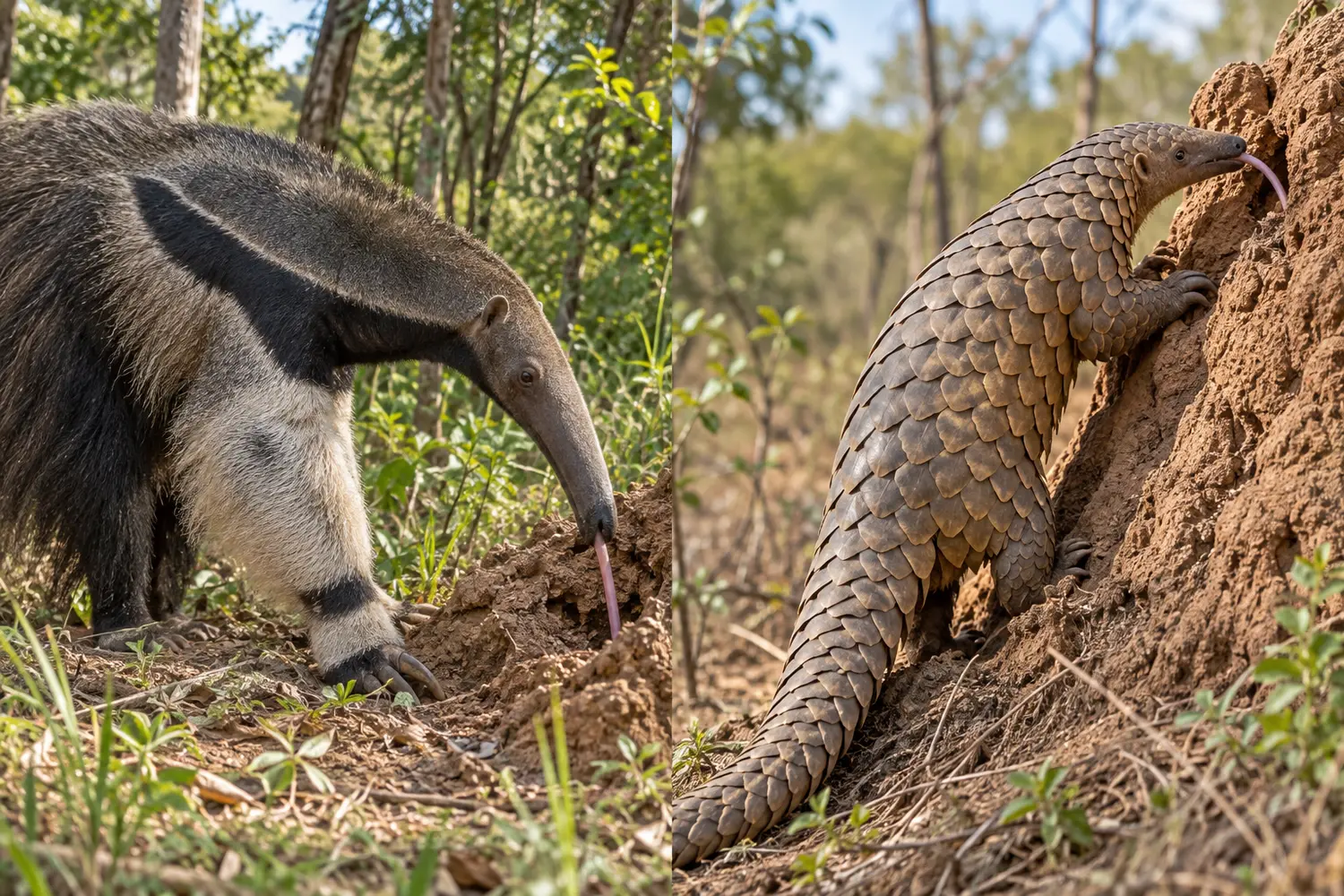
The giant anteater (Myrmecophaga tridactyla) has no teeth. Instead, it opens insect nests with powerful foreclaws and inserts a long, narrow tongue coated in sticky saliva. The tongue can extend roughly 60 centimeters (about two feet), and zoo references commonly report movements of up to about 150 times per minute.
Its anatomy is more complex than saying the tongue is simply “anchored to the sternum.” A specialized sternoglossus muscle and the elongated hyoid-and-tongue system help support rapid extension and retraction. Studies of anteater feeding also show that the jaws move in unusual ways to help control and house the tongue.
Estimates of up to 30,000 ants and termites per day appear widely in zoo and husbandry sources. They are useful for conveying the scale of feeding, but they should not be treated as a daily count for every wild animal. Intake changes with insect availability, season, body condition and the size of colonies visited.
Pangolin: a tongue apparatus that extends into the torso
There are eight living pangolin species, and their proportions are not identical. All are toothless specialists that use long, sticky tongues to collect ants and termites. The tongue is supported by an unusually extensive muscular system associated with the sternum and, in some species, structures reaching through the thorax toward the abdomen or pelvis.
Recent three-dimensional work on the white-bellied pangolin found that the thoracoabdominal portion functions as a muscular hydrostat—a structure that can change shape while maintaining volume, much like an elephant trunk. Earlier dissections of African pangolins likewise documented tongue-associated tissues occupying parts of the thorax and abdomen.
Claims that “the pangolin” has a 16-inch tongue longer than its entire head and body, or holds a universal tongue-to-body record, collapse eight species into one figure. Tongue length and attachment anatomy vary, and the most defensible description is that pangolins possess exceptionally elongated tongue systems adapted for probing insect nests.
Similar diets, different evolutionary solutions
These four examples do not form a ranking of the “best” tongue. Each solves a different feeding problem.
- Chameleons capture mobile prey at a distance using rapid elastic recoil and adhesion.
- Giraffes manipulate leaves among branches with a flexible browsing organ.
- Giant anteaters collect many small insects rapidly after opening nests with their claws.
- Pangolins probe narrow nest galleries with a tongue system extending deep into the body.
Anteaters and pangolins are a particularly striking example of convergent evolution. They are not close relatives, yet both independently evolved toothlessness, strong digging claws, elongated snouts and sticky tongues in response to diets dominated by ants and termites.
Frequently asked questions
Does a chameleon’s tongue use suction?
Not in the simple sense of a suction cup. The enlarged pad conforms to prey, while viscous mucus and contact area create strong adhesion. Elastic tissues power projection, and muscles retract the tongue.
Is a giraffe’s dark tongue proven to prevent sunburn?
No direct experiment has established that function. Dark pigmentation is real, and a protective role against ultraviolet exposure is plausible, but it should be presented as a hypothesis rather than a proven fact.
How many insects does a giant anteater eat?
Many zoo and husbandry sources cite up to roughly 30,000 ants and termites per day. Wild intake varies, so the number is best treated as an estimate rather than a fixed daily quota.
Is a pangolin’s tongue longer than its body?
Not as a universal rule. Pangolin species differ in size and tongue anatomy. Their tongue-associated muscles can extend deep into the torso, which is not the same as saying the externally extended tongue exceeds total body length.
References
- Evidence for an elastic projection mechanism in the chameleon tongue
- Dynamics of prey prehension by chameleons through viscous adhesion
- Scaling of ballistic tongue projection in chameleons
- Anatomy of the mouth of the giraffe
- Morphology, evolution and function of feeding in the giant anteater
- Smithsonian’s National Zoo: giant anteater
- Tongue and associated structures in two African pangolins
- 3D muscle architecture of the white-bellied pangolin tongue