
Bird nests vary from large stick platforms to delicate hanging chambers. Some birds build no nest at all. Comparing bald eagles, baya weavers and emperor penguins shows how breeding behavior and surroundings shape the way birds protect their eggs.
Bald eagles build platforms they can reuse
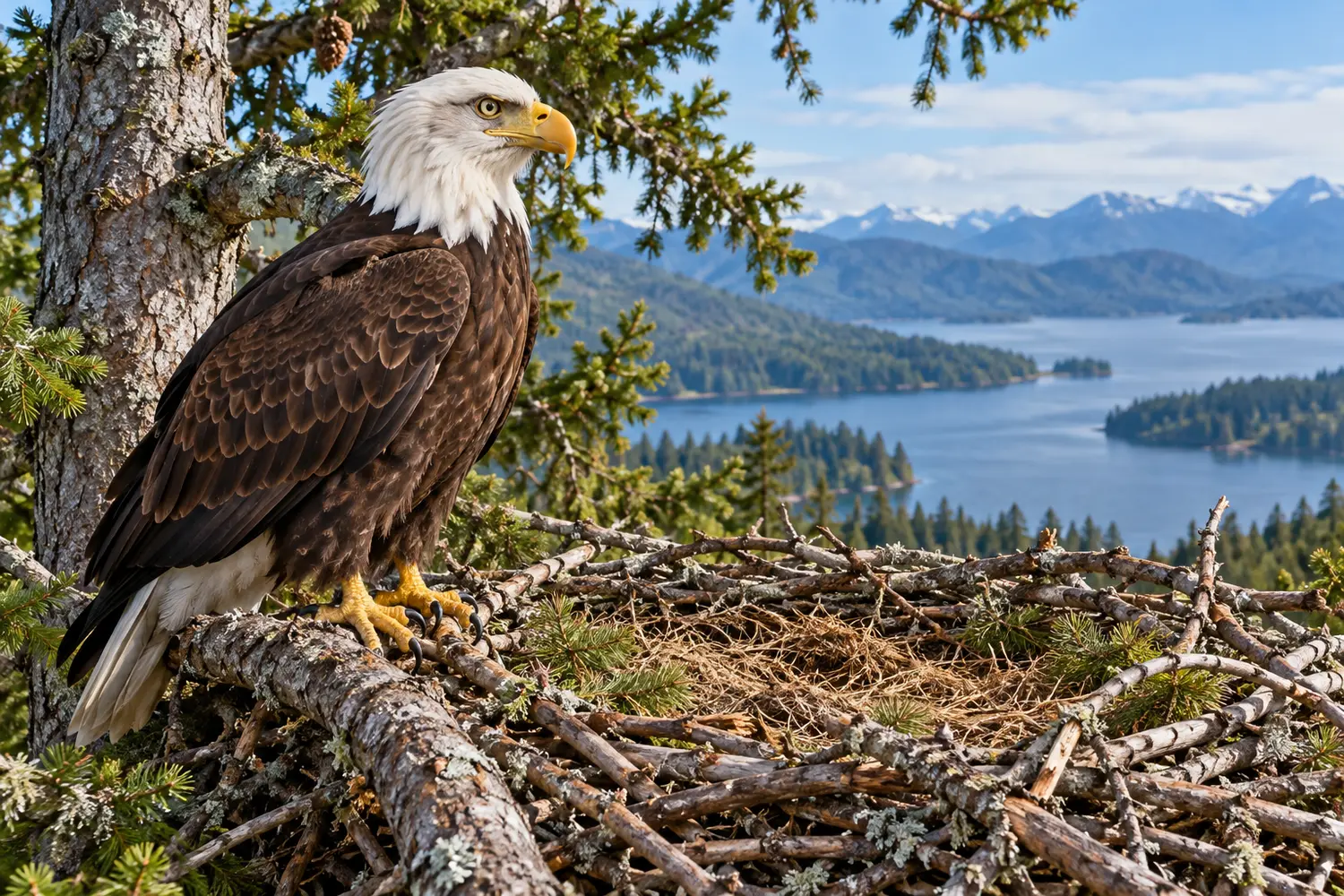
The bald eagle (Haliaeetus leucocephalus) usually places its nest in a sturdy tree near water. Both adults collect sticks, while the female does much of the arranging. Grass, moss and other softer material fill gaps, and finer material lines the interior. According to the Cornell Lab of Ornithology, typical nests measure about 5–6 feet across and 2–4 feet tall.
A pair may reuse a nest and add material over successive years. This helps explain why exceptionally large eagle nests attract attention, but record examples should not be treated as normal dimensions. The broad platform supports eggs and growing young; the supporting tree and the nest’s position matter as much as the amount of material.
Baya weavers weave hanging chambers
The baya weaver (Ploceus philippinus) uses strips of vegetation to create a suspended nest. Its swollen chamber and downward entrance tube give a completed nest its recognizable flask-like outline. Males build and display at nests during courtship. The structure is an active part of reproduction, rather than simply a container for eggs.
Hanging nests are sometimes positioned over water, but that does not make every nest predator-proof. In a 2006 study of nest choice, Suhel Quader examined both architecture and location. The Kadoorie Farm and Botanic Garden account explains that nest placement and anchoring are important, and that wind and predators can still cause breeding failure. A complex weave is one component of a successful nesting site, not a guarantee.
Emperor penguins incubate without a nest
Emperor penguins (Aptenodytes forsteri) use a different approach on Antarctic sea ice. After laying a single egg, the female transfers it to the male. He holds it on top of his feet beneath a fold of abdominal skin, keeping it away from direct contact with the ice. The Australian Antarctic Program describes how males remain at the colony to incubate while females travel to sea to feed.
The male relies on stored body reserves during this period. Huddling with other penguins helps conserve warmth in winter storms. Here, protecting an egg depends on parental posture, body heat and coordinated behavior rather than a structure assembled from sticks or grass.
Different solutions to the same breeding challenge
These strategies are not a ranking of the best bird nests. Eagles need a stable platform, weavers combine woven chambers with carefully chosen attachment sites, and emperor penguins carry their egg through incubation. Each approach has costs and vulnerabilities. Looking at materials, placement and parental care together gives a more useful comparison than judging a nest by size or complexity alone.