
Black mambas and king cobras are large venomous elapids, but they are not ecological rivals and never meet in the wild. The black mamba lives in sub-Saharan Africa. King cobras occur across parts of South and Southeast Asia. Comparing them is useful only when it explains their different anatomy, prey, defensive behavior and medical effects—not when it invents a fight or ranks them with fixed venom numbers.
Black mamba vs king cobra at a glance
| Trait | Black mamba | Northern king cobra |
|---|---|---|
| Scientific name | Dendroaspis polylepis | Ophiophagus hannah |
| Native range | Sub-Saharan Africa | Northern and eastern parts of the Asian king-cobra range |
| Body form | Long, slender and grey to olive-brown | Long, more robust and able to spread a hood |
| Typical prey | Small mammals and birds | Primarily other snakes |
| Major medical concern | Rapid neurotoxic paralysis | Neurotoxicity plus potentially severe local tissue injury |
Both snakes generally avoid people when given an escape route. A bite from either species is a medical emergency requiring immediate professional treatment.
They live on different continents
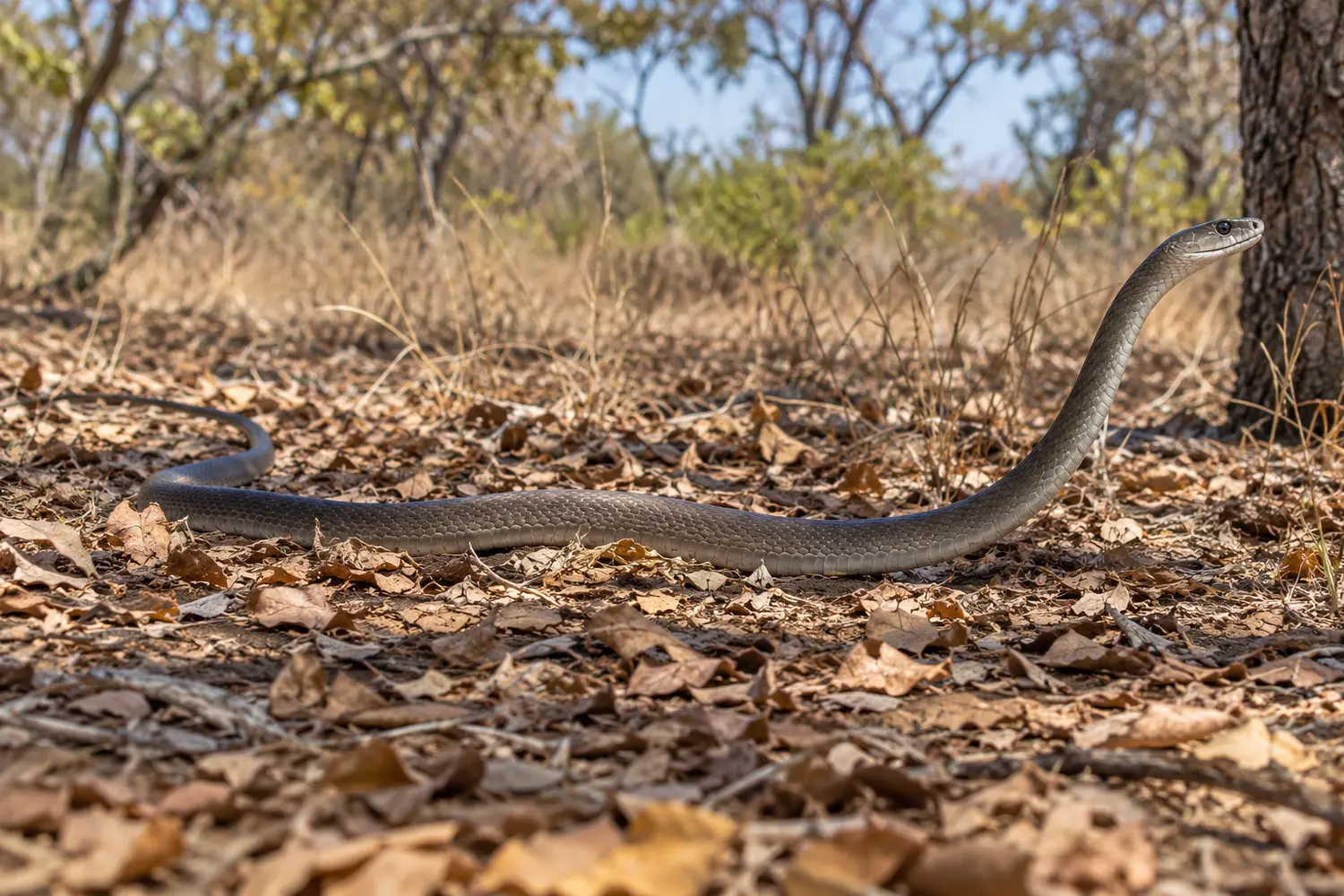
The black mamba occupies savannas, rocky hills, open woodland and other relatively dry habitats across much of sub-Saharan Africa. Its common name refers to the dark interior of its mouth, not to a uniformly black body. Adults are usually grey, olive or brownish.
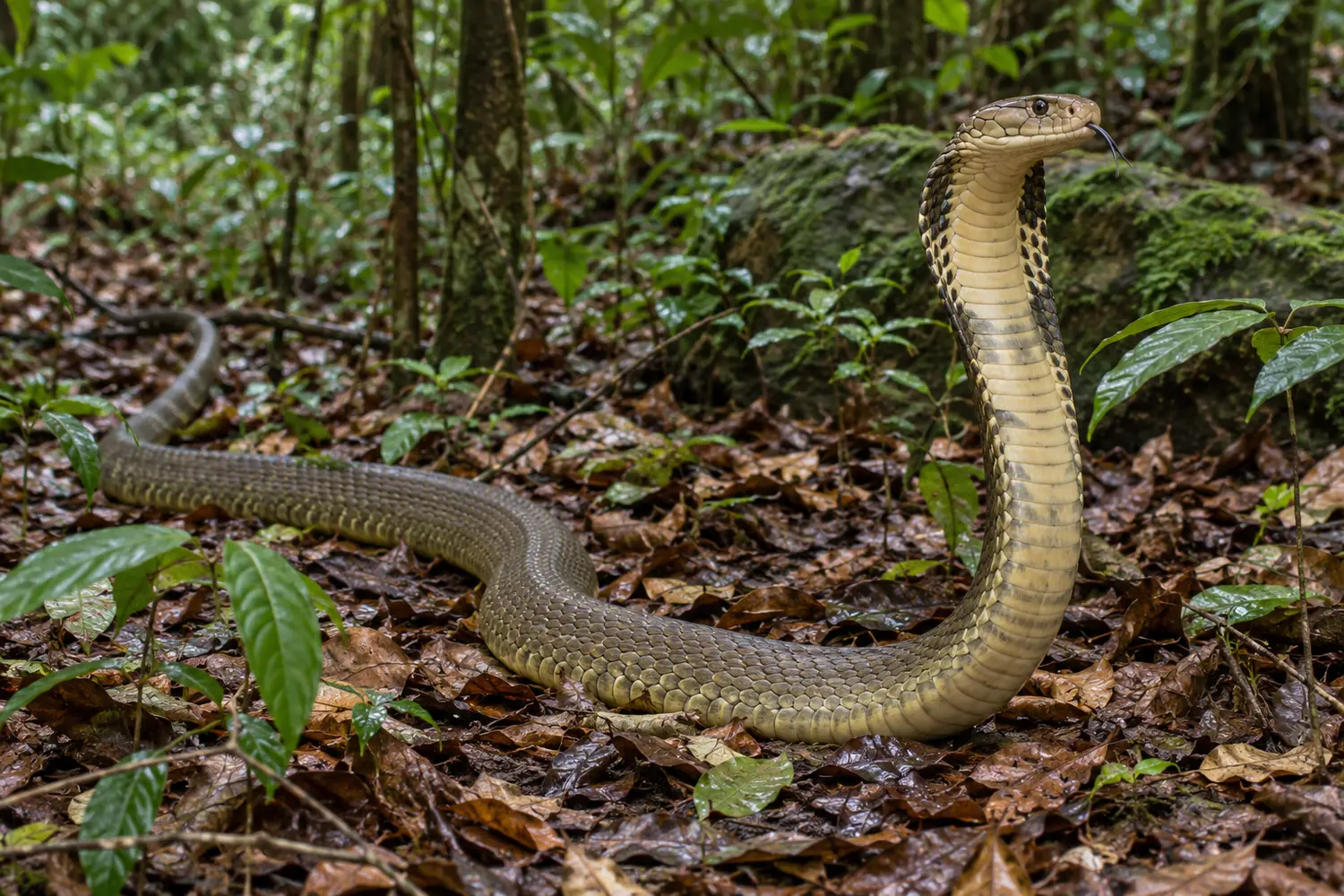
The name “king cobra” once referred to one widespread species, Ophiophagus hannah. A 2024 taxonomic revision recognized four geographically separated king-cobra species: the northern king cobra (O. hannah), Sunda king cobra (O. bungarus), Western Ghats king cobra (O. kaalinga) and Luzon king cobra (O. salvatana). Older medical and natural-history literature often uses O. hannah for the entire complex, so location now matters when interpreting records. Source: Das et al., 2024.
Size, speed and defensive display
King cobras are the world’s longest venomous snakes, with exceptional individuals reported beyond five meters. Black mambas are also among the longest venomous snakes in Africa, but their build is notably slender and adapted for efficient movement through open terrain and vegetation.
The black mamba is often called the world’s fastest snake, yet viral maximum-speed figures rarely come from controlled, repeatable field tests. It can move quickly over short distances, but speed should not be treated as a racing statistic. When threatened, a black mamba may lift its forebody, flatten the neck slightly, gape to expose the black mouth and strike if escape is blocked.
A king cobra can raise a substantial portion of its body and spread an elongated hood. The display makes the snake appear larger while allowing it to monitor a threat. Hooding is defensive communication, not proof that the animal is eager to attack.
Different hunting strategies and prey
Black mambas hunt primarily warm-blooded prey such as rodents, small mammals and birds. They use venom to immobilize prey and may follow a bitten animal using chemical cues.
King cobras are specialist snake predators—the genus name Ophiophagus means “snake eater.” They consume rat snakes, pythons and other snakes, including venomous species, although diet can vary. Their large size helps them overpower elongated prey, but they are not “apex predators” in the simplistic sense that nothing hunts them. Source: Smithsonian’s National Zoo.
How their venoms differ
Both venoms can disrupt nerve signaling, but their toxin mixtures and clinical patterns are not identical. Black mamba venom contains potent neurotoxins, including three-finger toxins and dendrotoxins. Severe envenoming can progress rapidly to weakness, paralysis and respiratory failure. Prompt antivenom and respiratory support can be lifesaving.
King-cobra envenoming can also cause neuroparalysis and respiratory failure. Clinical reviews additionally document pain, swelling and serious local tissue damage in some patients, including necrosis requiring repeated surgery. The severity of any snakebite depends on the bite site, venom injected, patient factors, treatment delay and access to appropriate antivenom and supportive care.
Why “120 mg vs 500 mg” is misleading
The source image assigns 120 milligrams of venom to the black mamba and 500 milligrams to the king cobra. These should not be presented as fixed payloads. Venom yield is usually measured from captive extractions, and results vary with snake size, population, health, time since the previous extraction and collection method. A defensive bite may inject a different amount—or occasionally no venom at all.
Venom quantity also cannot be separated from potency, toxin composition, delivery efficiency and the physiology of the victim. Laboratory toxicity tests may use mice, different injection routes and different endpoints. A larger measured yield does not create a universal “more lethal” ranking for humans.
Can one king-cobra bite kill an elephant?
The claim that a single bite can kill an Asian elephant should not be used as a standard measure of king-cobra venom. It does not specify the animal’s size, the bite site, the dose delivered or a documented outcome. The clinical and toxinological review of king-cobra envenomation provides a more useful framework: venom composition, delivery and the victim’s physiology all matter. Laboratory toxicity or venom-extraction figures are not a verified prediction for an elephant encounter.
For the same reason, “hyper-lethal” and “stops prey in its tracks” oversimplify black-mamba venom. A review of reported black-mamba envenomations documents serious, potentially rapid clinical illness, but that does not establish an identical time course for every bite. Both snakes merit respect without a sensational lethality comparison.
Which snake is more dangerous?
There is no responsible single winner. Black mamba bites are feared for potentially rapid neurotoxicity in regions where access to antivenom and ventilation may be limited. King-cobra bites are uncommon but can inject substantial venom and produce life-threatening systemic and local effects. Actual public-health risk also depends on how often people encounter each snake and how quickly treatment is available.
The safest response to either animal is distance. Never attempt to handle, corner or kill a venomous snake. Move away slowly, keep other people back and contact trained local wildlife or snake-removal professionals.
Frequently asked questions
Would a black mamba and king cobra meet in nature?
No. Black mambas are African, while king cobras are Asian. Any face-to-face image is a comparison or reconstruction, not a natural encounter.
Is the king cobra a true cobra?
It belongs to the elapid family but not to the “true cobra” genus Naja. King cobras belong to Ophiophagus.
Is a black mamba black?
Usually not externally. Its body is commonly grey, olive or brownish; the dramatic black lining inside the mouth inspired the name.
References
- Das et al. (2024): Taxonomic revision of the king cobra species complex
- King Cobra and Snakebite Envenomation: Natural History and Medical Importance
- The Clinical Course and Treatment of Black Mamba Envenomations
- Medical Threat of Mamba Envenoming: Venom and Antivenomics Analysis
- Confirmed King Cobra Bites in Malaysia, 2015–2020
- Smithsonian’s National Zoo: King Cobra Natural History