
A black panther and a spotted hyena are not rival versions of the same kind of predator. One is a melanistic big cat—usually a leopard in Africa or Asia, or a jaguar in the Americas—while the other is a distinct, highly social member of the hyena family. Their bodies, teeth, hunting methods and social systems reflect very different evolutionary paths.
That makes the popular “black panther vs. spotted hyena” matchup more useful as a biology comparison than as a fight prediction. A jaguar would never naturally meet a spotted hyena because they live on different continents. In Africa, the ecologically realistic comparison is a melanistic leopard and a spotted hyena, although black leopards are uncommon across much of the continent.
Black panther vs. spotted hyena at a glance
| Feature | Black panther | Spotted hyena |
|---|---|---|
| Taxonomy | A melanistic leopard or jaguar, not a separate species | Crocuta crocuta, a distinct species |
| Natural overlap | Only a black leopard could overlap with spotted hyenas in Africa | Occurs across much of sub-Saharan Africa |
| Typical social system | Mostly solitary | Lives in female-dominated clans, but often forages alone or in small groups |
| Claws | Retractable, curved claws suited to gripping and climbing | Short, non-retractable claws suited to running and traction |
| Skull and teeth | Cat skull with long canines for holding prey | Robust skull and enlarged premolars specialized for cracking bone |
| Hunting style | Stealthy stalk and short ambush | Flexible pursuit, group hunting, scavenging and competition at kills |
What is a black panther?
“Black panther” is an informal name, not a scientific species. It most often refers to a melanistic leopard (Panthera pardus) or melanistic jaguar (Panthera onca). Melanism increases dark pigment in the coat, but the normal rosette pattern usually remains visible as “ghost rosettes” under suitable light.
The genetic pathway is not identical in the two cats. Research has linked black coats in leopards to variants affecting the ASIP gene, while melanism in jaguars is associated with a dominant variant in MC1R. Calling both animals black panthers describes appearance, not close ecological equivalence.
Geography resolves much of the confusion. Jaguars are native to the Americas; spotted hyenas are African. Therefore, a black jaguar and spotted hyena do not encounter each other in a natural ecosystem. Leopards and spotted hyenas do overlap in parts of Africa, making a melanistic leopard the relevant animal for a realistic comparison.
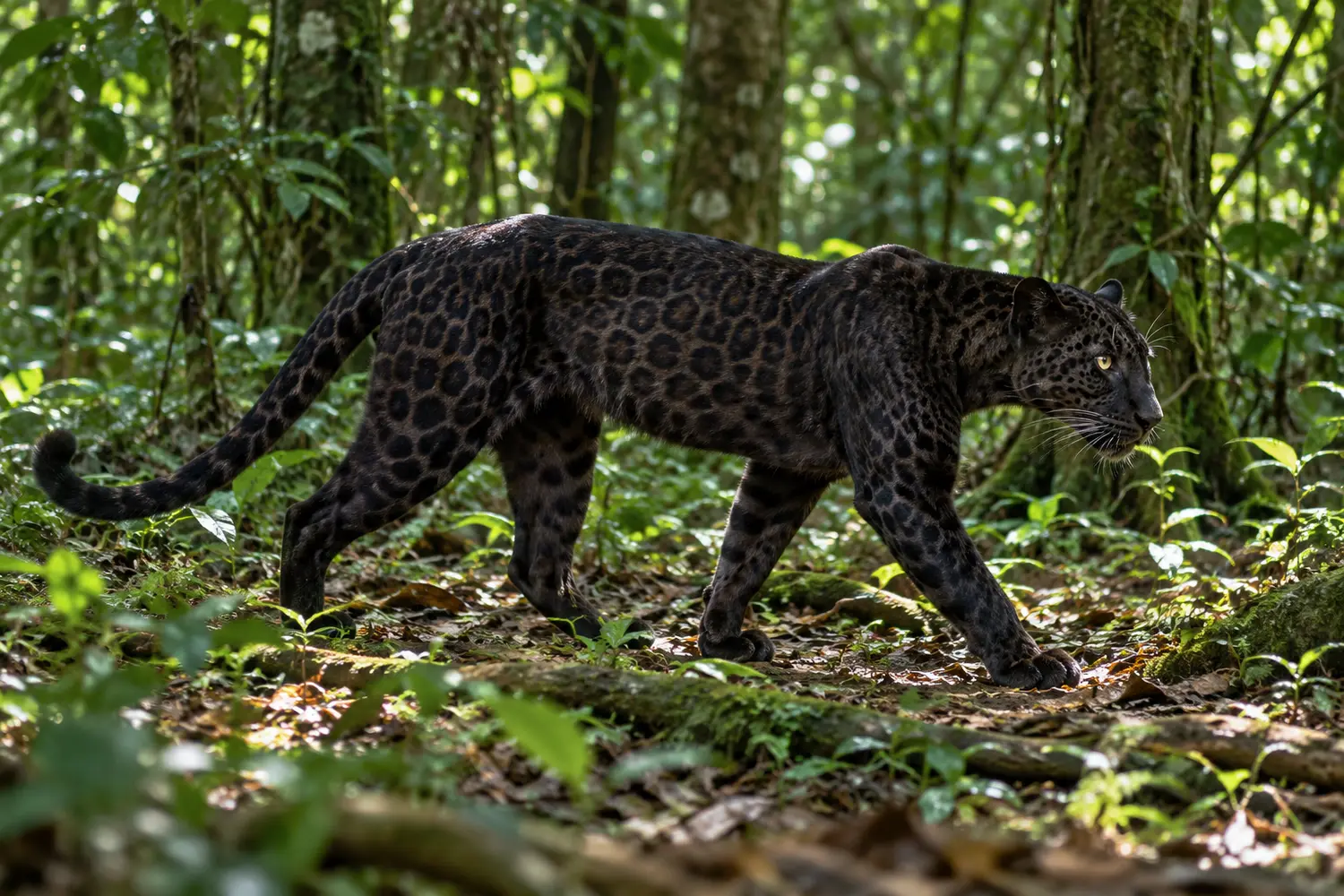
Size: neither animal has one universal weight
Leopard size varies dramatically by sex, subspecies, habitat and prey availability. Animal Diversity Web reports female leopards at roughly 17–58 kg, while males are generally heavier. Very large individuals exist, but “up to 90 kg” should not be treated as a normal black-panther weight. Melanism changes coat color, not the basic size range of the underlying leopard population.
Spotted hyena females are usually larger than males. Commonly cited adult ranges run from roughly 45 to 80 kg, although regional variation and measurement methods matter. Body mass alone does not identify a guaranteed advantage: age, sex, condition and local population can create considerable overlap.
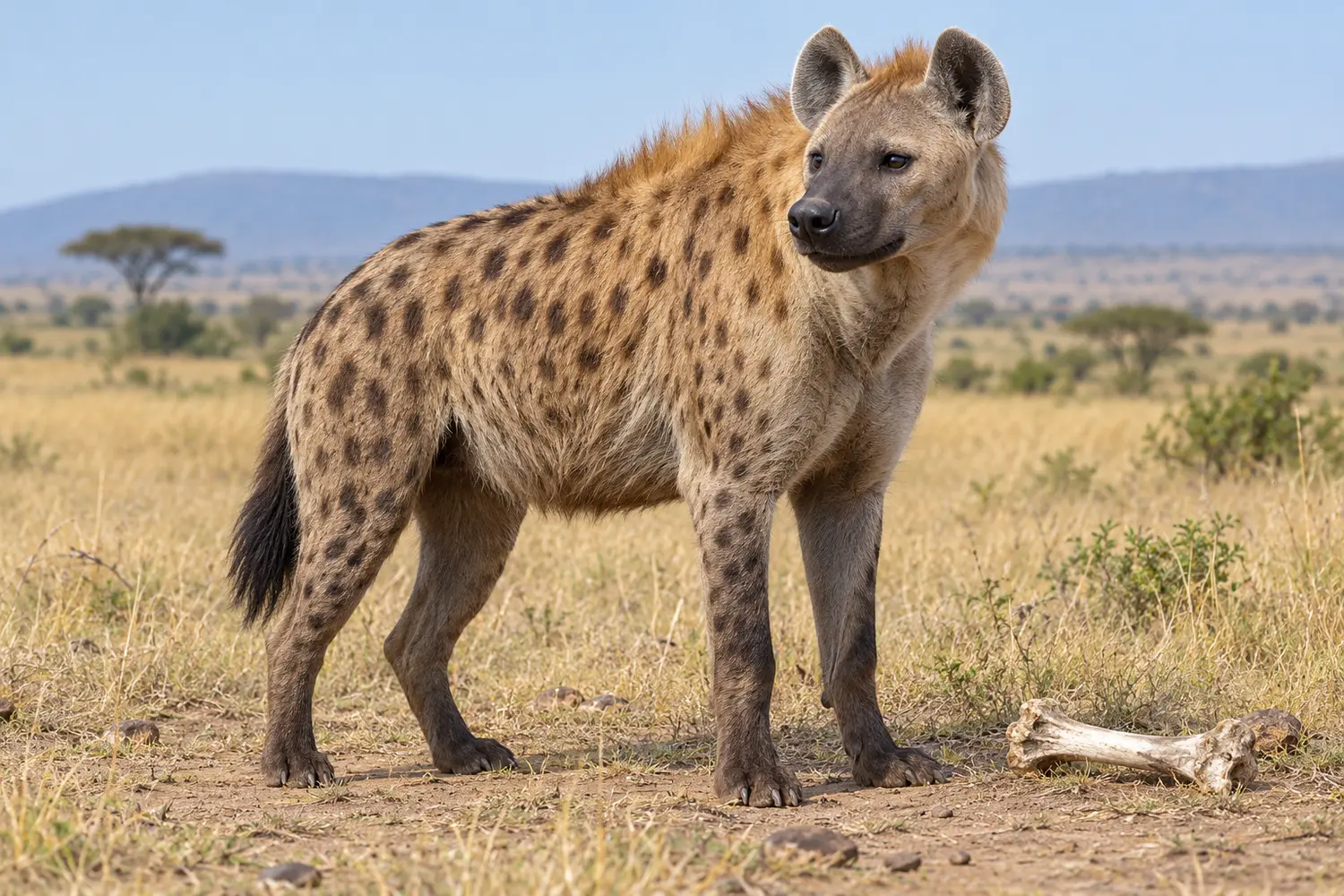
Their silhouettes are more informative. Leopards have flexible cat bodies, long tails and powerful forelimbs. Spotted hyenas have large heads, deep chests, long forelimbs and a back that slopes toward the hindquarters. That build supports efficient travel and strong feeding mechanics; it is not evidence that the hind legs are weak.
Claws, climbing and movement
A leopard’s retractable claws remain sharp because they are protected when not in use. The claws help grip prey, climb trunks and stabilize the cat on branches. Leopards are exceptional climbers, but viral claims that every leopard routinely hoists prey weighing twice its own mass are too broad. Whether a carcass can be moved depends on its size, the tree, branch angle and the individual cat.
Spotted hyenas have four toes on each foot, broad pads and short, non-retractable claws. Their feet are designed for traction and sustained terrestrial movement rather than climbing. Hyenas can travel long distances while searching for prey or carrion and may hunt alone, in small parties or in larger coordinated groups.
Why the 1,100 PSI claim is misleading
The often-repeated statement that a spotted hyena has a “1,100 PSI bite” is not a standardized specification for every animal. Force and pressure are different quantities, and results depend on where the bite is measured, the contact area, the animal’s motivation and the method used. Many popular comparisons mix modeled force, pressure and unsourced zoo anecdotes.
What research does support is more interesting: spotted hyenas have robust premolars, crack-resistant enamel, large jaw-muscle attachment areas and a vaulted skull that distributes stress during unilateral biting. As the permanent teeth develop, bone cracking shifts toward the rear premolars, where jaw mechanics provide greater leverage.
Leopards use long canines to seize and suffocate prey, while their carnassial teeth slice flesh. They can consume smaller bones, but they are not specialized for routinely processing large skeletal elements to the same degree as spotted hyenas. This is a functional difference, not a simple scoreboard of “bite power.”
Ambush hunter vs. flexible hunter-scavenger
L