
A blue whale’s tongue is a huge, flexible muscular organ that may weigh around 2.6 metric tonnes in the largest animals. During lunge feeding, it does not simply act as a rigid hydraulic piston. Instead, the tongue deforms as the mouth and ventral throat pouch expand around prey-filled water, then helps move retained krill toward the throat after water passes through the baleen.
Blue whale tongue facts at a glance
| Animal | Blue whale (Balaenoptera musculus) |
|---|---|
| Scientific weight estimate | Up to about 2,600 kg (5,700 lb) |
| Main feeding method | Lunge feeding |
| Primary prey | Krill |
| Filter | Baleen plates hanging from the upper jaw |
| Expandable structure | Ventral groove blubber from the throat toward the belly |
How heavy is a blue whale’s tongue?
A 2022 biomechanics paper described the blue whale tongue as a muscular hydrostat that can weigh up to approximately 2,600 kilograms. That is an estimate for an exceptionally large organ, not a standard measured weight for every blue whale.
Popular sources often raise the number to 3,600 or 4,000 kg and compare it with “an elephant” or “40 people.” Those comparisons are unreliable without specifying the size and sex of the elephant or the body mass assigned to each person. Individual whales also vary enormously. A cautious scientific summary is that the largest blue whale tongues may weigh several tonnes, with about 2.6 tonnes supported in the biomechanics literature.
What happens during lunge feeding?
Blue whales are rorquals, a family of baleen whales with expandable grooves running along the underside of the throat. To feed, a whale accelerates toward a dense krill patch and opens its jaws. Water and prey enter as the ventral groove blubber stretches outward, greatly increasing the capacity of the mouth.
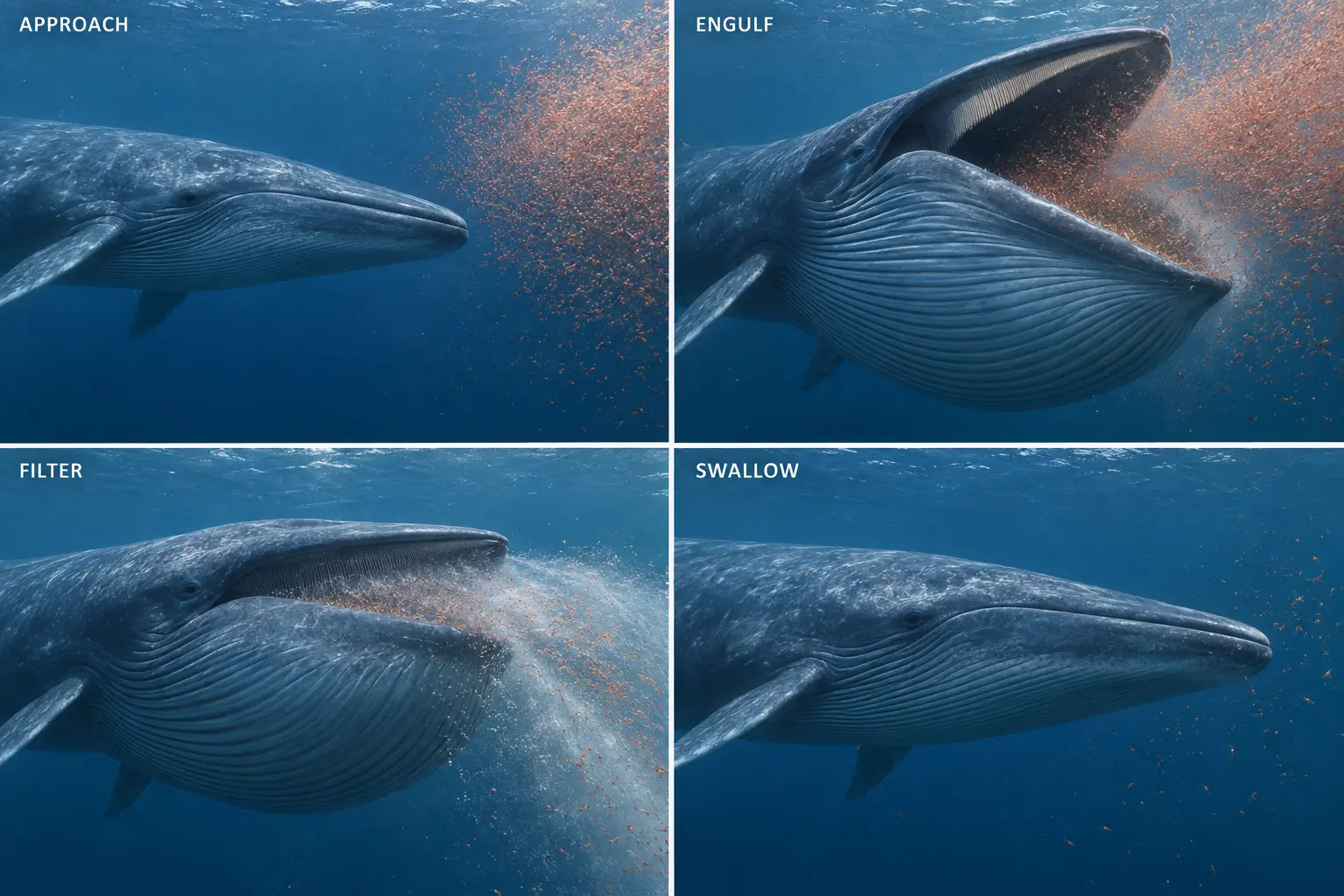
The engulfed water can impose tremendous drag, slowing the whale. Once the jaws close, elastic tissues recoil and the whale expels water through its baleen plates. The baleen’s fringed inner edges retain krill, which the tongue then helps gather and move toward the relatively narrow esophagus.
Is the tongue a hydraulic piston?
Not in the simple mechanical sense implied by many viral descriptions. The rorqual tongue is unusually soft and deformable. Comparative anatomical research indicates that it can flatten and invert into the expanding oral pouch as water rushes into the mouth. It works as one component of a coordinated system invol