
Boerboel vs. Kangal comparisons often turn into imaginary fight rankings. That misses what makes both breeds remarkable. The Boerboel was shaped as a versatile South African farm guardian, while the Kangal Shepherd Dog was standardized as a Turkish livestock guardian. Their bodies, coats and working styles reflect those different jobs.
This guide compares verified breed standards, temperament, size and practical ownership. It does not predict a fight—and it does not repeat the viral claim that a Kangal has a scientifically established “743 PSI world-record bite.”
Boerboel vs. Kangal at a glance
| Trait | Boerboel | Kangal Shepherd Dog |
|---|---|---|
| Traditional role | South African general farm and property guardian | Turkish livestock guardian, especially for sheep |
| Build | Blocky, broad, muscular mastiff | Taller-looking, rectangular, robust and more rangy |
| Official adult height | AKC preferred: males 61–69 cm; females 56–64 cm | FCI: males 72–78 cm; females 65–73 cm, with stated tolerance |
| Official weight | AKC standard emphasizes balance and proportion rather than a fixed range | FCI: males 48–60 kg; females 40–50 kg |
| Coat | Short, dense and smooth | Dense undercoat with a 3–7 cm guard coat that varies with weather |
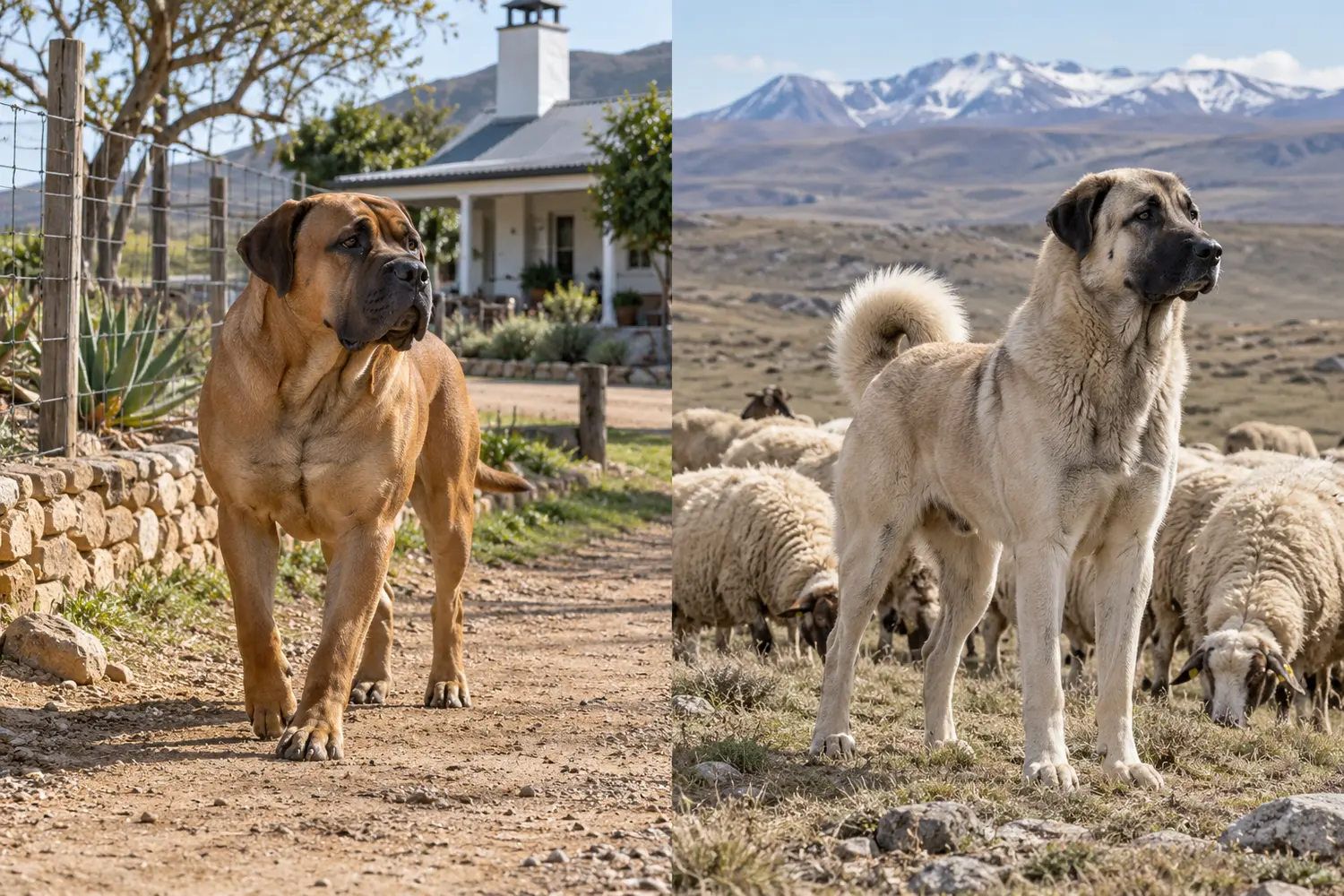
| Typical guardian setting | Home, family and farm property | Flock and open land |
Breed standards describe an ideal, not a guarantee for every individual. Sex, lineage, health, conditioning, socialization and training all influence the dog in front of you.
What is a Boerboel?
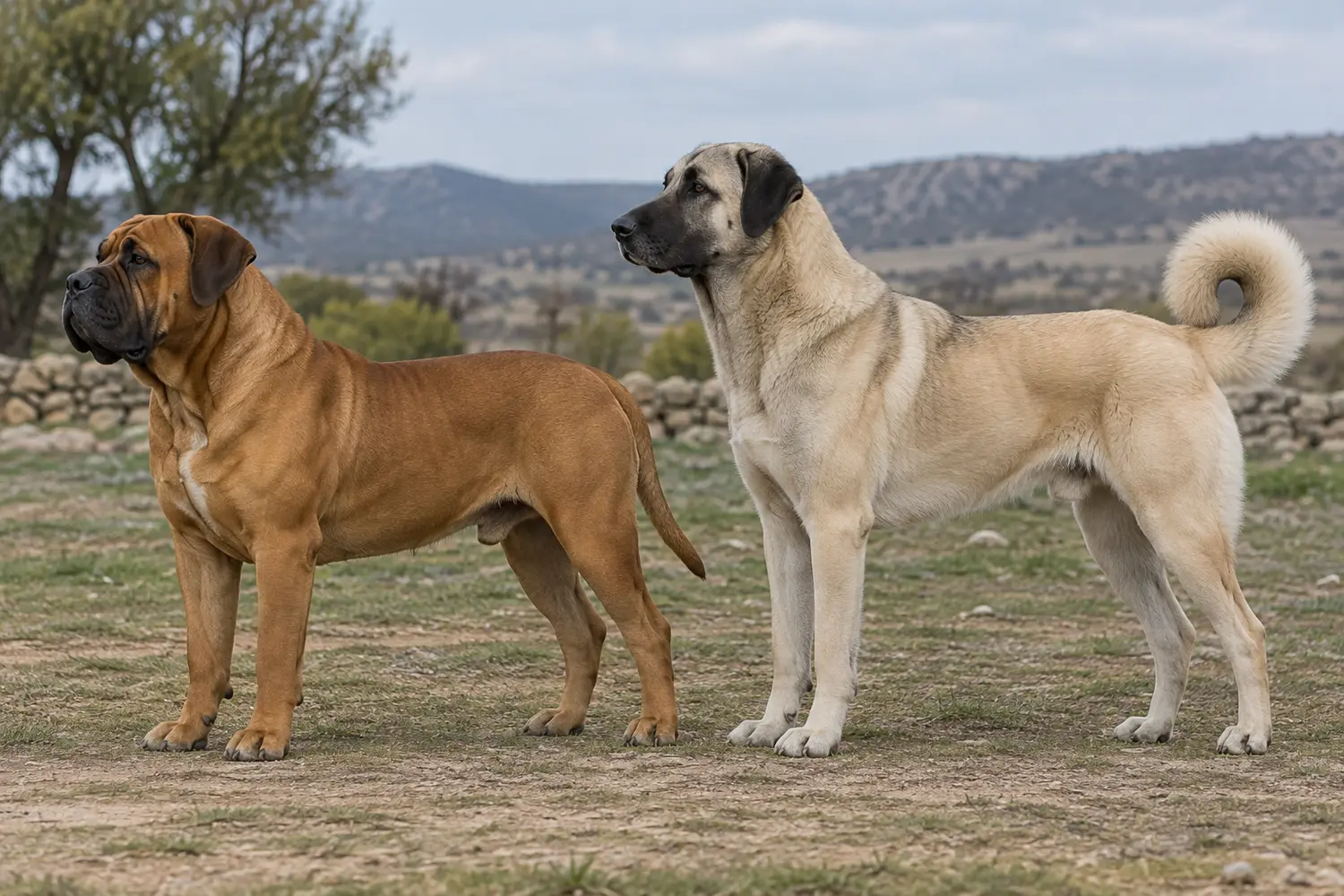
The Boerboel is a large South African mastiff developed around farms. The American Kennel Club standard describes a strong, confident and muscular dog whose movement should remain free, supple and agile. Its preferred height is 24–27 inches (61–69 cm) for males and 22–25 inches (56–64 cm) for females. Importantly, the same standard says balance, proportion and sound movement matter more than sheer size.
That point corrects a common internet shortcut. A Boerboel can be extremely substantial, but “up to 90 kg” is not an official universal target. Chasing maximum mass can work against mobility, joint health and functional structure. A responsible comparison should focus on a well-conditioned dog, not the heaviest specimen advertised online.
The breed’s blocky body, broad chest, heavy bone and short coat suit close supervision around a farmstead or property. A stable Boerboel should be discerning rather than indiscriminately reactive. Because it is powerful and naturally protective, early socialization, reliable boundaries and skilled handling are essential.
What is a Kangal Shepherd Dog?
The Kangal Shepherd Dog comes from Turkey and is classified by the Fédération Cynologique Internationale as a sheep-guarding dog. The FCI standard describes a large, powerfully built livestock guardian with a dark mask, a robust rectangular body and the ability to endure both heat and cold.
Official FCI ranges are 72–78 cm and 48–60 kg for males, and 65–73 cm and 40–50 kg for females. The breed has a dense undercoat and a harsh outer coat typically 3–7 cm long. Those features reflect a dog expected to spend long periods outdoors near livestock rather than a short-coated property guardian working mainly around buildings.
The standard calls for a steady, bold dog without aggression: independent, intelligent, loyal to its owners and wary of strangers while on duty. Independence is useful when a livestock guardian must assess events at a distance from people, but it also means a Kangal is not simply an oversized obedience dog. Owners need secure land, thoughtful socialization and realistic expectations.
Size and build: which dog is bigger?
There is no single answer because height, weight and overall bulk are different measurements. Under the cited standards, a male Kangal is typically taller at the shoulder than a Boerboel. The Boerboel usually looks broader and more compact, with a more massive mastiff outline. Individual Boerboels may weigh more than individual Kangals, but internet maximums should not be treated as normal or desirable.
The visual difference follows function. A comparatively rangy Kangal can cover open ground and remain with moving livestock. A Boerboel’s compact power and maneuverability fit the varied demands of a farm and homestead. Neither body plan is objectively “better”; each is a different compromise among strength, stamina, heat management and movement.
Does the Kangal really have a 743 PSI bite?
The popular “743 PSI” figure is not a recognized world record supported by a transparent, repeatable breed study. Bite force is force, while PSI is pressure—force divided by contact area. Online lists often mix those concepts and rarely explain whether values were directly measured, mathematically estimated or copied from another website.
Scientific reviews show why a single breed number is misleading. Researchers have measured or estimated canine bite forces with pressure sensors, anesthetized muscle stimulation, skull lever models and computer simulations. Results vary with body mass, skull dimensions, jaw shape, tooth position, motivation and measurement method. A 2009 study found that predicted bite force rose strongly with dog size and that skull shape also mattered in medium and large dogs, but it did not establish a league table of living breeds.
Both breeds have powerful jaws because they are large dogs. That does not justify attaching a precise PSI score to every Kangal or Boerboel, and bite strength alone says little about guardian reliability.
Temperament and working style
A well-bred Boerboel is expected to be calm, stable, confident and attentive to its family and territory. A well-bred Kangal is expected to be steady, independent and vigilant around livestock. Both can be reserved with strangers, and both require controlled exposure to people, animals and environments while young.
The practical distinction is where the dog directs its attention. A Boerboel is commonly managed as a family and property guardian. A Kangal is a livestock guardian whose instincts are most meaningful when bonded to stock and given suitable territory. Turning either breed into a status symbol—or encouraging suspicious behavior—creates risk rather than security.
Exercise, climate and living space
Neither breed is a sensible choice for a casual first-time owner. Both need daily movement, training and mental work, but endless high-impact exercise is inappropriate for growing giant-breed joints.
- Boerboel: needs structured walks, controlled strength-building activity, obedience and close household management. Its short coat offers less insulation in severe cold.
- Kangal: needs secure space, purposeful movement and an outlet for guardian behavior. Its double coat handles weather better, but shade, water and heat-aware scheduling remain essential.
A large yard is not a substitute for training. Fencing must be secure, gates managed carefully and visitors introduced under control. Local laws, insurance rules and breed restrictions should be checked before acquiring either dog.
Training and socialization
Start with reward-based foundation skills: recall, leash manners, place training, cooperative handling and calm responses at gates. Socialization should teach neutrality—not force a guardian breed to greet every person or dog. Punishment-heavy methods can increase conflict and suppress warning signals without changing the underlying emotion.
Because these dogs can physically overpower an adult, owners should work with a qualified trainer experienced with guardian breeds before problems appear. Livestock-guardian placement also benefits from mentors who understand bonding, fencing and predator pressure in the local landscape.
Health and responsible breeding
Large guardian dogs can face orthopedic disease and other inherited problems. Ask breeders for verifiable health testing appropriate to the breed, not only a routine veterinary check or claims that the parents “look healthy.” Meet stable adult relatives where possible, discuss longevity and avoid breeders selecting for extreme size, oversized heads or exaggerated aggression.
Good breeding preserves functional movement and sound temperament. It does not manufacture a “more dangerous” dog for social-media appeal.
Which guardian is right for you?
Choose the job and environment before the breed.
- A Boerboel may fit an experienced household seeking a closely managed farm or property guardian that lives as part of the family.
- A Kangal may fit an experienced rural owner who needs a livestock guardian, has secure acreage and understands independent working behavior.
Neither is automatically the better protector. Effective security depends on stable genetics, lawful management, training, fencing and a clear role. For many homes, a less intense breed plus good locks, lighting and cameras will be the safer solution.
Frequently asked questions
Is a Kangal stronger than a Boerboel?
“Stronger” is too vague to rank responsibly. The Boerboel is generally more compact and massive; the Kangal is generally taller and more rangy. No standardized scientific test crowns one breed the overall winner.
Would a Boerboel or Kangal win a fight?
A fight prediction is neither evidence-based nor responsible. Outcomes would depend on individual dogs and circumstances, and arranging dog fights is cruel and illegal in many jurisdictions.
Can either breed live in an apartment?
It is rarely an ideal setup. Size is only part of the problem: territorial behavior, visitor management, exercise and secure outdoor access make experienced rural or spacious suburban homes more realistic.
Are Kangals used against wolves and bears?
Kangals are livestock guardians developed to deter threats to flocks. Guardian dogs often work through presence, scent marking, barking and group defense. Saying every Kangal routinely fights wolves or bears exaggerates the role and ignores local predator ecology and management.