
Cane Corso vs. Dogue de Bordeaux comparisons often reduce two historic mastiffs to a fictional fight. In reality, both breeds were developed for demanding work, but their bodies and temperaments reflect different priorities. The Cane Corso is a comparatively athletic Italian utility dog. The Dogue de Bordeaux is a lower-set, heavier French guardian with an exceptionally broad head.
Neither breed has a scientifically proven fixed “PSI” score, and no responsible comparison can predict a universal winner. A useful comparison asks how they differ in size, movement, training needs, health and suitability for everyday ownership.
Cane Corso vs. Dogue de Bordeaux at a glance
| Trait | Cane Corso | Dogue de Bordeaux |
|---|---|---|
| Origin | Italy | France |
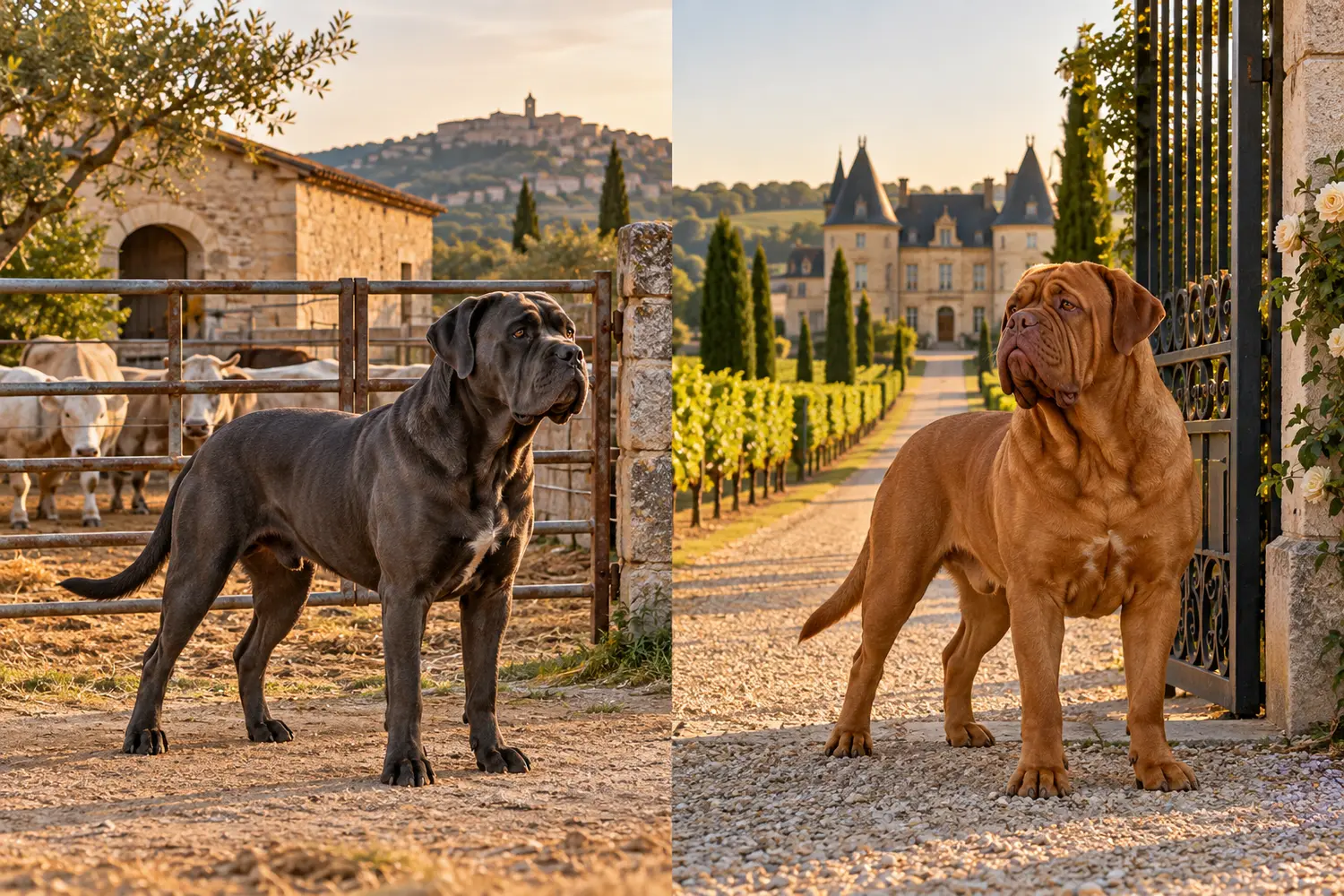
| Traditional role | Versatile farm, livestock, family and property guardian | Guard, defence and deterrence; historically also hunting and cattle work |
| FCI male height | 64–68 cm, with a 2 cm tolerance | 60–68 cm, with limited tolerance outside the range |
| FCI male weight | 45–50 kg | At least 50 kg |
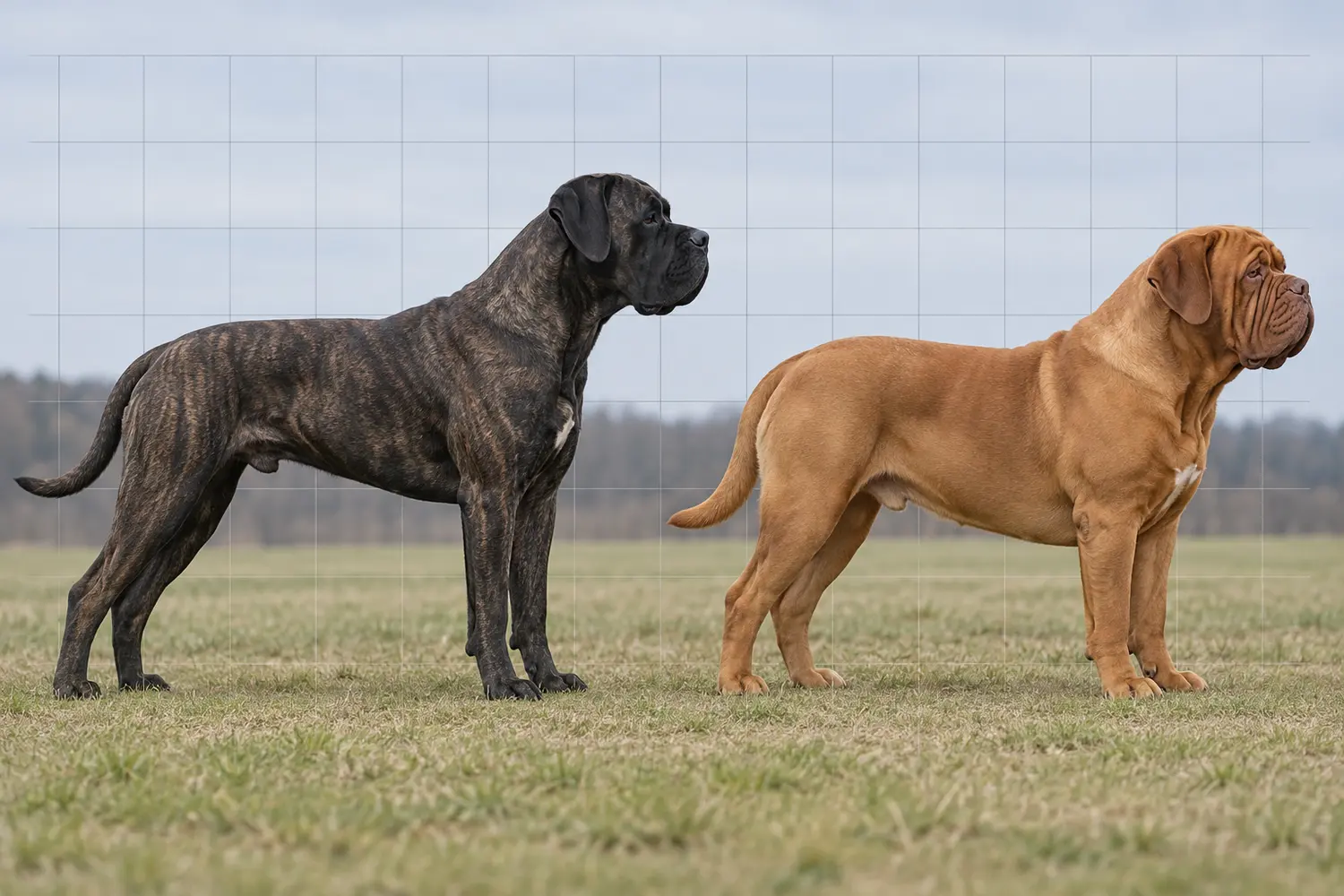
| Build | Longer-legged, leaner and more agile | Stocky, deep-chested and closer to the ground |
| Coat | Short; black, grey, fawn or brindle varieties | Short, fine and fawn, with several permitted mask types |
| Typical character | Responsive, vigilant and handler-oriented | Calm, affectionate and imposing, with a high stimulus threshold |
Breed standards describe an ideal rather than every individual dog. Sex, lineage, health, conditioning, socialization and learning history can produce substantial variation.
What is a Cane Corso?
The Cane Corso Italiano is classified by the Fédération Cynologique Internationale as a molossoid, mastiff-type working dog. The current FCI standard describes it as a polyvalent utility dog and a guardian of property, family and livestock. It was also historically used for herding cattle and hunting big game.
A correct Cane Corso should be robust without becoming cumbersome. The standard calls for lean, powerful muscle, a body slightly longer than tall and an extended trot as the preferred gait. Those features help explain why the breed is generally more agile and quicker to respond than heavier mastiffs.
That athleticism does not make every Corso a high-endurance sport dog. Heat, age, joint health, airway function and conditioning all affect performance. Nor does responsiveness remove the need for experienced handling: Corsos are strong guardians that require early socialization, secure management and reward-based training.
What is a Dogue de Bordeaux?
The Dogue de Bordeaux, sometimes called the French Mastiff, is one of France’s historic molossoid breeds. Its FCI standard lists guard, defence and deterrence as its modern utilization. Historical accounts also associate the breed with hunting large game, guarding houses and cattle, and work alongside butchers.
The breed’s outline is distinctive: stocky and imposing, with a body longer than tall, a chest deeper than half the dog’s height and an enormous but proportionate head. The muzzle is short, and the skull perimeter of an adult male roughly corresponds to his height at the withers under the standard.
Despite the intimidating appearance, the FCI temperament description emphasizes vigilance without aggressiveness. It calls the Dogue calm, balanced, affectionate and strongly attached to its owner. Individual temperament still depends on responsible breeding and development.
Size and body structure
The breeds overlap in height, but they distribute mass differently. FCI Cane Corso males are 64–68 cm tall and weigh 45–50 kg; females are 60–64 cm and 40–45 kg. Height may vary by 2 cm above or below the stated range.
Dogue de Bordeaux males stand 60–68 cm and weigh at least 50 kg. Females stand 58–66 cm and weigh at least 45 kg. The Dogue standard gives minimum weights rather than a maximum, but more mass is not automatically better. Exaggerated heaviness can reduce mobility and worsen orthopedic, cardiac or respiratory strain.
The Corso is typically taller on the leg and more efficient in an extended trot. The Dogue has a lower center of mass, deeper chest, heavier front and shorter muzzle. These are breed-type differences—not proof that one dog can “absorb force” or defeat another.
Temperament and training differences
Both breeds were selected to deter threats and can be reserved with strangers. However, their working styles often feel different in daily life.
- Cane Corso: often quicker, more responsive and more interested in structured interaction with the handler.
- Dogue de Bordeaux: often steadier and less hurried, but still powerful, watchful and capable of independent decisions.
These are tendencies, not guarantees. A fearful, impulsive or poorly socialized dog is not a superior guardian. Owners should reward calm observation, teach reliable handling skills and prevent uncontrolled rehearsal of fence running, charging visitors or conflict with other dogs.
Are the viral bite-force numbers accurate?
No standardized peer-reviewed evidence establishes a fixed bite pressure of 650–700 PSI for the Cane Corso or a fixed 556 PSI for the Dogue de Bordeaux. Those precise-looking numbers circulate widely online without a reproducible breed-specific testing protocol.
Veterinary research shows why a simple ranking is unreliable. Bite force changes with body and skull size, tooth position, gape angle, motivation, training, oral pain and the measuring method. Studies may record voluntary chewing, electrically stimulated muscle contraction, dry-skull lever estimates or computer models—measurements that are not directly interchangeable.
Pressure also differs from force: PSI requires both the force and the contact area. A value measured at a molar cannot be casually converted into a universal pressure at the canine teeth. Both breeds can cause severe injury, but invented leaderboards add no meaningful safety information.
Which breed is stronger or more athletic?
The Dogue de Bordeaux usually carries more mass and has a broader, heavier head. The Cane Corso generally has the advantage in stride length, agility and sustained movement. “Strength,” however, can refer to body mass, pulling ability, acceleration, muscular force or endurance; no single breed label measures all of them.
Individual age, sex, health and conditioning matter greatly. It is therefore neither scientific nor humane to predict which breed would win a fight. Deliberately arranging such an encounter risks catastrophic injury and is illegal in many places.
Exercise and daily management
A healthy adult Cane Corso usually benefits from purposeful walks, obedience practice, scent games and controlled strength or mobility work. Repetitive high-impact exercise should be avoided while a puppy’s skeleton is developing.
The Dogue de Bordeaux also needs daily activity, but exercise should account for its heavier frame and shorter muzzle. Heat and humidity can make exertion harder, especially in dogs with airway compromise. Slow conditioning, access to water and stopping at the first sign of distress are more important than forcing a fixed mileage target.
Both require secure fencing, leash skills and an owner physically capable of controlling a large dog. Neither should be left to patrol a yard without guidance as a substitute for socialization and training.
Health considerations
Large and giant dogs can face hip and elbow disease, cruciate injuries and gastric dilatation-volvulus. The Dogue de Bordeaux’s brachycephalic head shape also makes breathing, heat tolerance and anesthesia planning especially important. A dog that snores heavily, struggles to recover after mild exercise or has blue or pale gums needs veterinary assessment rather than more conditioning.
Prospective owners should ask breeders for documented orthopedic and cardiac testing appropriate to the breed and country. Extreme head size, excessive skin, oversized bodies and restricted movement should never be mistaken for quality.
The current Cane Corso standard specifies natural ears and tail. The Dogue de Bordeaux is also naturally drop-eared with an undocked tail. Cosmetic alteration is restricted or illegal in many jurisdictions and provides no substitute for health or stable temperament.
Which breed is right for you?
A Cane Corso may suit an experienced owner who wants:
- A more athletic guardian for regular structured training
- A dog that tends to work closely with its handler
- Daily mental work as well as physical exercise
A Dogue de Bordeaux may suit an experienced owner who wants:
- A calmer, heavier companion and property guardian
- A dog whose activity can be adapted to a lower-impact routine
- The ability to manage brachycephalic and giant-breed health risks
Neither is an easy first dog or a sensible choice for someone attracted mainly by appearance or intimidation. Before acquiring either breed, check housing, insurance and local breed rules, evaluate resident pets and children, and identify a qualified trainer and veterinarian.
Frequently asked questions
Is a Dogue de Bordeaux larger than a Cane Corso?
Their official height ranges overlap. The Dogue de Bordeaux is usually stockier and has a higher minimum male weight, while the Cane Corso is generally taller-legged and leaner.
Which breed is easier to train?
The Cane Corso often shows greater speed and responsiveness in structured training. The Dogue can learn well but may work at a more deliberate pace. Motivation, breeding and the trainer’s skill matter more than stereotypes.
Can they live with other dogs?
Some individuals can, particularly with careful selection, early socialization and thoughtful introductions. Same-sex conflict and territorial behavior can occur in either breed, so compatibility should never be assumed.
Which breed has the stronger bite?
There is no reliable standardized breed-specific test proving a fixed winner. Online PSI numbers for both breeds should be treated as unsupported unless a transparent, repeatable method and appropriate sample are provided.
The bottom line
The Cane Corso and Dogue de Bordeaux are serious guardians with different physical emphases. The Corso is generally leaner, faster and more responsive; the Dogue is generally heavier, lower-set and more deliberate. The responsible choice depends on health, temperament, management and the owner’s experience—not on a hypothetical fight.