
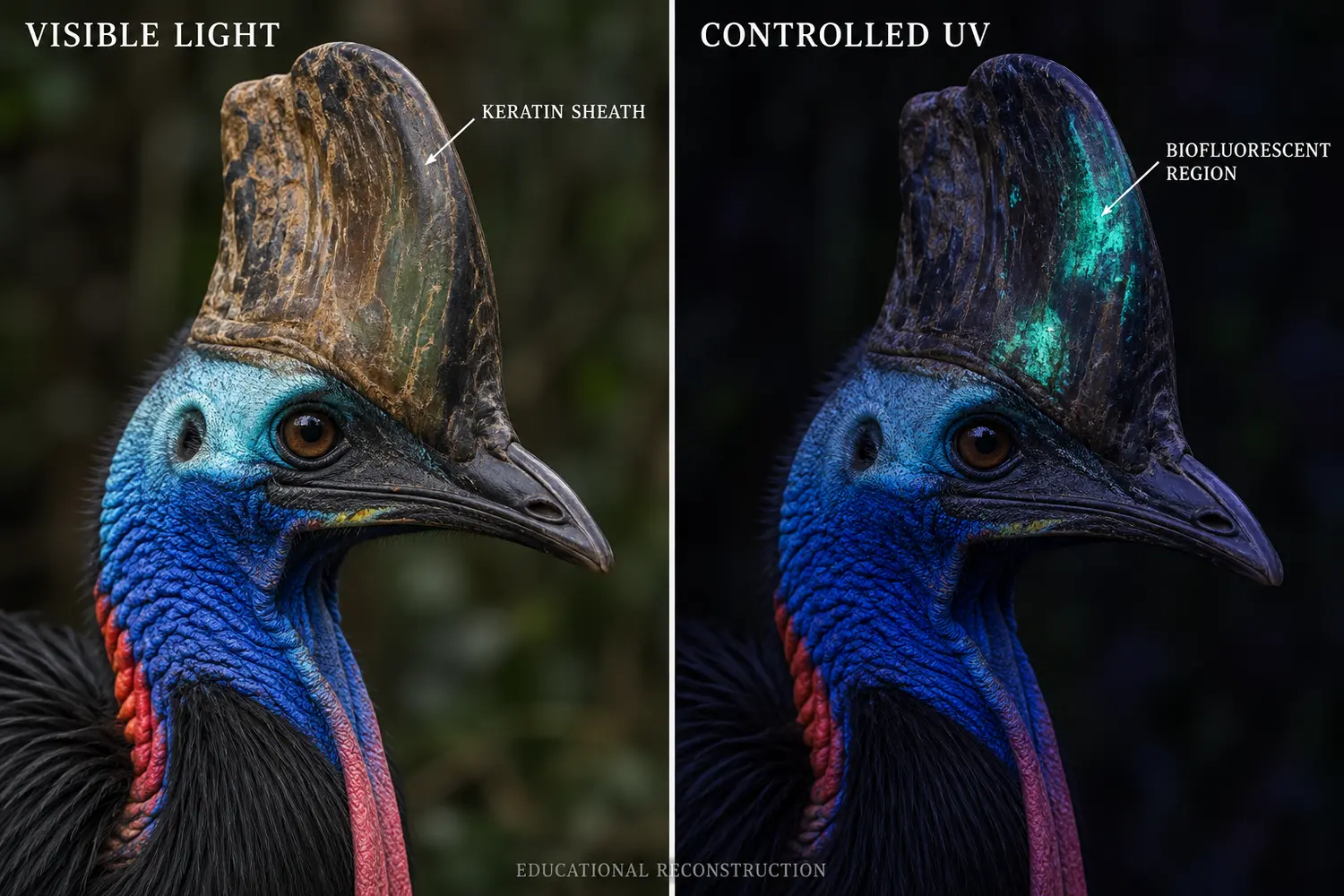
A southern cassowary already looks extraordinary in visible light: glossy black plumage, vivid blue skin, two red wattles and a tall helmet-like casque. Under controlled ultraviolet illumination, parts of that casque can reveal another feature—a blue-green biofluorescent pattern in its keratin covering.
The finding is real, but the viral version runs ahead of the evidence. The study was published in Scientific Reports on February 24, 2026, not in PLOS ONE. It demonstrated cassowary casque fluorescence and ultraviolet reflectance across three cassowary species. It did not prove that the casque acts as a secret communication beacon in a dark rainforest.
What did the 2026 cassowary study discover?
Researchers examined the heads of living cassowaries and museum specimens under ultraviolet light at 365 nanometers and 385–395 nanometers. They found that the keratin sheath covering the casque could absorb UV energy and re-emit some of it as visible blue or green light. That process is called biofluorescence.
The team also used a UV-sensitive camera to test reflectance. Casque keratin reflected 365-nanometer UV—a wavelength within the visual sensitivity range attributed to cassowaries and many other birds. Fluorescence and reflectance are related to ultraviolet light, but they are not the same phenomenon:
- Biofluorescence occurs when a material absorbs shorter-wavelength light and re-emits it at a longer wavelength.
- UV reflectance means ultraviolet light bounces from the surface without being converted in the same way.
Both findings make the casque more visually complex than it appears to human eyes. Whether a wild cassowary perceives that complexity as a social signal remains an open question.
Which cassowaries were tested?
The genus Casuarius contains three living species: the dwarf cassowary (Casuarius bennetti), southern cassowary (Casuarius casuarius) and northern cassowary (Casuarius unappendiculatus). The study included all three.
For its main statistical analysis, the research team used 86 preserved specimens: 32 dwarf cassowaries, 46 southern cassowaries and eight northern cassowaries. Living birds were photographed separately because different camera equipment prevented those images from being pooled into the same quantitative analysis.
The patterns differed among species. Dwarf cassowary casques were generally nonfluorescent, apart from a minimal patch in one tested specimen. Southern cassowaries tended to show fluorescence toward the rear of the casque. Northern cassowaries showed more forward or extensive patterns, with variation between subspecies and individuals.
This species-level difference is one reason researchers are interested in possible visual roles. It may also help identify incomplete museum specimens or assist field surveys. Neither use requires assuming that cassowaries consciously send coded messages with their casques.
Does the casque glow naturally in the rainforest?
The laboratory observation does not mean a cassowary shines like a neon sign in ordinary forest light. The vivid experimental images were produced using controlled UV sources, selected camera settings and, for some published figure images, a yellow filter and adjusted contrast or color balance to depict the fluorescence clearly.
Natural visibility depends on more than whether a material can fluoresce. Researchers would need to measure the UV spectrum and intensity reaching birds in different habitats and at different times—direct sun, closed canopy, dawn, dusk and overcast conditions. They would also need visual models based on cassowary eyes and behavioral tests showing that birds respond to the patterns.
The 2026 authors explicitly said their observations could not confirm whether cassowaries detect the species-specific casque patterns under natural lighting. Describing the feature as a proven “secret beacon” therefore turns a plausible hypothesis into an established fact.
Can cassowaries see ultraviolet light?
Bird vision often extends into wavelengths that humans cannot see. Cassowaries belong to the palaeognath lineage, which also includes emus, ostriches, rheas, kiwis and tinamous. Evidence about their retinal pigments supports sensitivity into the ultraviolet range.
That makes UV reflectance biologically relevant: the birds potentially have the sensory equipment needed to perceive it. But sensory capacity alone does not demonstrate communication. A signal also needs to be available in the environment, detectable against its background and connected to a receiver’s behavior.
In other words, “can perceive UV” and “uses casque UV patterns to communicate” are different scientific claims. The first has supporting visual physiology; the second still requires field and behavioral evidence.
What is a cassowary casque made of?
The casque is not a solid horn or a hollow plastic-like cap. It combines an internal bony core with an external keratinous sheath. Keratin is the structural material found in bird beaks, claws and feathers, as well as mammalian hair and nails.
Under visible light, southern cassowary casque keratin can appear brown, green, dark gray or black in different regions. The 2026 work linked some of those visible colors with areas that fluoresced under the tested UV wavelengths. It also detected variable fluorescence in parts of the beak covering.
Casque shape varies between species and substantially among individual southern cassowaries. Earlier anatomical work found frequent left-right asymmetry, so an idealized perfectly straight casque should not be treated as the universal form.
What does the casque do?
Scientists have proposed several roles over many decades, including display, sound-related functions, protection while moving through vegetation and thermoregulation. Evidence is not equally strong for every proposal, and the casque may perform more than one task.

A thermal window
A separate 2019 study used infrared thermography on 20 living adult southern cassowaries across a range of ambient temperatures. The casque behaved as a thermal window: its surface became warmer relative to the environment at high temperatures, supporting heat release, while heat loss was restricted in cooler conditions.
This thermoregulatory evidence does not conflict with the new UV result. Biological structures often have multiple roles. A casque could participate in heat exchange while also presenting visual information, but each function needs its own evidence.
A visual display
Cassowary species differ in average casque shape, and the 2026 study found species-specific fluorescence patterns. Those observations are consistent with a possible display role in recognizing species, potential mates or rivals. “Consistent with” is the important phrase: no experiment has yet shown a cassowary changing its behavior because of a casque’s UV pattern.
Other proposed roles
The idea that the casque works as a resonance chamber for low-frequency calls has been discussed, but anatomical studies have questioned a simple acoustic-amplifier explanation. Claims that it acts mainly as a crash helmet or vegetation-clearing battering ram also need caution. Cassowaries move through dense vegetation, but that fact alone does not identify the casque’s primary evolutionary function.
Is the southern cassowary really the world’s most dangerous bird?
The phrase is a popular label, not a scientific ranking. Southern cassowaries are powerful, flightless birds with strong legs and a long inner claw on each foot. They can cause serious injury when threatened, habituated to food or defending chicks. That makes respectful distance essential.
However, attacks are unusual compared with the number of peaceful encounters. A Queensland review found that many recorded incidents involved birds previously fed by people. Feeding encourages cassowaries to approach humans and may lead to aggressive food-seeking behavior, vehicle strikes or the bird being removed or killed.
Queensland authorities advise people never to feed or approach cassowaries, never to approach chicks, keep dogs controlled, secure food waste and move away calmly while placing a solid object between themselves and the bird if necessary. The UV discovery does not make cassowaries more dangerous; it simply reveals another feature of their biology.
Why southern cassowaries matter to rainforests
Southern cassowaries eat fruit from many rainforest plants and carry seeds away from parent trees. Large fruits that smaller animals cannot swallow make them particularly important seed dispersers. Their movement helps connect plant populations and supports forest regeneration.
Conservation labels require geographic context. The species is considered Least Concern globally by the IUCN, but Australia’s southern cassowary population (C. c. johnsonii) is listed as Endangered under federal law. In Queensland, habitat loss and fragmentation, vehicle strikes and dog attacks remain major concerns.
The distinction prevents two opposite errors: treating the entire species as globally endangered, or assuming a global Least Concern category means vulnerable regional populations need no protection.
What the study proves—and what it does not
The evidence supports four careful conclusions:
- Cassowary casque keratin can biofluoresce under controlled ultraviolet illumination.
- The casque can reflect 365-nanometer UV light.
- Fluorescent coverage and distribution differ among cassowary species and individuals.
- The observed patterns create a credible hypothesis for visual signaling.
It does not yet show that a southern cassowary’s casque glows conspicuously under every rainforest canopy, that birds use it as a beacon, or that it carries a specific social message. Those questions require natural-light measurements and behavioral experiments.
The real result is compelling without exaggeration: a structure that looks dull to human eyes contains species-linked optical patterns in a part of the spectrum cassowaries may perceive. It is a new clue to a casque whose full story is still being uncovered.
Frequently asked questions
Do cassowary casques glow in the dark?
No. Biofluorescence requires incoming light, such as ultraviolet illumination. It is not bioluminescence and does not generate light independently in darkness.
Was the UV study published in PLOS ONE?
No. The full research article was published in Scientific Reports on February 24, 2026.
Is the whole southern cassowary fluorescent?
The study focused on keratin of the casque and parts of the beak. It did not report the bird’s entire body glowing under UV.
Does the casque help a cassowary cool down?
Separate thermographic research supports a thermal-window function. The casque released more heat at high ambient temperatures and conserved heat in cooler conditions.
Sources
- Scientific Reports: Ultraviolet light illuminates species-specific biofluorescent casque patterns in cassowaries
- Scientific Reports: Cassowary casques act as thermal windows
- Ornithology: Species-specific casque shapes in the genus Casuarius
- Queensland Government cassowary safety guidance
- Australian Government: Southern cassowary conservation