
A cat can move each outer ear independently, often aiming a pinna toward a sound before the head begins to turn. This rapid movement helps the ear collect direction-dependent acoustic information, but the familiar claims that every cat has “32 independent muscles in each ear” and can rotate each ear through an exact 180 degrees need context.
The visible ear flap—the pinna—is a mobile, cartilage-supported funnel. Muscles around its base pull it forward, backward, outward or downward. The ears do not identify a sound source by themselves; they change the sound reaching the ear canals, while the auditory system also compares timing, intensity and spectral differences between the two ears.
Why do cats move their ears?
Mobile pinnae help cats sample their acoustic surroundings without first moving the whole head or body. That is useful for an animal that may need to notice a quiet prey animal, another cat or a potential threat while remaining still.
Researchers have measured feline pinna movement with magnetic search coils while trained cats oriented to sounds. The ears showed a short-latency response linked to sound onset and a later movement that accompanied orientation toward the target. In other words, an ear flick can be part of the sensory response itself, not simply a visible sign that the cat has already decided where to look.
The pinna also changes the spectrum of an incoming sound according to its direction. Experiments that altered pinna position changed the transfer of sound into the ear canal, and behavioral work found that cats use pinna-shaped spectral cues when judging where a sound originated—especially its elevation.
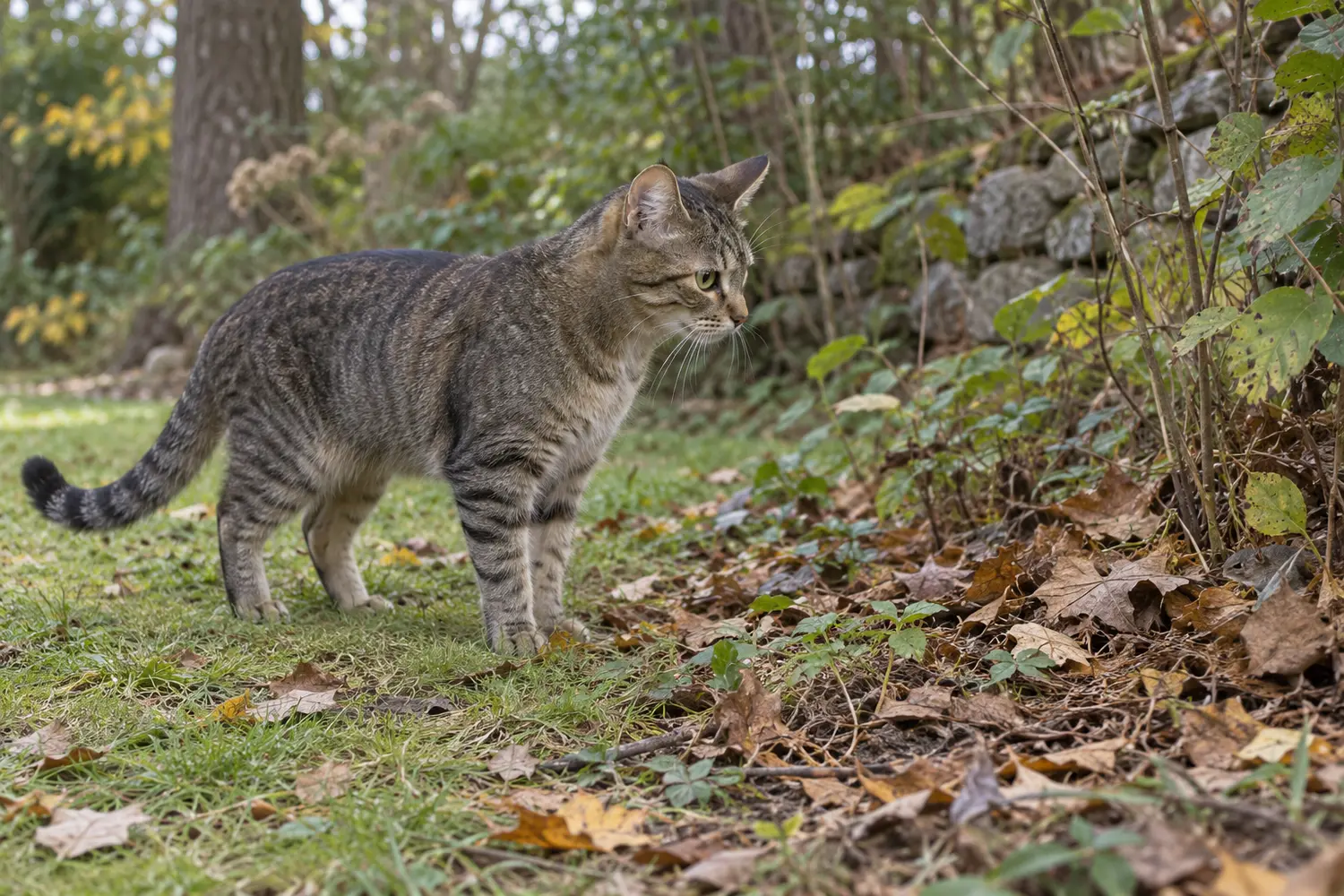
What part of the ear moves?
A cat’s ear has three main regions: the outer, middle and inner ear. The mobile portion people see is the pinna, part of the outer ear. It gathers sound and channels it down the external ear canal toward the eardrum. Vibrations then pass through the small bones of the middle ear to the cochlea in the inner ear, where they are converted into nerve signals.
The inner ear also houses the vestibular apparatus involved in balance. That does not mean the visible ear flap controls balance; hearing and balance share the inner-ear region but rely on different sensory structures.
The pinna is made mainly of elastic cartilage covered by skin and fur. Small skeletal muscles attach around its base. Coordinated contractions change the ear’s angle and shape. The facial nerve supplies the muscles that move the pinna, while auditory information travels through the vestibulocochlear nerve.
Do cats really have 32 muscles in each ear?
The number 32 is widely repeated by veterinary and pet-health sources, including VCA Animal Hospitals, which says cats have 32 muscles controlling each ear. However, anatomical counts depend on what is treated as a separate muscle, subdivision or muscular slip. Standard anatomical descriptions often organize the auricular muscles into groups and may list fewer named muscles than popular summaries.
So “32 muscles” is best treated as a commonly cited anatomical count—not proof that there are 32 entirely independent motors acting in isolation. Ear movement is coordinated by nerves and muscle groups. A cat does not consciously operate dozens of muscles one by one.
Can a cat rotate its ears 180 degrees?
Cats can sweep their pinnae through a broad range and point the ears in noticeably different directions. Yet an exact 180-degree rotation should not be treated as a fixed measurement for every cat, every ear or every posture.
“Rotation” can describe different things: the direction the opening faces, movement around the base, or the total arc between extreme forward and backward positions. Published sound-localization studies measure ear position and timing, but they do not establish a universal 180-degree maximum for all cats. Ear shape, age, muscle tone, attention and individual anatomy all influence the visible range.
The accurate takeaway is simpler: feline pinnae are highly mobile and can move independently enough to sample sounds from different directions while the head remains relatively still.
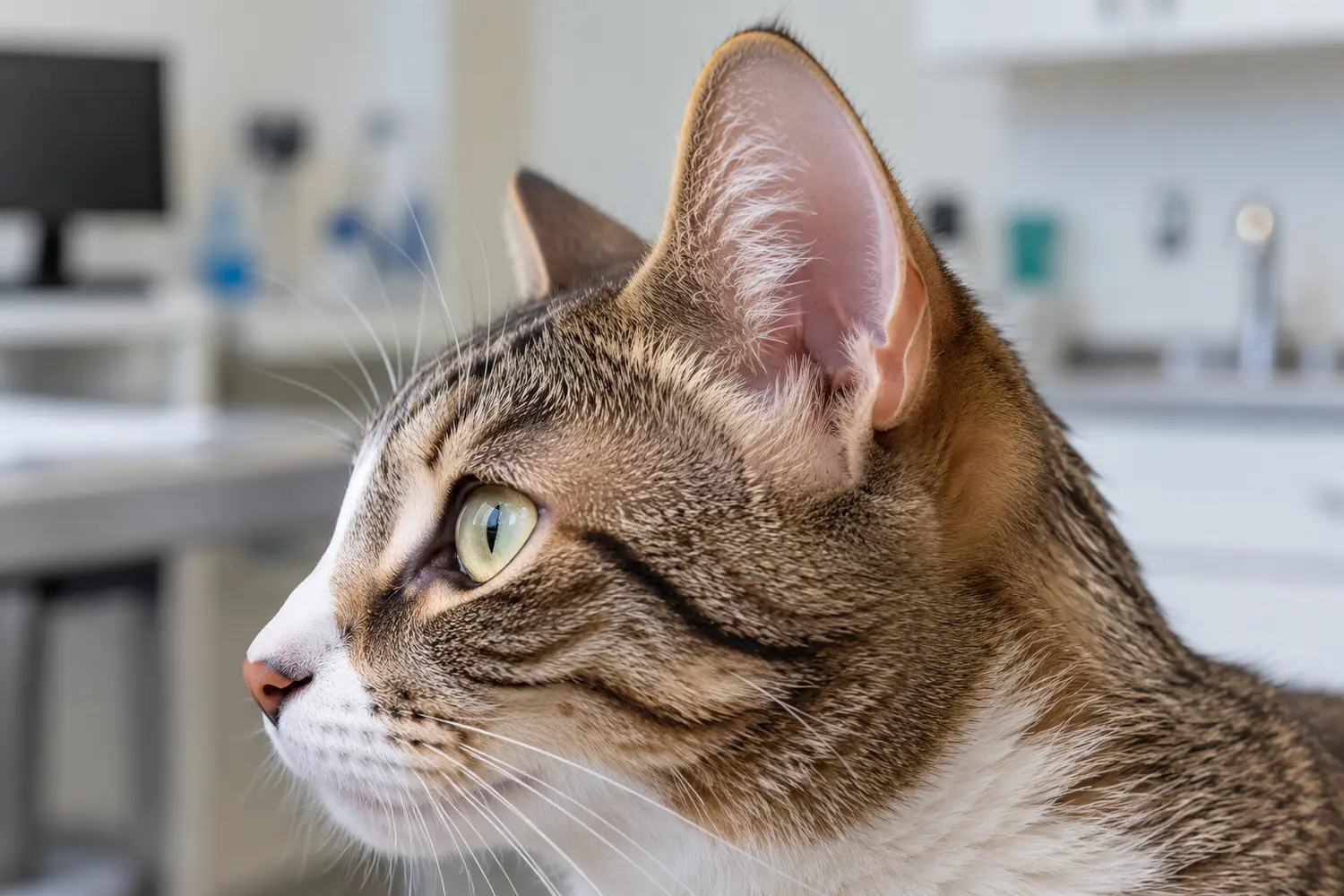
How moving ears help locate sound
Sound localization is a combined calculation rather than a single “radar” function. Cats can use several cues:
- Interaural time differences: a sound from one side may reach the nearer ear slightly earlier.
- Interaural level differences: the head can reduce the sound level reaching the farther ear, especially at higher frequencies.
- Pinna-based spectral cues: the ear flap’s folds filter frequencies differently depending on the sound’s direction.
- Movement: changing ear or head position provides another sample and can reduce ambiguity.
The two ears may point differently because the cat is sampling more than one direction or tracking a moving source. An ear turned sideways is not necessarily malfunctioning. Context matters: a relaxed cat may casually monitor the room, while a hunting cat may repeatedly swivel the pinnae before shifting its gaze or body.
How good is a cat’s hearing?
Cats hear frequencies well above the upper limit of typical human hearing. Cornell University’s Feline Health Center notes that people generally hear up to around 20,000 cycles per second, while cats may detect 60,000 cycles per second or more. Sensitivity varies with the individual and with test methods, and high-frequency hearing may decline with age or disease.
High-frequency sensitivity is useful for detecting the calls and movements of small prey. It does not mean a cat hears every quiet sound from an unlimited distance. Loudness, background noise, distance, obstacles, frequency and the cat’s attention all affect detection.
Ear direction also communicates mood
Cat ears are sensory structures and expressive signals. Forward-facing