
A cheetah vs Boerboel comparison places two African mammals side by side, but they are not natural rivals. The cheetah is a wild cat shaped by evolution for short, agile pursuits. The Boerboel is a domesticated, mastiff-type dog developed in South Africa as a versatile farm and guardian dog.
That distinction matters. Viral posters often turn the comparison into a hypothetical fight and attach precise bite-force numbers to both animals. Those claims are not a sound way to compare them. A more useful approach is to ask how each animal’s body, behavior and history suit a very different job.
Cheetah vs Boerboel at a glance
| Trait | Cheetah | Boerboel |
|---|---|---|
| Scientific identity | Acinonyx jubatus, a wild felid | Canis lupus familiaris, a domestic dog breed |
| Primary adaptation | Short, agile pursuits of prey | Farm companionship, guarding and controlled power |
| Build | Light, long-limbed and flexible | Substantial, muscular and balanced |
| Behavioral context | Wild predator with species-specific social patterns | Domestic dog whose behavior depends on genetics, socialization and handling |
| Responsible comparison | Anatomy, locomotion, behavior and history—not staged conflict | |
The cheetah is built for acceleration and turning
Cheetahs are famous for speed, but peak speed alone does not explain how they hunt. A field study using high-resolution tracking collars recorded a maximum of 25.9 meters per second—about 93 kilometers per hour. Yet most observed hunts involved more moderate speeds. The study highlighted exceptional acceleration, braking and turning performance rather than a simple top-speed contest.
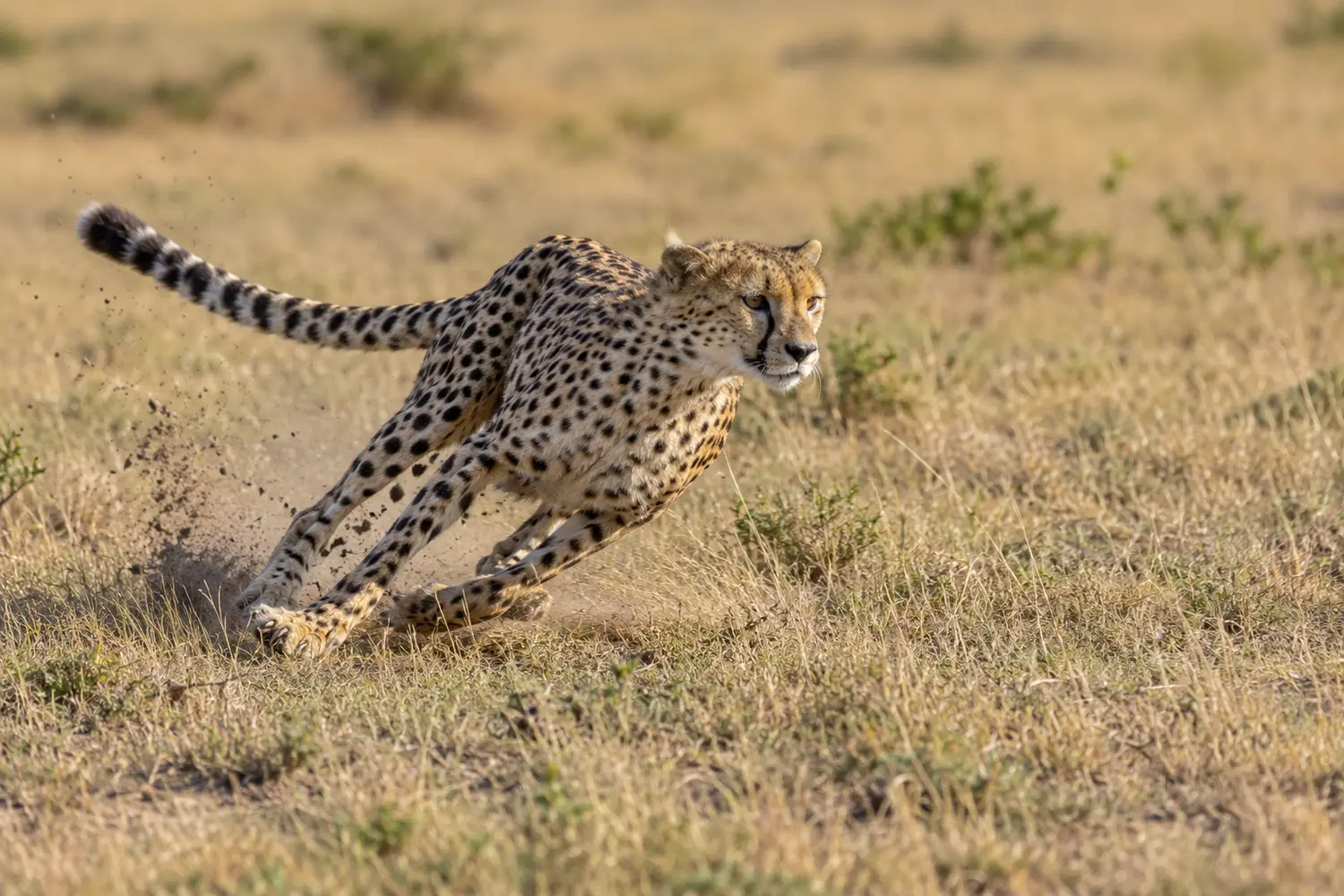
The body behind that performance is highly specialized. Long limbs increase stride length, while a flexible spine allows the trunk to extend and gather during a gallop. The feet provide traction, and the long tail helps manage balance as the animal changes direction. Research on wild hunts also shows that cheetahs slow near the end of a chase so they can match a prey animal’s sharp turns.
This is not unlimited endurance. A cheetah’s high-intensity pursuit is brief, and a successful hunt depends on selecting an opportunity, closing distance and controlling the final maneuver. Describing the animal as merely a “100-kilometer-per-hour cat” misses much of the biology.
The Boerboel is a substantial working dog
The Boerboel was developed in South Africa as a general farm dog. Official breed standards emphasize a large, strong and muscular animal that should remain balanced and mobile. The American Boerboel Club describes the desired temperament as intelligent, manageable, protective and willing to please, while kennel standards emphasize a calm, stable and confident character.

Those words do not mean every individual behaves identically. A dog’s temperament is influenced by breeding, early experience, training, health and environment. Because Boerboels are powerful dogs, responsible ownership requires secure management, careful socialization and reward-based training. Their physical strength is a management responsibility, not evidence that they should be tested against wildlife.
Why bite-force numbers are misleading
The source poster assigned fixed figures of 475 pounds per square inch to the cheetah and 700 PSI to the Boerboel. Those numbers should not be treated as verified species or breed averages.
Bite measurements depend on what is being measured, the tooth position, the animal’s size, motivation and the method used. Direct measurements, pressure sensors and computer estimates do not produce interchangeable values. A precise-looking number circulating without a transparent study design is not a reliable basis for ranking animals.
For the same reason, “raw power” is too vague to be scientific. The cheetah’s skeleton and muscles support rapid locomotion and prey capture. The Boerboel’s robust frame reflects domestic selection for a substantial working dog. Neither description creates a valid single scale of superiority.
Would a cheetah and Boerboel fight?
There is no biologically useful “winner.” Cheetahs are wild animals that generally reduce risk when they can, while a well-managed domestic dog should not be allowed to pursue wildlife. Any forced encounter would be dangerous, unethical and highly dependent on individual circumstances.
In areas where dogs and wild carnivores overlap, separation and prevention are the responsible goals. Secure fencing, supervision and local wildlife guidance protect the dog, the wild animal and people.
Conservation and ownership are different responsibilities
Cheetah conservation concerns wild populations, habitat, prey, connectivity and conflict with people. A Boerboel, by contrast, depends entirely on human care. Prospective owners should evaluate local rules, housing, insurance, training access and whether they can safely manage a large guardian breed throughout its life.
The shared African association is real, but it should not erase the fundamental distinction: one is a specialized wild predator; the other is a domesticated working dog.
Frequently asked questions
Is a cheetah faster than a Boerboel?
Yes. The cheetah is specialized for short high-speed pursuits. A Boerboel is athletic for a large dog but was not developed for sprinting at cheetah speeds.
Does a Boerboel have a 700 PSI bite?
There is no dependable standardized evidence that establishes 700 PSI as a breed-wide average. Bite-force claims need a transparent method, sample and measurement context.
Are cheetahs and Boerboels closely related?
No. The cheetah belongs to the cat family, Felidae. The Boerboel is a domestic dog in the family Canidae.
Which animal is stronger?
“Stronger” has no single scientific meaning here. The cheetah is highly specialized for acceleration and maneuverability; the Boerboel has the heavier, more robust build expected of a large working dog.
References
- Wilson et al. — Locomotion dynamics of hunting in wild cheetahs
- Wilson et al. — Cheetahs, Acinonyx jubatus, balance turn capacity with pace when chasing prey
- Hudson et al. — Functional anatomy of the cheetah hindlimb
- American Boerboel Club — Official breed standard
- Kennel Union of Southern Africa — Boerboel breed standard