
A cheetah is faster than a Greyhound at peak speed, but the viral “100 meters versus 500 meters” story is not a scientifically established race result. Both animals are elite sprinters, yet their speed figures come from different settings: wild hunting runs, controlled biomechanics trials and organized dog races.
A fair comparison therefore asks what has actually been measured, how each animal produces speed and why maximum velocity alone cannot predict every hypothetical race.
Cheetah vs Greyhound speed at a glance
Tracking collars on five wild cheetahs in Botswana recorded 367 mainly hunting runs. The highest measured speed was 25.9 meters per second, equal to about 93 kilometers per hour or 58 miles per hour. Most hunts, however, occurred at more moderate speeds. The animals also produced exceptional acceleration, braking and turning forces.
Scientific literature on racing Greyhounds commonly reports short-duration speeds around 17 meters per second, about 61 kilometers per hour. A later track study found a typical dog accelerating to just under 19.5 meters per second—roughly 70 kilometers per hour—between 80 and 150 meters into a race.
These measurements support the broad conclusion that the cheetah has the higher peak-speed capacity. They do not support treating 120 km/h for every cheetah or 72 km/h for every Greyhound as guaranteed performance.
How cheetahs produce extraordinary speed
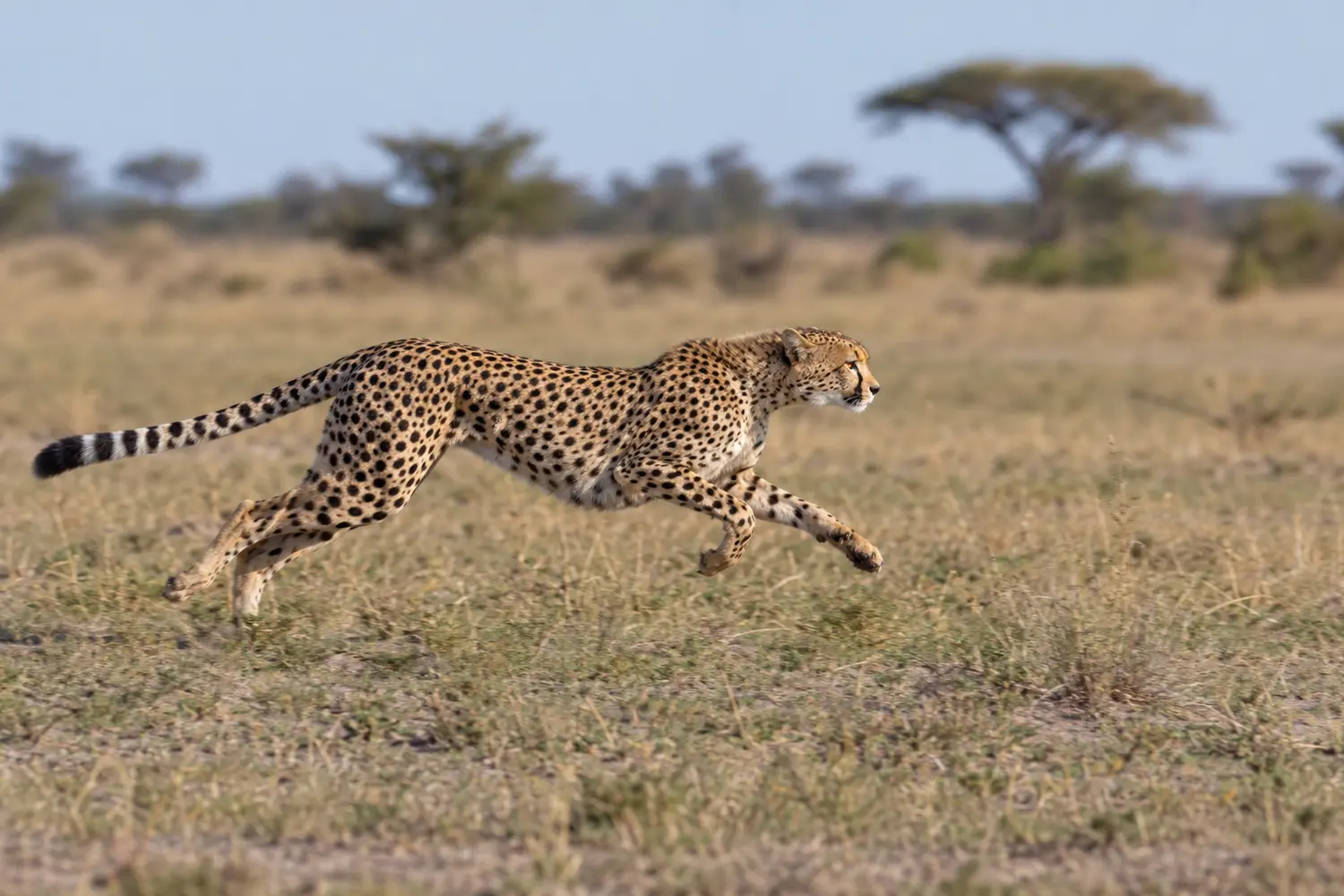
The cheetah’s body combines long limbs, a flexible spine, powerful back muscles and a gallop that includes airborne phases. During rapid running, spinal flexion and extension lengthen the stride. Its limbs cycle quickly, while the tail helps stabilize the body during directional changes.
Comparative biomechanics show that cheetahs and Greyhounds use high-speed gallops differently. Cheetahs can reach higher stride frequencies and place a larger share of body support on their hindlimbs at high speed. Their anatomy also reflects the need to accelerate, decelerate and turn while pursuing unpredictable prey.
That last point matters. A hunt is not a straight-line time trial. Data from free-ranging cheetahs show that they often reduce speed near the end of a chase so they can match sharp escape turns. Success depends on grip, acceleration and maneuverability as well as velocity.
Why Greyhounds are exceptional canine sprinters
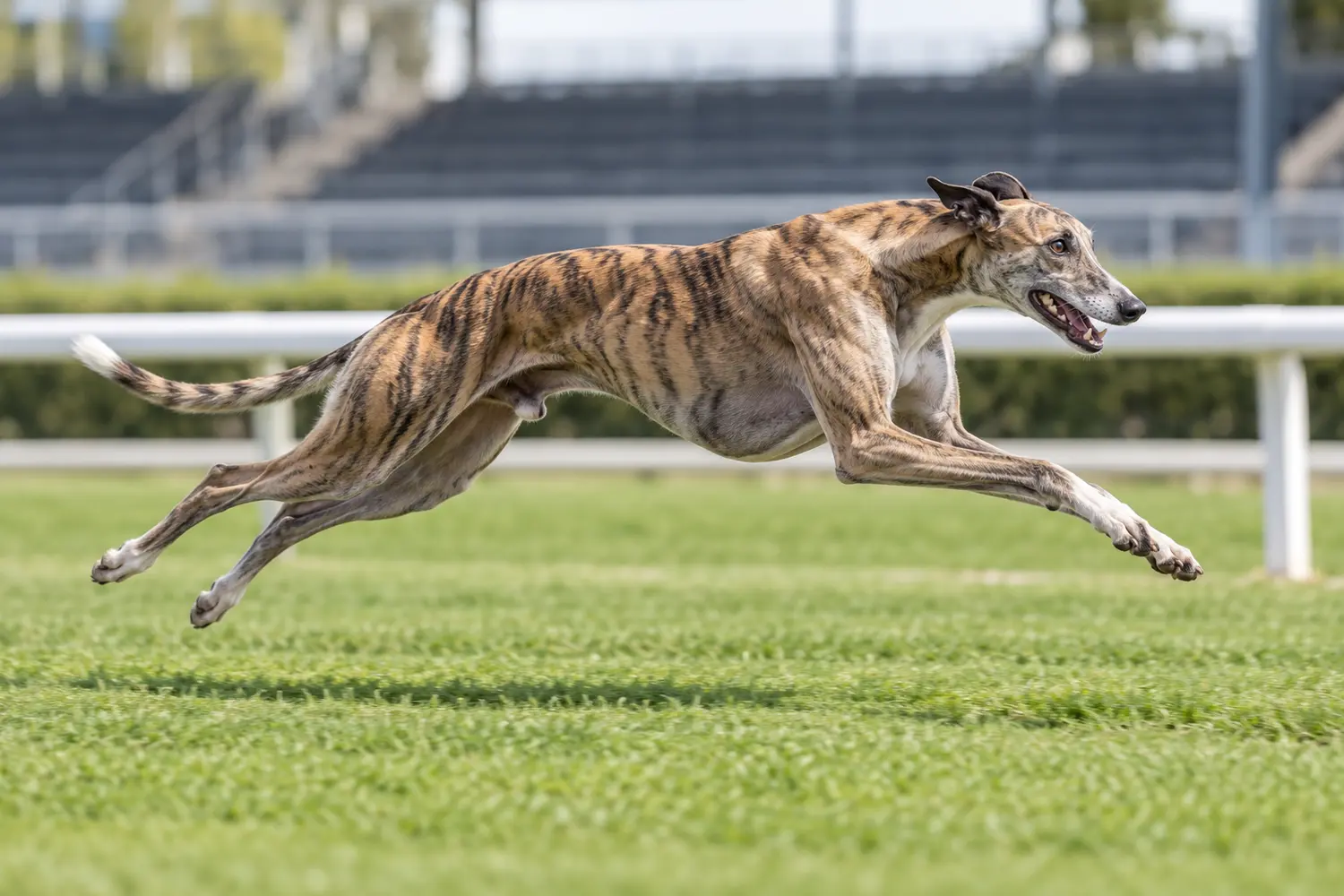
Greyhounds have undergone intense artificial selection for high-speed running. Their deep chest, long limbs, relatively light frame and flexible back support a double-suspension gallop in which all four feet can leave the ground twice during a stride cycle.
Anatomical studies describe substantial sprint specializations in both the front and rear limbs. Powerful muscles near the hips and shoulders generate and control movement, while long distal limb segments help the feet travel quickly. Researchers have also documented how racing Greyhounds alter limb mechanics when accelerating.
Unlike a wild cheetah pursuing prey over irregular ground, racing Greyhounds run on prepared tracks and follow an artificial lure. Track design, curves, surface, fitness, age and individual condition all affect recorded speed. That is why one headline number cannot represent every dog or every race.
Would a Greyhound win a longer race?
The claim that a Greyhound automatically wins beyond 400 or 500 meters is plausible-sounding but oversimplified. It usually combines a cheetah’s short hunting efforts with a Greyhound’s track-racing ability, then turns those observations into a race outcome that has not been established under controlled, matched conditions.
Distance alone is not enough to predict the result. The answer would depend on pace, temperature, track surface, curves, motivation, starting method and the health and training of the individual animals. A cheetah may not choose to sustain a maximum-effort run without the context of hunting, while a Greyhound is conditioned to chase a lure around a track.
The responsible conclusion is narrower: cheetahs have the higher measured top speed and remarkable maneuverability; racing Greyhounds are exceptionally fast dogs capable of maintaining competitive speeds around a track. Science does not provide a universal distance at which the winner must switch.
Are the acceleration claims reliable?
Statements that a cheetah reaches 100 km/h in exactly three seconds are often repeated without enough context. Wild-field studies confirm extraordinary forward acceleration, but performance varies among runs and individuals. A single automotive-style “zero to 100” figure should not be treated as a biological constant.
The same caution applies to claims that a Greyhound reaches top speed in exactly six strides. Stride count changes with the dog, starting speed, surface and what researchers define as top speed. Measured acceleration mechanics are more informative than a viral fixed number.
Frequently asked questions
What is the fastest measured cheetah speed in the wild?
A collar-based field study recorded 25.9 meters per second, approximately 93 km/h. Most hunting runs were slower than that maximum.
How fast can a racing Greyhound run?
Published studies report around 17 m/s for short periods, while track-position data have measured typical maximum racing speed just below 19.5 m/s. Results vary with the dog and conditions.
Are cheetahs and Greyhounds closely related?
No. A cheetah is a wild cat in the family Felidae; a Greyhound is a domestic dog in the family Canidae. Their similar sprinting silhouettes are examples of different lineages evolving or being selected for high-speed locomotion.
References
- Wilson et al.: Locomotion dynamics of hunting in wild cheetahs
- Wilson et al.: Cheetahs balance turn capacity with pace when chasing prey
- Hudson et al.: High-speed galloping in the cheetah and racing Greyhound
- Williams et al.: Functional anatomy of the racing Greyhound pelvic limb
- Williams et al.: Functional anatomy of the racing Greyhound thoracic limb
- Hayati et al.: Racing Greyhound path-following dynamics