
A chicken egg looks simple from the outside, but beneath the shell is a layered biological system that protects a developing embryo, supplies water and nutrients, allows respiratory gases to diffuse, and helps keep the yolk correctly oriented. Each structure has a particular role, from the microscopic pores in the shell to the twisted chalazae around the yolk.
This guide explains chicken egg anatomy without treating the egg as a sealed capsule or a miniature mechanical device. The shell does not actively breathe, the air cell does not pump oxygen, and the white spot on every yolk is not automatically an embryo.
What are the main parts of a chicken egg?
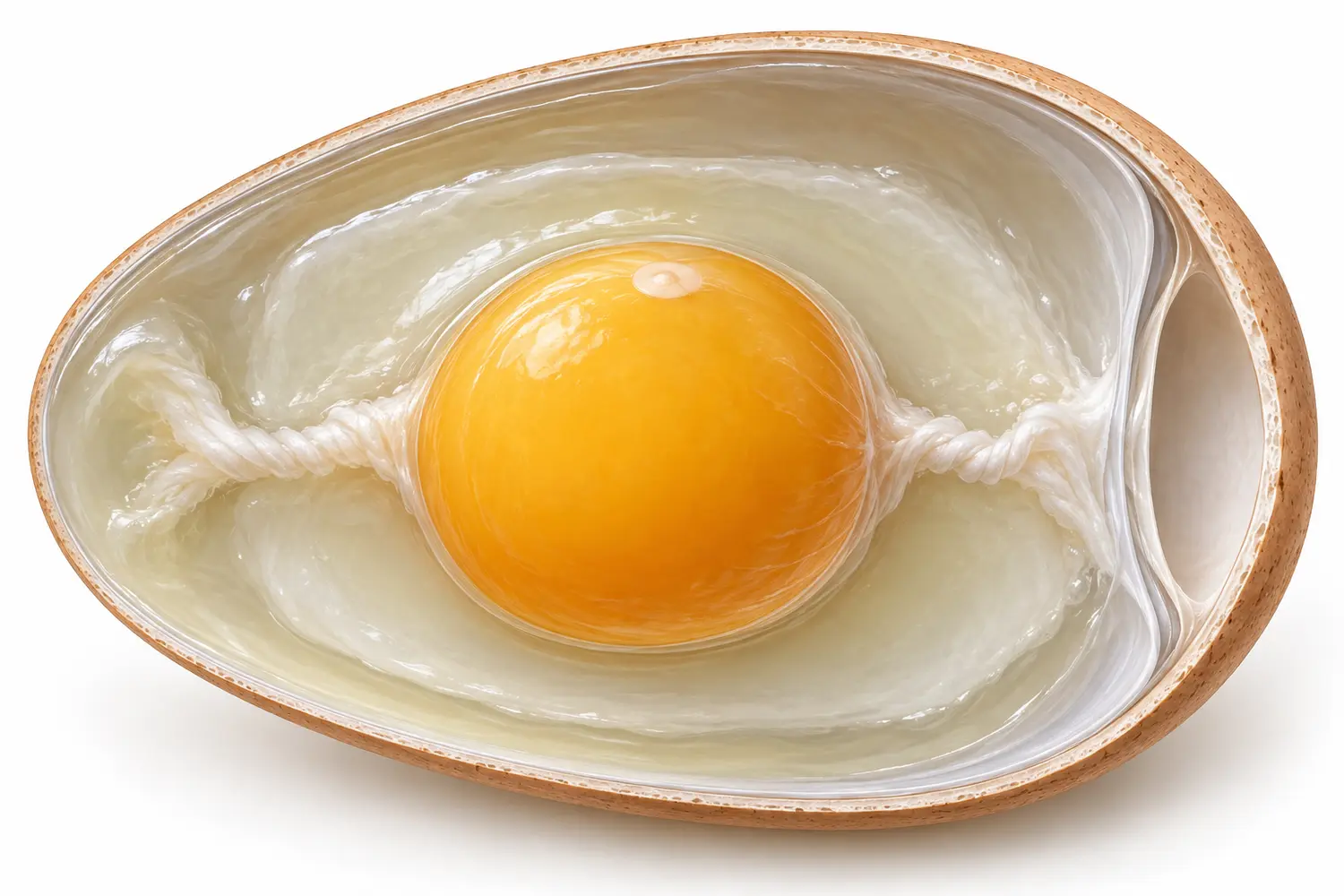
A freshly laid chicken egg can be divided into four broad components: the shell and its outer cuticle, the two shell membranes, the albumen or egg white, and the yolk. Within those regions are specialized structures including the air cell, chalazae, vitelline membrane and germinal disc.
From outside to inside, the principal parts are:
- the protein-rich cuticle;
- the calcium-carbonate shell and its pores;
- the outer and inner shell membranes;
- the air cell at the broad end;
- thin and thick layers of albumen;
- the paired chalazae;
- the vitelline membrane;
- the nutrient-rich yolk; and
- the germinal disc on the yolk’s upper surface.
How does the eggshell protect the contents?
The hard shell is built mainly from calcium carbonate crystals arranged within an organic matrix. Its curved form distributes force efficiently, helping it withstand the normal pressures of laying, nesting and incubation. Strength still varies with shell thickness, mineralization, hen age, diet, health and handling. An eggshell is protective, not indestructible.
At the shell surface is the cuticle, a thin protein-rich coating deposited late in egg formation. It helps limit microbial attachment and penetration and modifies the movement of water and gases through the shell. The cuticle does not create a sterile barrier, and it can vary in thickness and coverage between eggs.
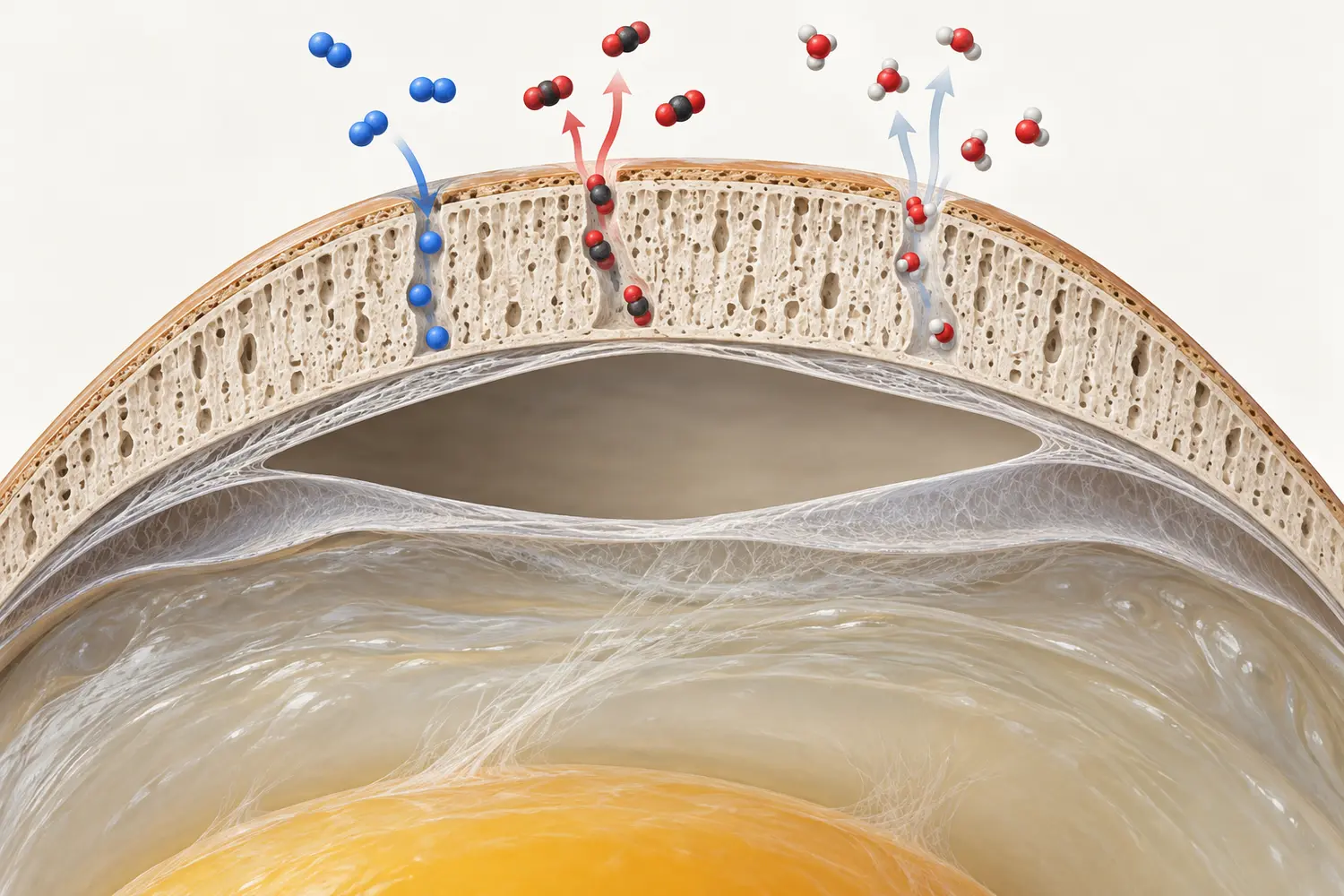
The mineral shell contains thousands of microscopic pore channels. These pathways allow oxygen to diffuse inward while carbon dioxide and water vapor diffuse outward during incubation. The exact number, dimensions and distribution of pores vary, so a single pore count should not be presented as universal for every chicken egg.
What do the shell membranes do?
Immediately beneath the shell are two fibrous layers called the outer and inner shell membranes. They help contain the albumen and add another physical barrier against microorganisms. Their fibers also provide a framework on which the mineral shell is formed while the egg is still inside the hen’s oviduct.
The membranes usually lie close together over most of the egg. At the broad end, however, they separate after laying to create the air cell. They do not serve as lungs and do not actively move gases; diffusion occurs in response to concentration and pressure gradients across the shell system.
Why does a chicken egg have an air cell?
The contents of a newly laid egg are warmer than the surrounding air. As they cool, their volume contracts slightly. Air enters through shell pores, and the two shell membranes separate at the blunt end, forming a pocket called the air cell.
During incubation, water loss enlarges this space. Near hatching, a chick typically breaks through the inner shell membrane into the air cell, an event called internal pipping. The temporary air supply helps bridge the transition before the chick opens the shell and begins breathing external air more directly.
Air-cell size is also used when eggs are candled for quality assessment because it generally increases with storage time and moisture loss. It is not, by itself, a perfect clock: storage temperature, humidity, shell conductance and individual egg characteristics all influence its size.
How does gas exchange happen through a solid shell?
The shell feels solid to human fingers but is microscopically porous. During development, the embryo consumes oxygen and produces carbon dioxide and water. Differences in concentration drive these gases through the pore channels. The shell’s conductance must balance two competing needs: providing enough respiratory exchange while limiting excessive water loss and microbial entry.
The cuticle and material within pore openings contribute to that balance. They can reduce bacterial penetration while still permitting the movement of gases and water vapor. Gas exchange is therefore a property of the shell, cuticle, membranes and surrounding environment—not a task controlled by the air cell alone.
What is albumen, and why are there several layers?
Albumen is the egg white. It is mostly water but also contains proteins, minerals and other molecules. Rather than being one uniform liquid, a fresh egg has regions of thicker and thinner albumen. These layers cushion the yolk, supply water and protein to a developing embryo, and help separate the yolk from the shell.
Albumen proteins also contribute to chemical defense. Some bind nutrients that bacteria need, while others can damage microbial membranes or inhibit enzymes. These defenses reduce risk rather than guaranteeing that an egg cannot become contaminated.
As an egg ages, carbon dioxide escapes and the albumen’s chemistry changes. Thick white gradually becomes less firm, which is why an older egg spreads farther when cracked onto a flat surface. That change is useful for estimating freshness, but it does not by itself determine whether an egg is safe to eat.
What are chalazae?
Chalazae are twisted, cord-like strands of dense albumen extending from opposite sides of the yolk. Their spiral structure helps suspend the yolk within the surrounding white and permits it to rotate rather than remaining rigidly fixed.
This arrangement helps keep the germinal disc oriented toward the upper side of the yolk. Chalazae are normal anatomy, not developing embryos or foreign tissue. They tend to be more obvious in fresh eggs because the albumen is firmer.
What holds the yolk together?
The yolk is enclosed by the vitelline membrane, a transparent but organized layer that separates yolk material from the albumen. A strong membrane helps the yolk retain its rounded shape when the egg is opened.
Over time, water can move from the albumen into the yolk. The yolk enlarges and the vitelline membrane becomes weaker, making an older yolk more likely to flatten or rupture. This is a storage-related physical change, not evidence that the egg was fertilized.
What does the yolk provide?
The yolk stores much of the egg’s energy, lipids, vitamins, pigments and minerals. In a fertilized egg, the developing embryo does not simply sit inside the yolk. It grows at the germinal disc and progressively uses yolk resources through extraembryonic tissues.
The shell also contributes to development. As incubation proceeds, calcium mobilized from the inner shell helps mineralize the chick’s skeleton. The egg is therefore both a protective chamber and a finite package of materials assembled by the hen before laying.
Is the germinal disc already a chick?
No. A small pale spot called the germinal disc is present on the yolk of both fertilized and unfertilized eggs. In an unfertilized egg, it contains the hen’s reproductive cell but cannot develop into a chick on its own.
Fertilization occurs inside the hen’s oviduct before albumen, membranes and shell are deposited. If fertilization has occurred, cell division begins before the egg is laid. By laying, the developing blastoderm can already contain many cells, although continued normal development requires suitable incubation conditions.
A germinal disc in an ordinary table egg should therefore not be described as an embryo merely because it is visible. Fertility and early development are related but distinct questions.
How is the egg assembled inside the hen?
The process begins when a yolk is ovulated from the ovary. It enters the oviduct, where fertilization may occur if sperm are present. Successive regions of the oviduct add albumen, form the shell membranes and deposit the mineral shell and cuticle. The completed egg is then laid.
Shell formation requires substantial calcium, and repeated laying places physiological demands on a hen. Egg traits are influenced by genetics, age, nutrition, disease, environmental conditions and laying cycle. The egg cannot be understood independently of the bird that produced it.
For another example of chicken anatomy adapted to environmental demands, see our guide to how a chicken’s comb helps exchange heat.
Frequently asked questions
Does the shell let an embryo breathe?
Yes, but passively. Oxygen, carbon dioxide and water vapor diffuse through microscopic pores in the shell. The shell and air cell do not actively pump air.
Is the white string inside an egg a baby chick?
No. The twisted white strands are chalazae, normal albumen structures that help suspend and orient the yolk.
Does every egg contain a germinal disc?
Yes. Both fertilized and unfertilized chicken eggs have a germinal disc. Only a fertilized disc can continue developing into an embryo under suitable conditions.
Why is the air cell at the broad end?
The membranes most commonly separate there as the newly laid egg cools and its contents contract. The air cell then enlarges as moisture is lost during storage or incubation.
Are brown eggs structurally different from white eggs?
Shell color is produced by pigments and does not by itself determine nutritional value, fertility or overall strength. Breed, hen age, nutrition and shell formation have greater importance for structural quality.