
Desert warthog vs. common warthog is a comparison between two living species, not two regional names for the same animal. They can look almost identical in the field, but their ears, facial “warts,” teeth, head shape and geographic ranges reveal important differences.
Several popular descriptions get the comparison backward. The desert warthog is not a 150-kilogram giant: the IUCN Wild Pig Specialist Group describes it as slightly smaller than the common warthog and notes that reliable body measurements have not been recorded. The often-quoted 50–150 kg range belongs to the common warthog.
Desert warthog vs. common warthog at a glance
| Feature | Desert warthog | Common warthog |
|---|---|---|
| Scientific name | Phacochoerus aethiopicus | Phacochoerus africanus |
| Range | Horn of Africa and eastern Kenya | Broadly across sub-Saharan Africa |
| Relative size | Generally slightly smaller; reliable measurements lacking | About 50–150 kg in published summaries |
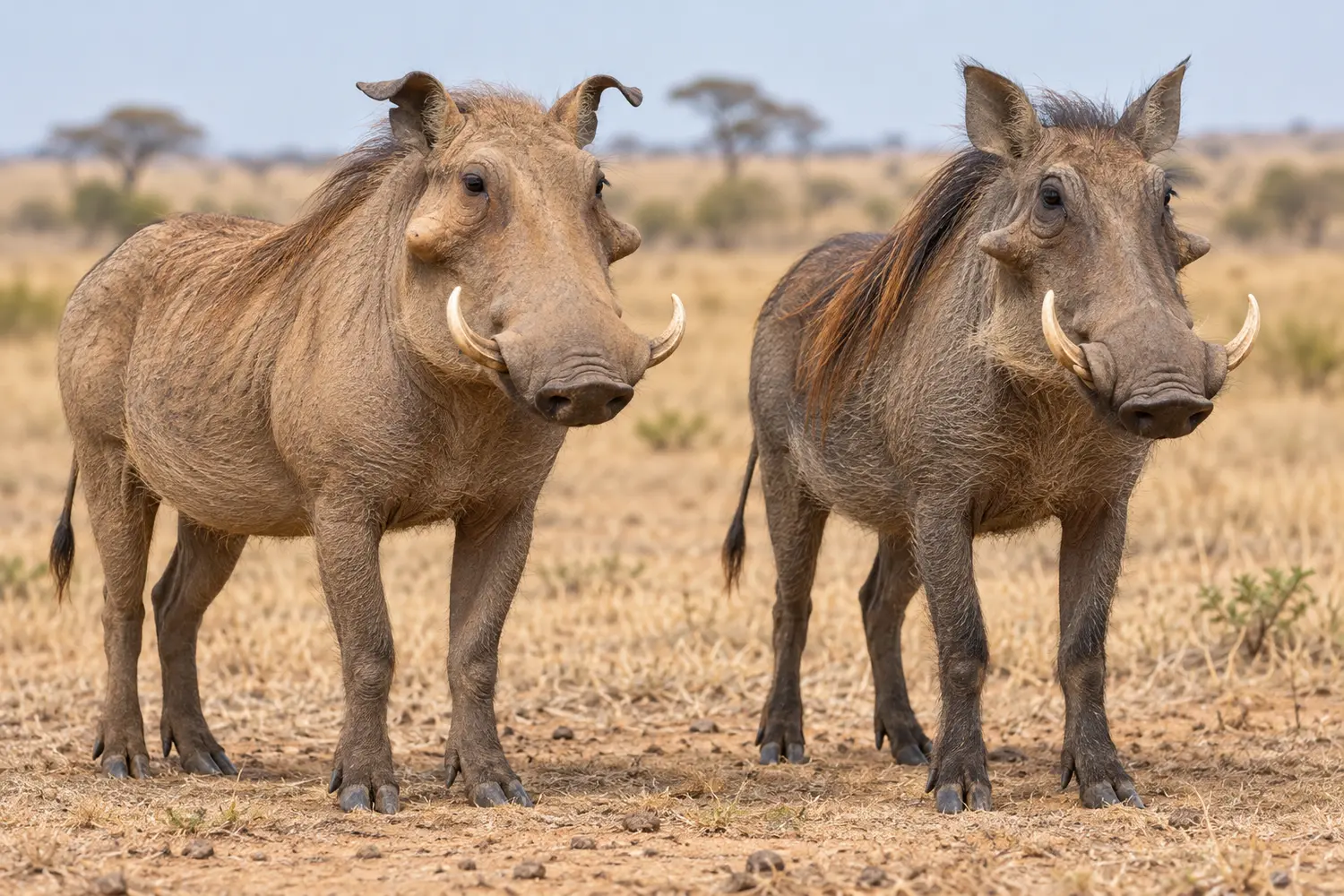
| Ear tips | Bent or flipped backward | More pointed and upright |
| Cheek warts | Hook-shaped or drooping | More cone-shaped |
| Incisors | Upper incisors absent; lower incisors absent or greatly reduced | Usually two upper and four to six lower incisors |
| Head viewed from front | More egg-shaped, with swollen areas below the eyes | More diabolo-shaped, without the same swelling |
| IUCN category | Least Concern, but poorly studied | Least Concern |
They are two genetically distinct species
For much of the twentieth century, the surviving East African desert warthogs were overlooked or confused with common warthogs. Morphological work and mitochondrial DNA later supported their recognition as separate species. Genetic research indicates that their lineages diverged millions of years ago.
The desert warthog includes the living subspecies P. a. delamerei in northeastern Africa. The nominate Cape warthog, P. a. aethiopicus, formerly occurred in southern Africa but became extinct in the nineteenth century. The common warthog remains the much more widespread and familiar species seen in safari media.
How to identify a desert warthog
The most useful field marks are concentrated around the face. Adult desert warthogs tend to have ear tips that fold backward, giving the ears a more angular outline. Their cheek or genal warts are hook-shaped or drooping rather than conical. Swelling beneath the eyes contributes to a broad, egg-shaped head when viewed from the front.
These differences are subtle. Lighting, age, sex, posture and viewing angle can all make identification difficult, and juveniles may not show every adult feature clearly. Location helps, but range alone is not always decisive because both species occur in parts of Kenya.
How to identify a common warthog
Common warthogs generally have pointed ear tips, cone-shaped cheek warts and a less swollen area below the eyes. Viewed from the front, the head has been described as diabolo-shaped—wider across the upper and lower portions and narrower through the middle.
The species also tends to have a more conspicuous mane, although coat condition changes with season and individual health. Like desert warthogs, common warthogs have sparse body hair, long tufted tails and enlarged canine teeth that form the familiar tusks.
The clearest anatomical difference is in the incisors
Desert warthogs are remarkable among living pigs because functional incisors are largely absent. Upper incisors are absent, while lower incisors may be missing or reduced to tiny teeth concealed by the gums. The animals therefore use their lips and gums to detach or pick up food.
Common warthogs usually retain two upper incisors and four to six lower incisors. That does not mean they rely only on incisors to feed. They are specialized grazers that crop short vegetation, often lowering themselves onto calloused wrist joints. Their snouts and tusks can also expose roots, bulbs and rhizomes.
The desert warthog’s molars show specialized features associated with a long working life under an abrasive diet, but its feeding ecology is surprisingly poorly documented. Claims about exact foods or extraordinary water-saving physiology should therefore be treated cautiously.
Which species is larger?
The common warthog is generally the larger of the two. Animal Diversity Web gives a broad common-warthog range of 50–150 kg, with males larger than females. That upper limit should not be presented as the normal weight of every animal.
For desert warthogs, the IUCN Wild Pig Specialist Group states that no body measurements have been recorded in a way that supports a reliable species-wide range. Available observations describe them as slightly smaller than common warthogs. The claim that desert warthogs reach 150 kg and are the larger, stockier species is therefore unsupported.
Habitat and geographic range
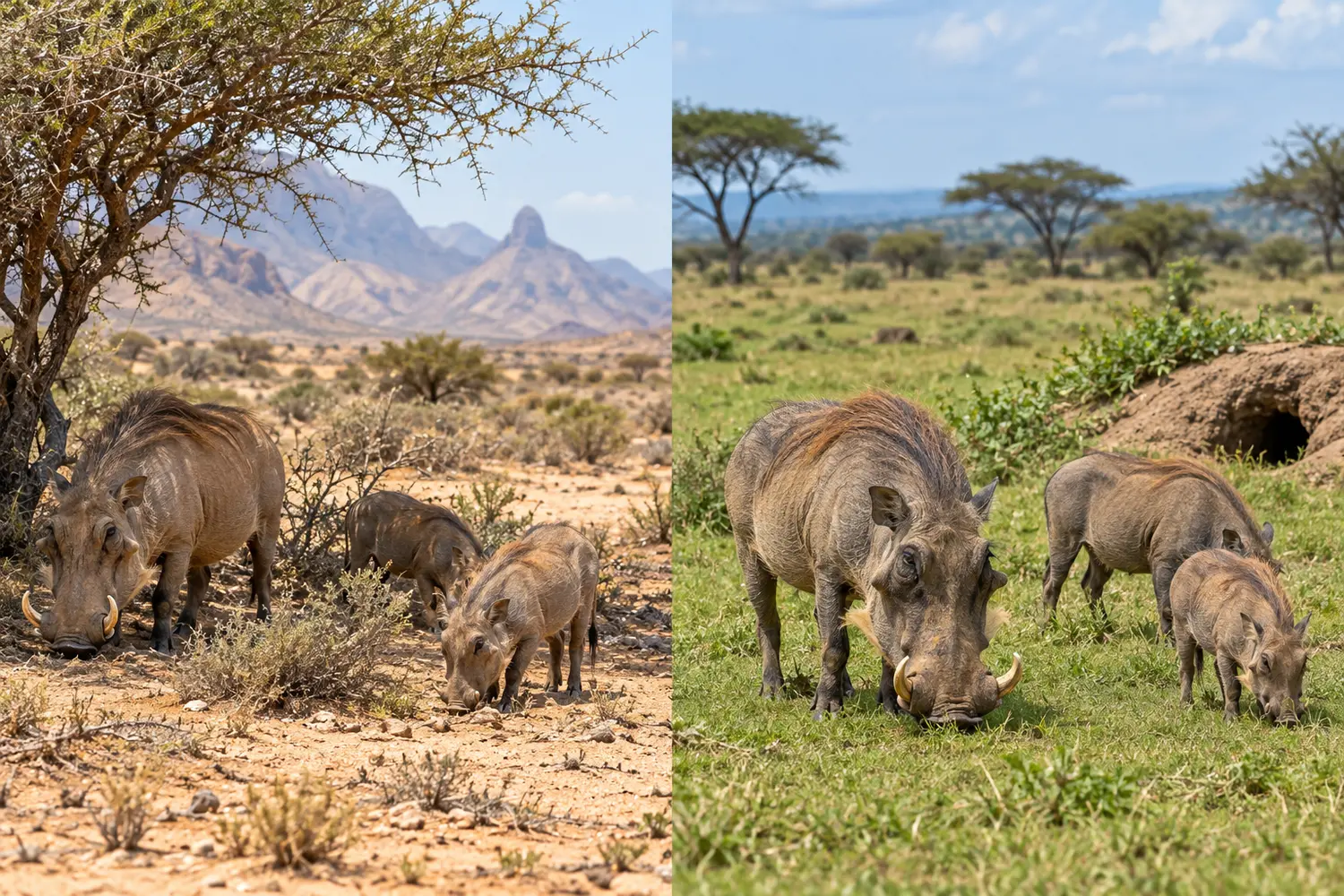
Desert warthogs occur in northwestern and southern Somalia, eastern Ethiopia and eastern Kenya. They favor open, arid plains with sandy soils, including dry bushland, semi-desert grassland and shrubland. Despite their name, they are not animals of the most waterless true deserts.
The species still depends on water and shade. Records indicate avoidance of both high-rainfall areas and the hottest, driest regions with extremely low rainfall. In some areas, desert warthogs gather near wells and adjust drinking times around human water use.
Common warthogs have a far broader distribution through grasslands, savannas and open woodlands of sub-Saharan Africa. They need access to forage, shelter and ways to regulate temperature. Mud wallows and water help them cool down, while burrows provide warmth, refuge and nursery sites.
Diet and grazing behavior
Common warthogs are primarily grazers but have a flexible diet. They eat grasses, roots, bulbs, berries and bark and may occasionally consume carrion. Kneeling on padded wrists lets them bring the mouth close to short grass without constantly bending the long forelegs.
Much less is known about the desert warthog’s diet. Its incisor loss and unusual molars suggest specialization for abrasive foods, but researchers do not yet have enough direct ecological data to describe a detailed menu. It is safer to state what the anatomy suggests than to present a speculative diet as fact.
Tusks and defense
In both species, the visible upper tusks are enlarged canine teeth. Lower canines sharpen against the upper pair. Warthogs can use these teeth in defense, but viral descriptions often exaggerate them as animals that routinely deliver fatal slashes to leopards and cheetahs.
A warthog’s first response to danger is often escape. It may run with its tail raised and use a burrow for shelter, frequently entering backward so that its head faces the entrance. If cornered, an adult can defend itself forcefully, but encounters depend on the predator, the individual warthog and the available escape route.
Tusks also have social functions. Common-warthog males typically push and strike with the head and blunter upper tusks during ritualized contests; dangerous lower tusks are used less often, and serious injuries are uncommon.
Social life and burrows
Females and young commonly live in family groups often called sounders. Adult males are more likely to be solitary or form temporary bachelor associations. Warthogs do not usually excavate elaborate dens themselves; they often occupy holes created by aardvarks or other animals.
Burrows buffer temperature and protect vulnerable piglets. Desert warthogs also spend nights in burrows, but their reproduction and social organization remain much less studied than those of the common species.
Conservation status
Both species are currently categorized as Least Concern globally. For the common warthog, a wide distribution and local abundance support that assessment, although hunting, habitat conversion and disease can affect regional populations.
The desert warthog’s category should not be mistaken for complete security. Its distribution is insufficiently known, and the species has received little focused ecological research. Overgrazing, competition for water, hunting and ivory use may create local pressure. Better surveys are needed to detect changes in range and abundance.
Frequently asked questions
Is a desert warthog bigger than a common warthog?
No evidence supports that claim. Specialist accounts describe the desert warthog as slightly smaller, while noting that reliable body measurements are unavailable.
Do desert warthogs have no teeth?
No. They lack upper incisors and have absent or greatly reduced lower incisors, but they retain canines, premolars and molars. Their tusks are modified canine teeth.
Can the two species live in the same area?
Yes. Their ranges overlap in parts of Kenya, which is why facial features and, when available, dental or genetic evidence are important.
Are their facial warts real warts?
They are thick pads of connective tissue rather than viral skin warts. They are especially developed in adult males and may provide protection during contests.