
Dogo Argentino vs. Cane Corso comparisons involve two powerful working breeds developed for different jobs. The Dogo Argentino is a white, athletic pack hunter created in Argentina for pursuing large game. The Cane Corso is an Italian mastiff traditionally used to guard property, family and livestock, with historical roles in farm work and hunting. Both need experienced ownership, but their structure, coat, instincts and daily management are not interchangeable.
Dogo Argentino vs. Cane Corso at a glance
| Feature | Dogo Argentino | Cane Corso |
|---|---|---|
| Origin | Argentina | Italy |
| Traditional role | Pack hunting of large game | Property, family and livestock guardian; versatile farm dog |
| FCI male height | 60–68 cm | 64–68 cm, with ±2 cm tolerance |
| FCI male weight | Approximately 40–45 kg | 45–50 kg |
| Typical build | Athletic, balanced and powerful | Robust, rectangular and muscular |
| Coat | Short and white | Short; several solid and brindle colors |
| Key management issue | Prey drive and energetic working needs | Protective instincts and territorial management |
Breed standards describe ideals rather than guarantees for every dog. Sex, bloodline, health, conditioning and individual temperament create variation. A responsible comparison therefore uses ranges and working tendencies instead of turning either breed into a stereotype.
Which breed is bigger?
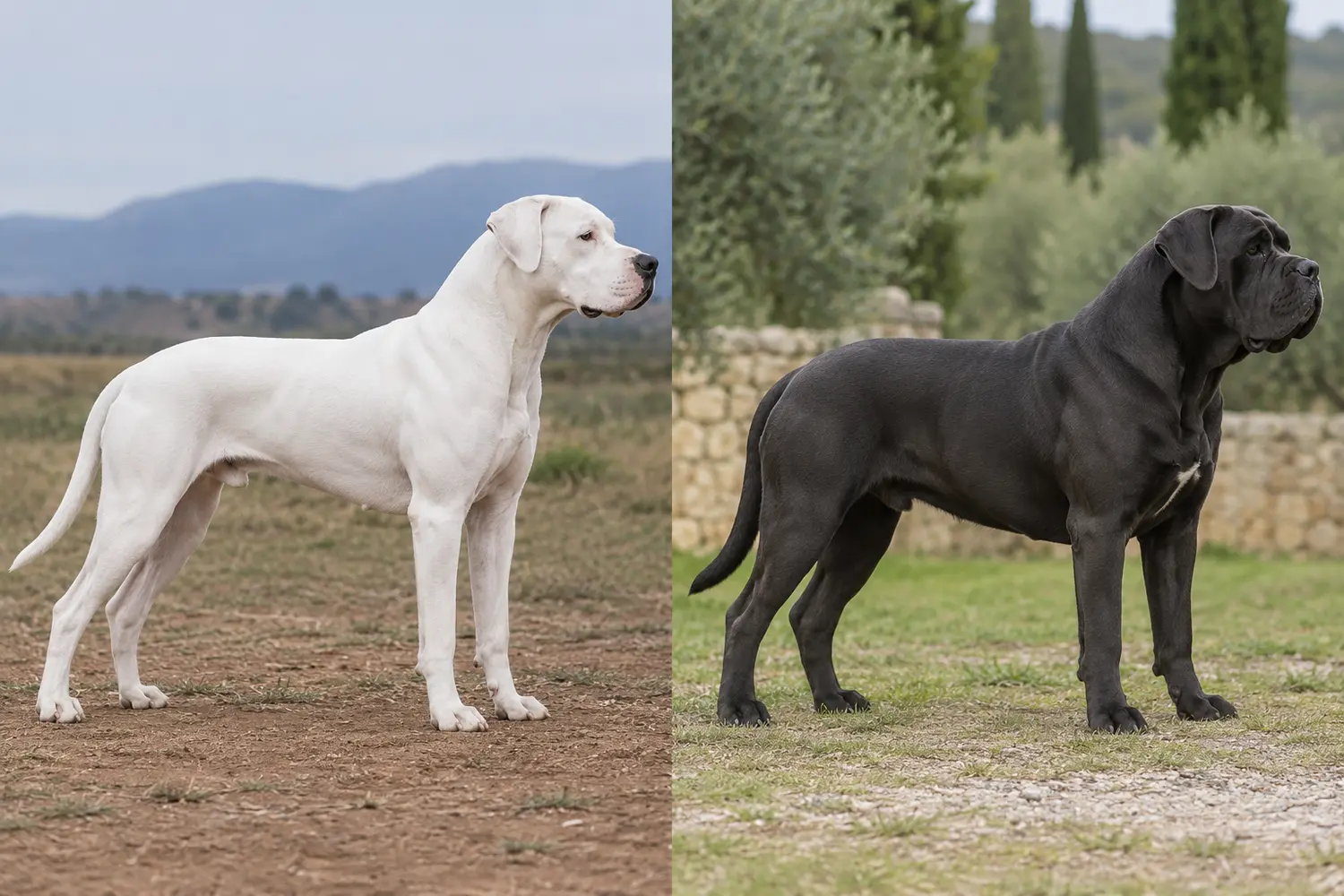
Under current Fédération Cynologique Internationale standards, the Cane Corso is usually heavier. Male Cane Corsi are listed at 45–50 kg and females at 40–45 kg. Male Dogo Argentinos are approximately 40–45 kg and females 40–43 kg. Their height ranges overlap substantially: Dogo males measure 60–68 cm at the withers, while Cane Corso males measure 64–68 cm with a tolerance of 2 cm above or below.
The numbers do not tell the whole story. The Dogo should look athletic and harmoniously proportioned, with a body only slightly longer than tall. The Cane Corso has a more obviously molossoid head and a robust rectangular outline. It is sturdy rather than cumbersome, and the FCI standard still emphasizes agility and responsiveness.
Body, head and coat differences
The Dogo Argentino has a relatively longer muzzle: its standard calls for a muzzle about the same length as the skull. The Cane Corso has a much shorter, square muzzle, approximately half the length of the skull. This makes the Corso’s head appear broader and more compact, while the Dogo’s profile looks more streamlined.
Coat makes identification straightforward. A Dogo Argentino is entirely white, although one dark patch on the head may be permitted within the standard. Cane Corsi may be black, several shades of gray or fawn, red, wheat-colored, or brindle, with rules governing masks and small white markings.
Natural ears differ, too. The Dogo has medium, broad ears that hang against the cheeks, while the Corso has triangular drooping ears set above the cheekbones. Both dogs can be recognized without cosmetic cropping or tail docking; the images in this article show natural ears and tails.
Different working histories
Antonio Nores Martínez deliberately developed the Dogo Argentino in Córdoba during the early 20th century. His breeding program combined the Old Fighting Dog of Córdoba with several other breeds to produce an athletic, cooperative pack dog with scenting ability, courage and stamina. The traditional quarry included wild boar and puma. Our full Dogo Argentino history and ownership guide explains that development in detail.
The Cane Corso belongs to Italy’s mastiff tradition. The FCI traces it to the old Roman Molossian and describes its name as deriving from cohors, associated with protecting or guarding the farmyard. The breed guarded property, family and livestock; historically it also herded cattle and hunted large game. Calling it only a “Roman war dog” leaves out centuries of practical rural work.
Temperament: hunting drive vs. guarding instinct
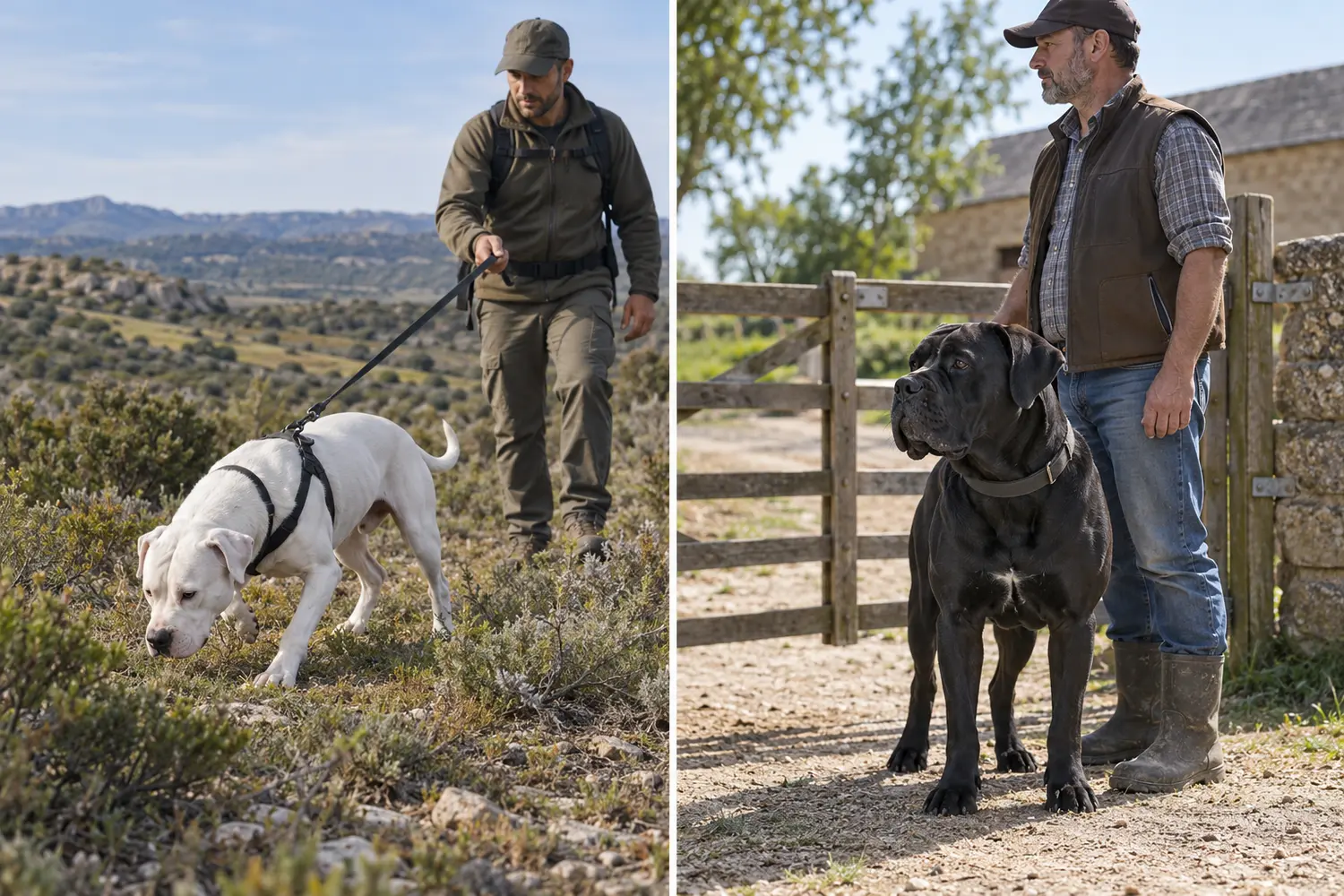
A Dogo Argentino was selected to locate, pursue and hold large quarry while working with people and other dogs. That background can appear today as athletic intensity, persistence and a strong interest in moving animals. It does not mean every Dogo has identical prey drive or that the breed should be encouraged to chase wildlife or neighborhood pets.
A Cane Corso was selected to notice changes around a property and respond to perceived threats. Well-managed dogs can be stable and devoted to their families, but a natural tendency to watch strangers is not the same as automatic judgment. Without broad socialization and trained responses, protective behavior can become difficult to control.
Neither breed should be described as inherently aggressive toward people. The FCI standards disqualify aggressive or excessively shy individuals, and the Dogo standard specifically states that human aggression is unacceptable. At the same time, these are large, physically capable dogs. Genetics, early experience, pain, training, supervision and the home environment all affect behavior.
Why the 700 PSI claim is unreliable
Online comparisons often assign the Cane Corso a 700 PSI bite and give the Dogo Argentino another precise number. Peer-reviewed veterinary literature does not support treating those viral breed figures as standardized specifications. Studies use different methods, including voluntary bites on transducers, electrically stimulated muscles, skull-based equations and finite-element models.
Results change with body size, skull shape, tooth position, gape angle, motivation and the measuring device. In one review, awake dogs produced highly variable forces because willingness to chew the sensor differed among individuals. Force measured in newtons also cannot be converted into a universal PSI value without defining the changing contact area. Breed-versus-breed PSI leaderboards therefore create false precision.
Head shape and jaw structure still matter biologically, but they do not predict an individual dog’s temperament or make one breed a guaranteed winner in a confrontation. Responsible ownership is far more relevant than an imaginary maximum bite.
Exercise and training needs
Both breeds need daily physical activity, mental work and consistent reinforcement-based training. The Dogo often benefits from structured outlets such as scent games, tracking-style exercises, hiking, obedience, rally or other activities that use its athleticism without rehearsing uncontrolled chasing. Reliable recall and secure containment are especially important.
The Cane Corso needs exercise but also careful training around entrances, visitors, handling and public neutrality. Rewarding calm observation, teaching a place cue and practicing controlled greetings are more useful than encouraging indiscriminate suspicion. AKC guidance notes that the breed is generally better suited to experienced owners who can provide early training, socialization and ongoing mental stimulation.
Harsh punishment can add fear or conflict to already powerful dogs. Training should build predictable choices and cooperation. A qualified, reward-based trainer can help owners create a plan before problems develop, while a veterinary behaviorist is appropriate for serious fear or aggression.
Health screening priorities
For Dogo Argentinos, the national breed club recommends hip evaluation, a cardiac examination and BAER hearing testing. BAER is important because a dog deaf in one ear may appear to hear normally in everyday life. Responsible breeders should provide actual test results rather than saying their dogs are simply “vet checked.”
Cane Corso health protocols include hip, elbow, cardiac and patellar evaluations plus DNA tests for breed-relevant conditions such as neuronal ceroid lipofuscinosis and dental-skeletal-retinal anomaly. No screening program guarantees a problem-free puppy, but transparent results improve decision-making.
Prospective owners should also discuss bloat risk, orthopedic care, healthy growth and maintaining a lean body condition with a veterinarian. A heavier dog is not automatically a better example of either breed.
Which breed fits which home?
The Dogo Argentino may suit an experienced, active owner prepared to manage prey drive, provide substantial engagement and verify hearing and orthopedic health. The Cane Corso may suit an experienced owner seeking a serious guardian temperament and willing to invest in public neutrality, visitor routines and lifelong socialization.
Neither is an ideal default choice for a first-time owner. Household animals, children, local breed restrictions, insurance rules, secure fencing, access to professional training and the specific dog’s background all deserve consideration. Breed alone cannot guarantee compatibility.
Frequently asked questions
Is a Cane Corso larger than a Dogo Argentino?
The official height ranges overlap, but the Cane Corso standard lists a higher male weight range. Individual dogs can fall near either end of their standard, so the difference is not absolute.
Which breed is more protective?
The Cane Corso has the more specialized property-guardian history. Dogos can also be protective of their families, but their defining traditional work is coordinated big-game hunting. Individual temperament and training remain crucial.
Who would win in a fight?
There is no responsible or useful answer. Staging or encouraging dog fights is cruel and dangerous, while speculative predictions ignore individual variation. The meaningful comparison is which breed’s needs an owner can meet safely.
Sources
- FCI Standard No. 292 — Dogo Argentino
- FCI Standard No. 343 — Cane Corso Italiano
- American Kennel Club — Dogo Argentino History
- American Kennel Club — Is the Cane Corso a Good Fit?
- Frontiers in Veterinary Science — Bite Forces and Their Measurement in Dogs and Cats
- Dogo Argentino Club of America — Health Statement
- Cane Corso Association of America — Health Testing