
Domestic donkeys and onagers are both members of the horse family, but they are not simply tame and wild versions of the same animal. The domestic donkey descends primarily from African wild asses, while the onager is an Asiatic wild ass adapted to deserts, semi-deserts and steppes.
That distinction matters when comparing their speed, behavior and relationship with people. Viral graphics often describe the donkey as a slow “workhorse” carrying 30 percent of its body weight and the onager as an untamable 70 km/h runner. The speed estimate has published support, but the universal load limit does not.
Donkey vs onager at a glance
| Feature | Domestic donkey | Onager |
|---|---|---|
| Scientific identity | Equus africanus asinus | Equus hemionus; Persian onager is E. h. onager |
| Origin | Domesticated from African wild-ass lineages | Wild equid native to parts of Asia |
| Typical role | Companion, pack, draft and agricultural animal | Wild grazer and browser |
| Habitat | Human-managed environments worldwide | Desert, semi-desert and steppe |
| Published upper speed | No reliable universal figure for all breeds and conditions | About 70 km/h in published secondary references |
What is a domestic donkey?
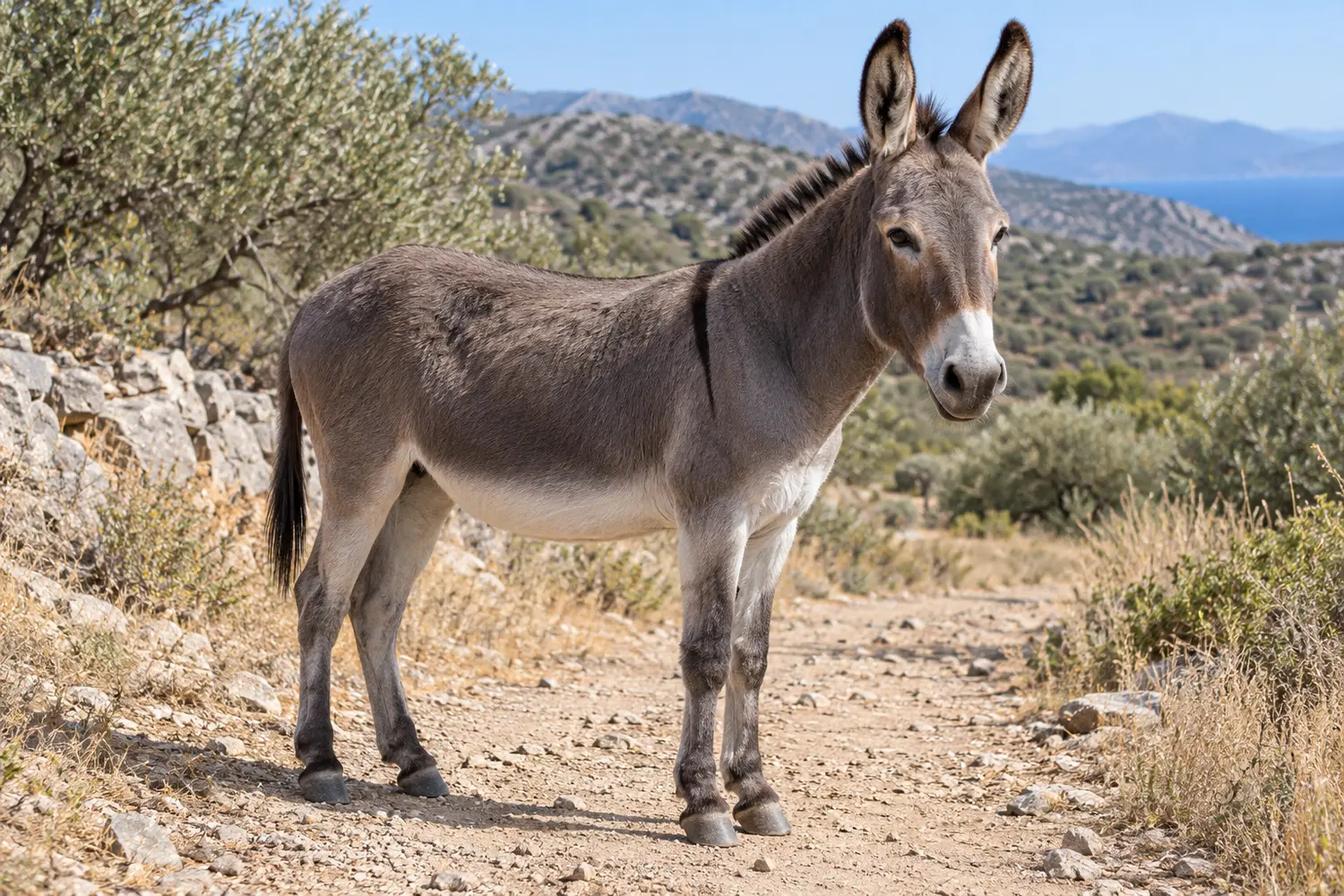
The domestic donkey is a domesticated equid, not a small horse. Donkeys have their own body proportions, metabolism, vocal communication and behavioral responses. Their long ears assist hearing and heat dissipation, while compact hooves and careful foot placement can be useful on dry, uneven ground.
For thousands of years, people have used donkeys for carrying, pulling and transport. However, that history does not justify treating any donkey as capable of carrying a fixed percentage of body weight. A 2024 equine welfare review states that research is limited and there is no accurate, science-based permissible load limit that applies generally to donkeys.
Safe work depends on the animal’s size, age, fitness, health, conformation, hoof condition, terrain, temperature, distance, speed, tack fit and how the load is balanced. A percentage such as 20 or 30 percent may appear in practical guidance, but it should never replace an individual welfare assessment.
What is an onager?
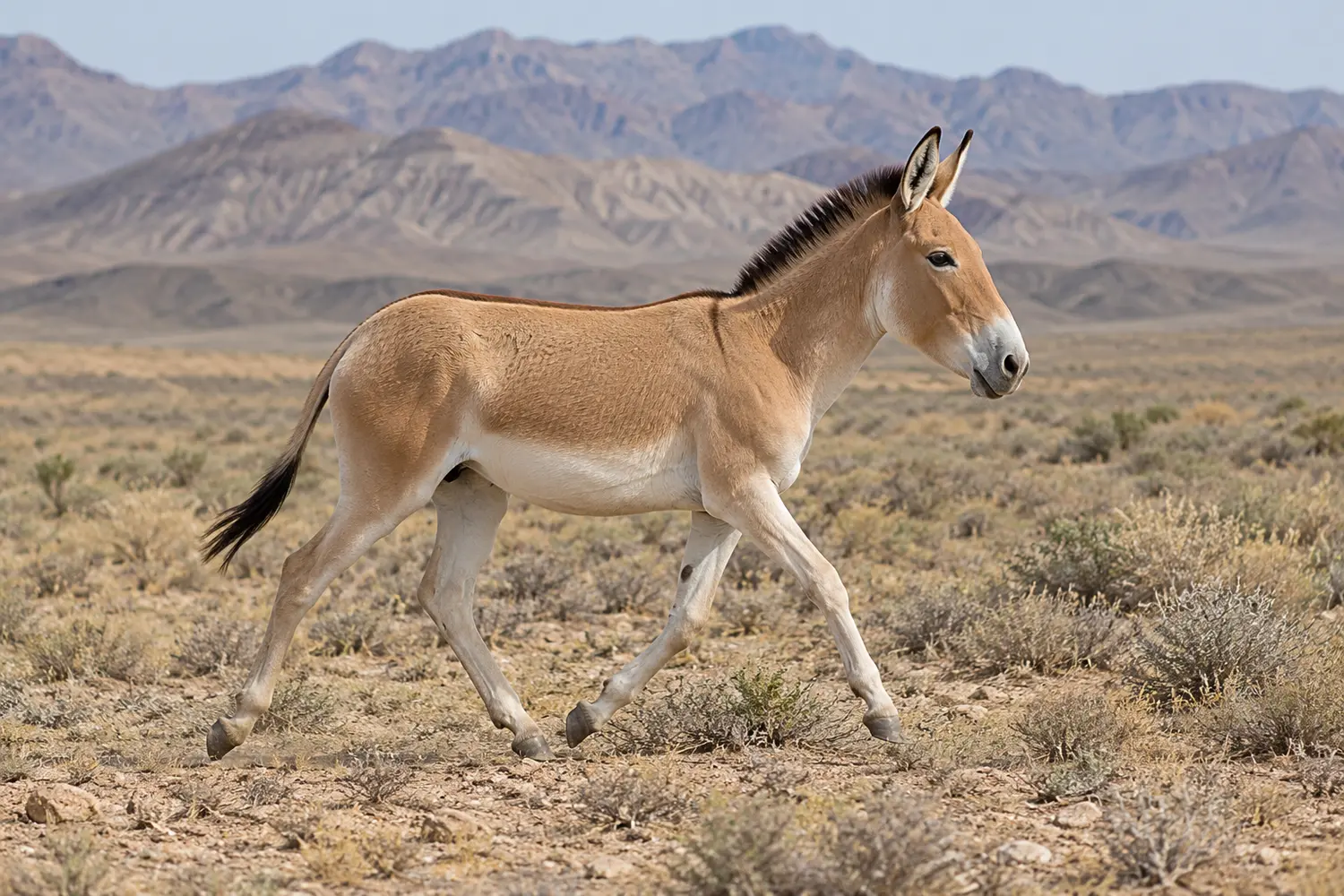
“Onager” can be used specifically for the Persian onager, Equus hemionus onager, while “Asiatic wild ass” refers to the wider species Equus hemionus and its regional forms. Smithsonian describes the Persian onager as the largest of the currently recognized Asiatic wild-ass subspecies.
Onagers are built for movement across open, dry country. Their sandy coats, pale undersides and dark dorsal stripes suit arid landscapes. Animal Diversity Web reports body masses around 200–260 kg for the wider species and an upper speed near 43 mph, approximately 69–70 km/h. That figure is best treated as a reported maximum rather than a speed maintained routinely by every animal.
The claim that onagers can sustain 50 km/h over long distances is repeated in secondary references, but it should not be confused with a standardized endurance trial. In the wild, speed is one part of a broader survival strategy that includes vigilance, group behavior, habitat knowledge and access to scarce food and water.
Why donkeys and onagers behave differently
Domestic donkeys have lived under human selection and management for generations. Individuals can learn handling, work routines and relationships with people, although temperament varies widely. Their tendency to pause and assess uncertain situations is sometimes mislabeled as stubbornness. It can instead be a cautious response from an animal that does not rely on rapid flight in exactly the same way as a horse.
Onagers remain wild animals. Calling them “untamable” is too absolute—individual animals can be managed in professional conservation facilities—but they have not undergone the long domestication process that shaped donkeys. Wild behavior, space requirements and conservation needs make them unsuitable as ordinary working or companion animals.
Which animal is faster?
The onager has the clearer evidence for high running speed. Published zoological summaries cite approximately 70 km/h. The commonly repeated 24 km/h top speed for domestic donkeys is harder to trace to controlled research and varies with breed, surface, motivation and measurement method.
A direct ranking is also not especially informative. Domestic donkeys were shaped for useful work, manageability and survival in human environments, whereas onagers face natural selection in exposed Asian landscapes. One animal’s value is not reduced because the other can run faster.
Conservation changes the comparison
Domestic donkeys occur worldwide, though many working animals still face poor nutrition, overloading, inadequate hoof care and ill-fitting equipment. The onager’s challenge is different: wild populations have been affected by habitat loss, hunting and competition with livestock for food and water.
Smithsonian conservation programs maintain Persian onagers as part of efforts to preserve this threatened wild lineage. Protecting onagers requires connected habitat, reliable water access, reduced conflict and careful population management—not attempts to domesticate them.
Frequently asked questions
Is an onager a wild donkey?
It is an Asiatic wild ass in the horse family. It is related to donkeys but is not the direct wild ancestor of the domestic donkey.
Can every donkey carry 30 percent of its weight?
No. There is no universal science-based carrying limit suitable for every donkey. Fitness, health, terrain, weather, distance and load balance must all be assessed.
Can onagers really run 70 km/h?
Zoological references report upper speeds around 70 km/h, but this is an approximate maximum rather than a guaranteed or continuously sustainable speed.