
The fishing cat (Prionailurus viverrinus) is a stocky Asian wild cat that readily swims, dives and hunts along wetland edges. Its name is accurate—but incomplete. Fish can be important prey, yet field research shows a broader diet, and several popular claims about “paddling paws” and a rudder-like tail go beyond what the evidence can firmly support.
Key Takeaways
- Fishing cats are strongly associated with marshes, mangroves, reed beds and other wet habitats across parts of South and Southeast Asia.
- They can swim and enter deep water, but much observed fishing consists of waiting, stalking and striking from shallow water or the bank.
- Their diet can include fish, mammals, birds, reptiles, amphibians, mollusks and insects.
- The species is currently listed as Vulnerable on the IUCN Red List, with a declining population.
What Is a Fishing Cat?
The fishing cat is a medium-sized member of the cat family and part of the leopard-cat lineage. It has a compact, muscular body, relatively short legs, a broad head and a short tail. Its coarse-looking olive-gray coat is patterned with dark spots and stripes, providing camouflage among reeds, muddy banks and broken wetland vegetation.
Although it is sometimes introduced as “Asia’s aquatic feline,” semi-aquatic is the more useful description. Fishing cats still walk, rest, scent-mark, reproduce and hunt on land. Their special distinction is that water is not merely an obstacle: it is a regular part of their habitat and foraging behavior.
How Do Fishing Cats Hunt in Water?
Fishing cats are capable swimmers and have been observed entering water, swimming and diving. A study that analyzed 197 camera-trap video clips offered a more detailed view of how they fish. The cats spent much of their recorded fishing time sitting and waiting for prey to approach, while actual hunting attempts made up a relatively small share of observations. They used different tactics in shallow and deeper water.
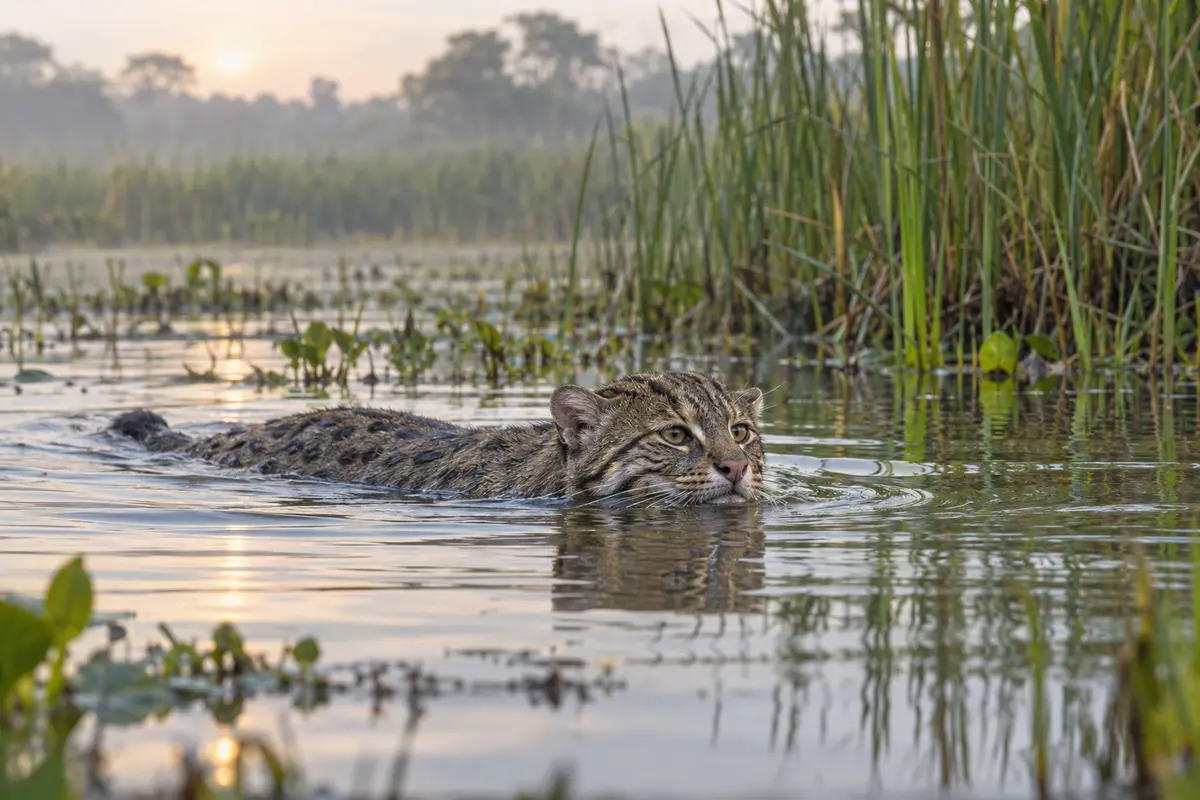
Near an edge, a fishing cat may watch the surface, probe with a paw or make a rapid strike. It can also submerge more of its body and pursue aquatic prey. Reports that the cat taps water to imitate an insect are repeated by reputable zoos, but the behavior should not be presented as the species’ universal or primary technique without context. Waiting and opportunistic capture are at least as important.
Are Fishing Cat Paws Really Webbed?
The front toes have interdigital skin that is commonly described as partial webbing, and the claws remain slightly visible when retracted. Those features may help the animal grip slippery prey. However, the popular idea that fishing cats possess uniquely webbed “paddles” is exaggerated. Comparative descriptions have noted that similar webbing occurs in other cats, so it should not be treated as proof of a specialized swimming stroke.
The fishing cat’s dense coat includes an underlayer that helps keep water away from the skin. Its short tail is visually distinctive, but calling it a proven “rudder” is more confident than the available evidence permits. The animal’s overall build, behavior, coat and comfort in water matter more than any single headline adaptation.
Do Fishing Cats Eat Only Fish?
No. Their common name describes a conspicuous behavior, not an exclusive diet. A 2025 study combining microscopic scat analysis with DNA metabarcoding detected fish alongside mammals, birds, reptiles, amphibians, mollusks and insects. The researchers characterized the fishing cat as having a diverse diet rather than being dependent on fish alone.
Diet changes with local opportunity. In a marsh, wild fish, frogs, crabs and water-associated rodents may be available. In human-dominated landscapes, cats can also encounter farmed fish, poultry or other domestic animals. This flexibility helps explain why fishing cats can persist near people, but it also creates conflict when losses are attributed to them.
Where Do Fishing Cats Live?
Fishing cats have a broad but patchy distribution across South and Southeast Asia. Strongholds occur in countries including India, Nepal, Bangladesh and Sri Lanka, with records elsewhere in the region. They are associated with freshwater marshes, floodplains, swamps, mangroves, reed beds and riverine habitats, though they may also use grassland and forest near water.
“Wetland cat” does not mean every population occupies pristine wilderness. Camera traps and tracking studies record fishing cats in working landscapes containing aquaculture ponds, rice fields, villages and roads. What matters is whether enough cover, prey, water and safe movement routes remain connected.
Are Fishing Cats Nocturnal?
Fishing cats are often active at night, which can reduce encounters with people and match the activity of certain prey. Yet describing them as strictly nocturnal is too simple. Camera traps have recorded activity across different hours, and timing can vary with habitat, disturbance, season and prey. Like many wild cats, they adjust behavior to local conditions.
Why Are Fishing Cats Threatened?
The IUCN Red List classifies the fishing cat as Vulnerable and reports a continuing decline in mature individuals and habitat quality. The IUCN Cat Specialist Group identifies loss and fragmentation of wetlands, marshes, mangroves, grasslands and forests as major threats. Agriculture, aquaculture, infrastructure and industrial development can drain, pollute or divide the habitat the cats need.
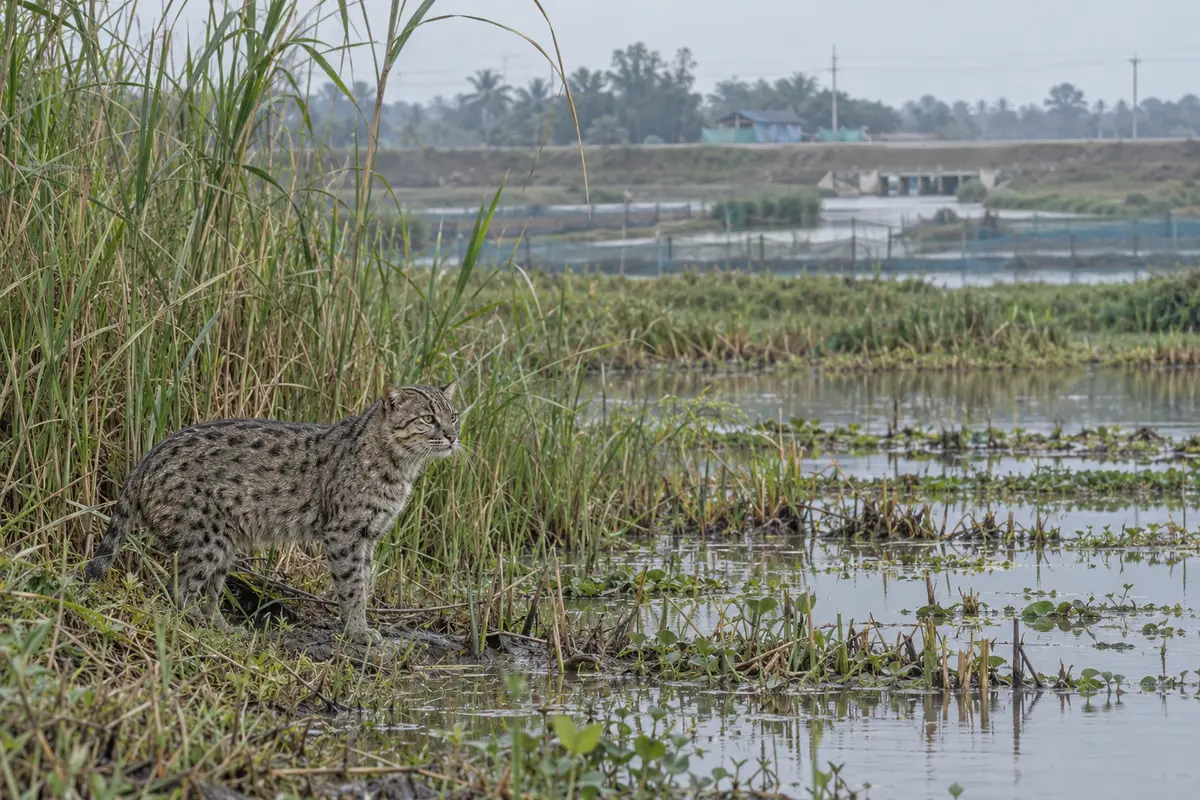
Retaliatory killing is another serious pressure. A cat suspected of taking fish or small livestock may be trapped or killed even when the individual animal’s role is uncertain. Road collisions, non-target capture in snares, hunting and pollution add further risk. These threats often occur outside protected areas, where wetlands are economically important to local communities as well as wildlife.
How Can Fishing Cats Be Protected?
Protecting fishing cats begins with protecting functioning wetlands. That includes maintaining reed and mangrove cover, limiting untreated pollution, preserving corridors between habitat patches and designing roads with wildlife movement in mind. Conservation programs also work with fish farmers and residents to document losses accurately and reduce retaliation.
Monitoring is essential because the catâ€