
A thermal image of a fox can look almost magical. The nose, ears, lower legs and paws may glow in warm colors, while the thickly furred body fades into the cold background. But the camera is not showing that the fox’s body has become invisible or that its coat allows no heat to escape. It is showing a cooler outer surface over well-insulated regions and warmer surfaces where fur is thinner, blood flow is closer to the skin, or heat exchange is easier.
That distinction matters. Fox thermal imaging is a useful way to study how different body regions exchange heat, but it does not directly reveal core body temperature. The colors also depend on the camera settings, temperature scale and environmental conditions. Here is what the science actually tells us.
What does a thermal camera see on a fox?
An infrared camera detects long-wave radiation emitted from a surface and converts it into a temperature estimate. On a fox, the surface may be fur, bare skin, a wet nose or snow stuck to the coat. The camera cannot look through the winter pelage to measure the animal’s core temperature.
Dense fur slows the movement of heat from warm skin to cold air by trapping layers of relatively still air. As a result, the outside of the coat can remain much cooler than the body beneath it. Against snow or cold ground, that outer coat may occupy a similar part of the camera’s color scale and appear dark. It is still present, still radiating energy and still losing some heat.
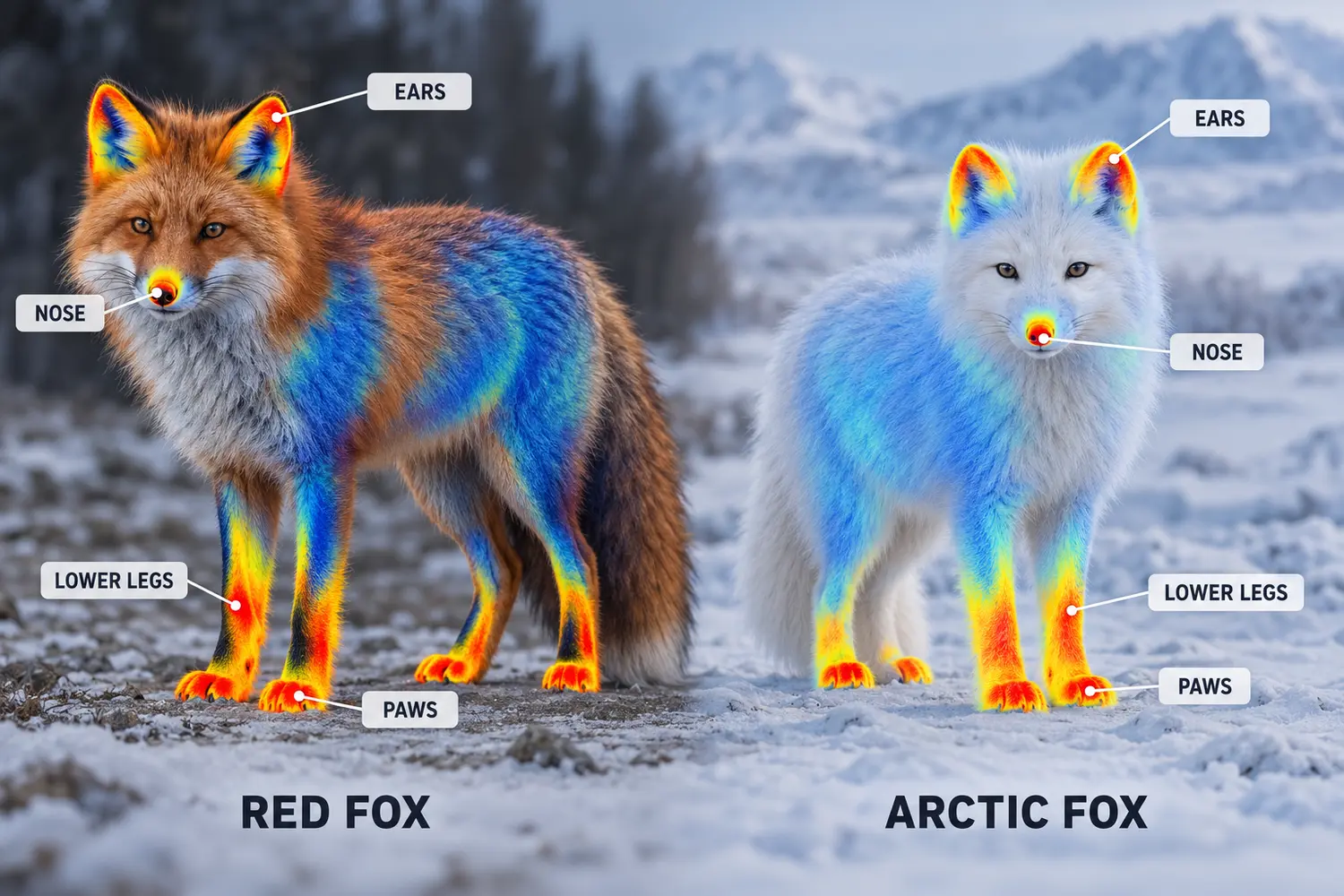
A study of red foxes, Arctic foxes and kit foxes used infrared thermography across environmental temperatures from about -25°C to 33°C. It identified the nose, ears, lower legs and paws as important heat-exchange regions, although the exact pattern differed among species and conditions. The face and top of the head also contributed in red and kit foxes, while the heavily insulated Arctic fox showed a different distribution.
Why do the nose, ears and paws look warmer?
Warm-looking areas tend to have less insulation, exposed or short fur, and blood vessels closer to the surface. That makes it easier for heat from circulating blood to reach the exterior. These regions can therefore function as adjustable thermal windows: blood flow can change as the animal balances conserving heat against releasing excess heat.
Nose and face
The nose is sparsely insulated and often moist, so it commonly contrasts with the surrounding fur. A bright nose does not mean that most of the fox’s heat leaves there, and a cold-looking nose does not prove poor circulation. Moisture, breathing, recent contact with snow and the camera angle can all influence its apparent temperature.
Ears
Fox ears are thin structures with a blood supply near the surface. Their edges or inner surfaces may appear warm when blood flow is high. Species shape matters: Arctic foxes have relatively compact ears that reduce exposed surface area, whereas kit foxes have much larger ears suited to a different thermal environment. Even so, ears are only one part of the whole heat budget.
Lower legs and paws
The distal legs have less bulky insulation than the torso, and the paws repeatedly contact the ground. Both can make them stand out in infrared images. Foxes can also conserve heat in their limbs through vascular control and countercurrent exchange, in which warm arterial blood transfers heat toward cooler returning venous blood. A thermal image captures the surface result at one moment, not the full internal mechanism.
How a winter coat reduces heat loss
A fox coat is not simply a thick blanket. Fine underfur traps air close to the skin, while longer guard hairs help protect that insulating layer from wind, snow and moisture. Seasonal changes in coat depth and density increase insulation during winter. Body posture adds another layer of control: a curled fox reduces exposed surface area and can cover its nose and paws with its tail.
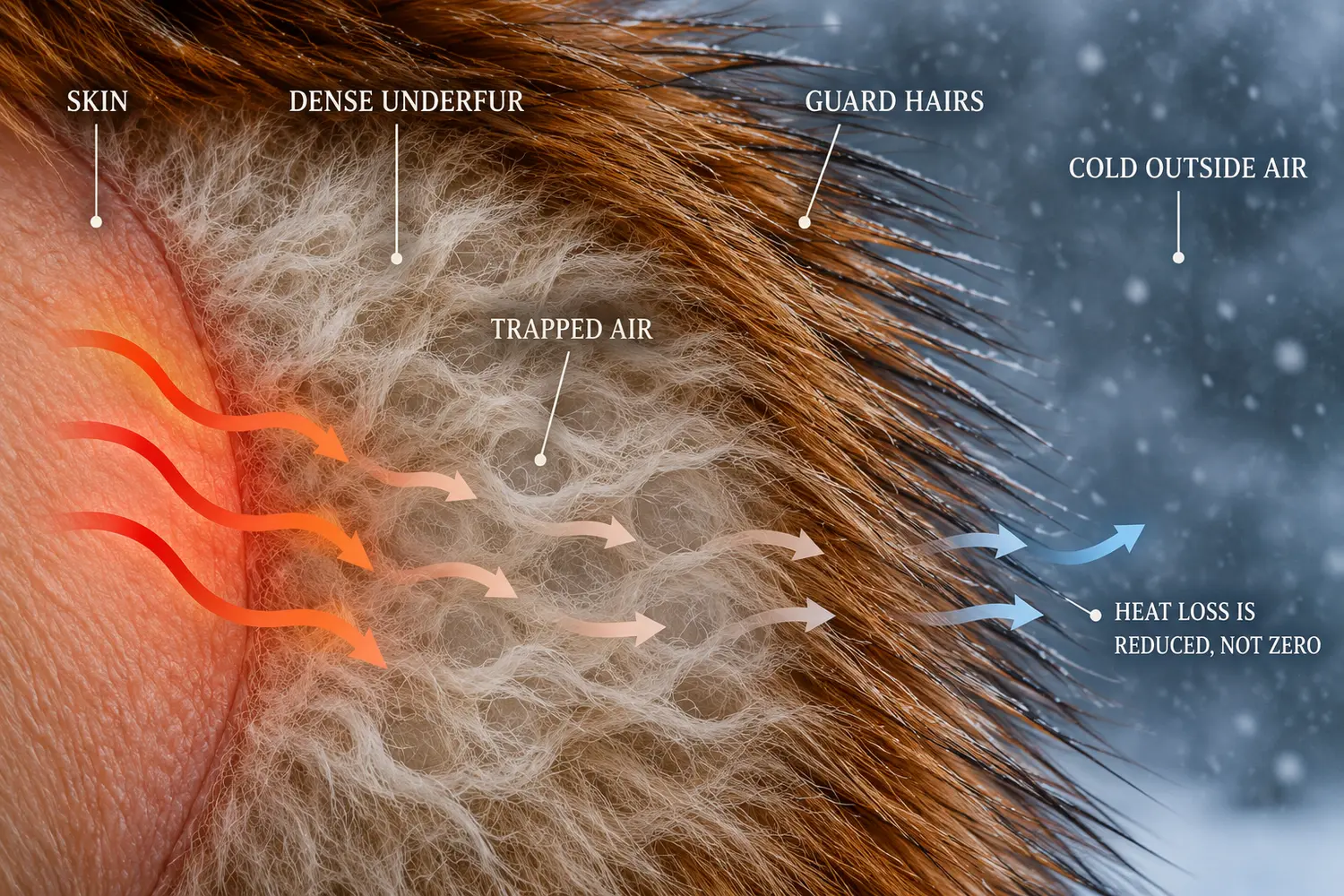
The outside of an efficient coat can be close to ambient temperature while the skin below remains warm. That is why touching only the outer fur—or seeing it as dark on a thermogram—cannot tell us the animal’s core temperature. Similar principles apply to many cold-adapted mammals and birds.
Does a dark body mean “flawless thermal efficiency”?
No biological insulation is flawless. A living fox continuously produces metabolic heat and exchanges energy with its surroundings. Heat can leave by radiation, convection and conduction, as well as through respiration and evaporation. Fur greatly reduces some of those pathways, but it cannot eliminate them.
Research on fox energetics also shows why species and season cannot be collapsed into a single viral claim. Arctic foxes are exceptionally well insulated, while red foxes reach the energetic cost of cold at milder temperatures. Yet both species regulate heat through a combination of pelage, circulation, posture, activity and behavior. The thermal image is one snapshot of that system.
Why thermal colors can mislead
Most thermal cameras apply a false-color palette to temperature data. Red or white usually means warmer within the selected scale; blue or black means cooler. Change the minimum and maximum values, and the same scene can look dramatically different. Without a visible scale and calibration details, the colors should not be treated as precise measurements.
Other sources of error include:
- Distance and resolution: a small nose or ear may occupy too few pixels for an accurate reading.
- Viewing angle: oblique views can change the apparent radiation received by the sensor.
- Fur properties: coat depth, density, color, wetness and direction all affect the surface signal.
- Weather: wind, humidity, precipitation and recent sunlight can warm or cool the coat independently of core temperature.
- Reflected radiation: snow, sky and nearby surfaces can influence what the camera records.
- Emissivity settings: using one assumed value for every surface can introduce error because fur, skin and moist tissue are not identical targets.
For those reasons, wildlife researchers standardize distance and angle where possible, record weather conditions, use calibrated equipment and interpret regions of interest rather than relying on a striking color palette alone.
Can thermography tell whether a fox is healthy?
Thermal imaging can be valuable for non-contact observation. It may help researchers study heat loss, detect unusually warm or cool regions, monitor animals with minimal disturbance, or guide a closer veterinary examination. But it is not a stand-alone diagnosis. Inflammation, injury, wet fur, recent exercise, stress and environmental exposure can produce overlapping patterns.
A veterinarian or wildlife biologist needs behavioral observations, physical examination and other evidence before drawing conclusions about fever, frostbite, circulation or disease. A single social-media image—especially one without a temperature scale, capture distance or weather data—cannot support those claims.
Red fox, Arctic fox and kit fox: one family, different solutions
The fox thermography study is especially useful because it compared species adapted to different climates. Arctic foxes combine dense seasonal fur with compact ears, a short muzzle and furred foot pads. Red foxes occupy a broad climatic range and use a flexible mix of coat change, shelter, posture and activity. Kit foxes live in hot, dry regions and have proportionally large ears that can aid heat exchange.
All three can show relatively warm noses, ears, lower legs and paws, but the prominence of each region changes with species, air temperature, circulation and behavior. There is no universal fox thermogram that applies to every animal at every moment.
What a sleeping fox image really proves
A dark torso beside glowing extremities is good evidence that the outer winter coat is cooler than less-insulated surfaces under those particular imaging conditions. It illustrates effective insulation and regional control of heat exchange. It does not prove that no warm air escapes, that the animal is thermally invisible, or that every bright patch represents wasted heat.
The more accurate—and more interesting—lesson is that a fox manages heat as a whole system. Fur, blood vessels, body shape, posture, metabolism and behavior work together. Thermal imaging lets us see part of that balance, provided we remember that the colors describe a surface, not the full temperature of the animal beneath it.
Frequently asked questions
Can a thermal camera see a fox through thick fur?
No. It records radiation from the outer fur surface. It cannot see through the coat to the skin or core.
Why might a fox’s body disappear against snow?
The coat surface and background may fall into similar temperature ranges or colors on the selected palette. The fox remains detectable with suitable settings and resolution.
Are a fox’s ears always hot?
No. Their surface temperature changes with blood flow, activity, posture, weather and species. Ears can help exchange heat, but they are not permanently warm.
Does winter fur stop all heat loss?
No. Winter fur reduces heat transfer by trapping air and protecting that layer from wind and moisture. Heat loss continues through the coat, exposed surfaces, breathing and other pathways.