
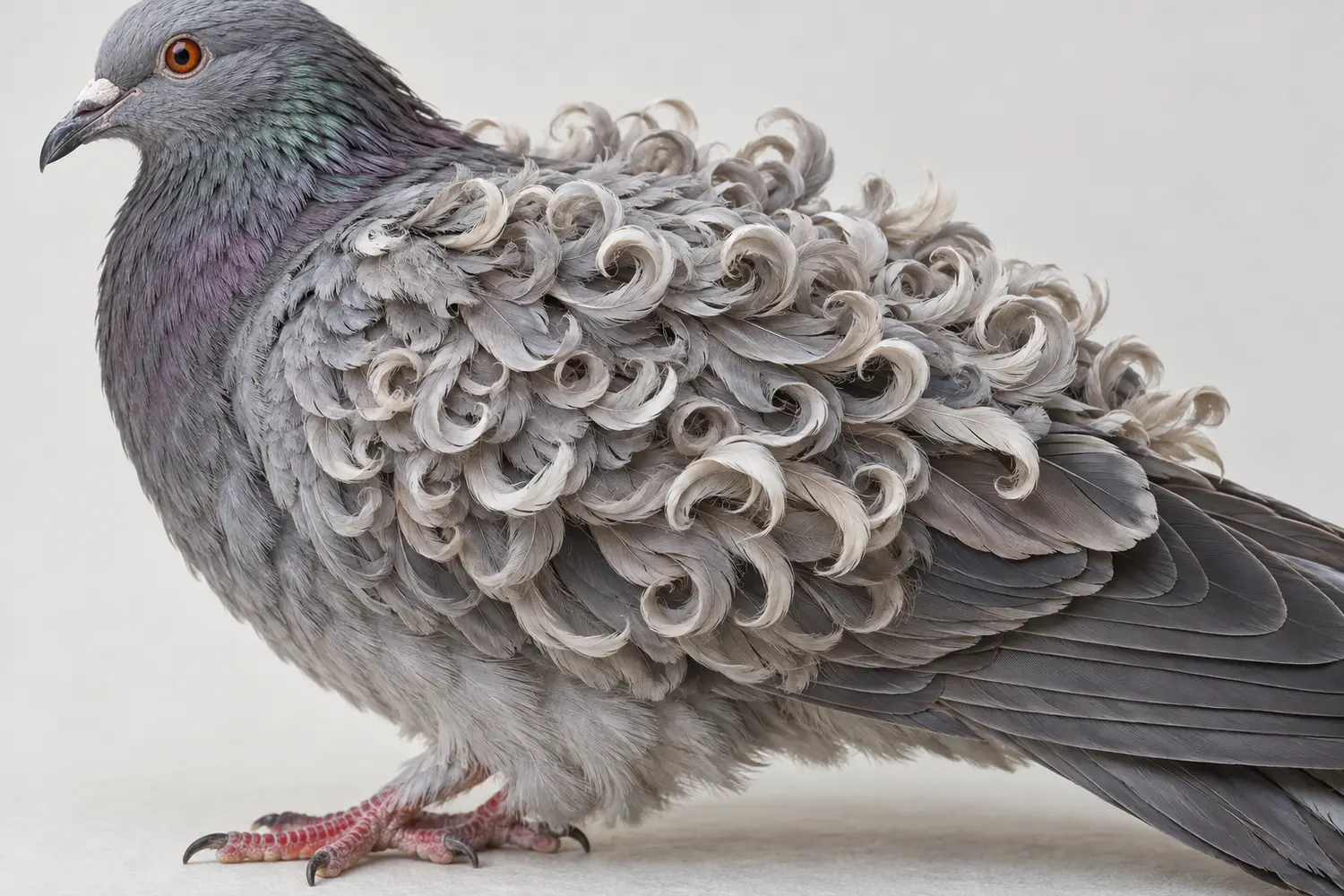
The Frillback pigeon looks as though its feathers have been carefully curled by hand. Across the wing shields and back, many contour feathers turn upward and end in open curls or ringlets. The effect is real, inherited and maintained through generations of selective breeding—not a separate species and not a hairstyle created after the bird hatched.
Frillbacks are domestic pigeons descended from the rock pigeon, Columba livia. Their appearance makes them popular exhibition birds, but the biology behind the curls is still not fully resolved. Historic breeding experiments suggest a complex inherited trait, while the precise molecular genes have yet to be identified.
What is a Frillback pigeon?
A Frillback pigeon is a fancy domestic pigeon breed selected for curled plumage. It belongs to the same species as racing pigeons, homing pigeons, city pigeons and hundreds of other domestic breeds. The differences among those breeds arose through human selection acting on inherited variation.
Breed standards place the greatest emphasis on the frill: the curled feathers should cover the wing shields and continue across the back in an orderly pattern. Frillback pigeons also normally have feathered feet, called muffs, with a wave or curl toward the feather ends.
The long primary flight feathers and tail are not supposed to become a mass of tight ringlets. Good examples retain recognizable pigeon wing and tail structure beneath the ornamental contour feathers.
Why do Frillback feathers curl?
A feather grows from a follicle, with a central shaft called the rachis supporting paired vanes. In Frillbacks, the developing feather curves so that its tip lifts away from the body. Differences in growth across the feather can produce the upward bend and ringlet-like ending.
The trait is inherited, but claims that one named gene has already been proved responsible should be treated cautiously. Breeding work reported in the 1930s suggested that two non-allelic factors, historically called Cu1 and Cu2, contribute to the phenotype and show incomplete dominance. Modern reviews still describe the molecular identity of those factors as unknown.
This distinguishes Frillback pigeons from Frizzle chickens. A mutation in the keratin gene KRT75 has been functionally linked to feather curvature in Frizzle chickens, but that result cannot simply be transferred to pigeons. Similar-looking feather forms can evolve through different genetic and developmental routes.
Are Frillbacks a different pigeon species?
No. A Frillback is a breed of domestic rock pigeon. Breed names describe selected populations within a domesticated species; they do not automatically represent species or subspecies.
Domestic pigeons demonstrate how much anatomical variation can accumulate without speciation. Selective breeding has produced crests, feathered feet, enlarged crops, unusual tail numbers, distinct beak shapes and many color patterns. The Frillback’s contribution to this diversity is feather structure.
Where are the curls located?
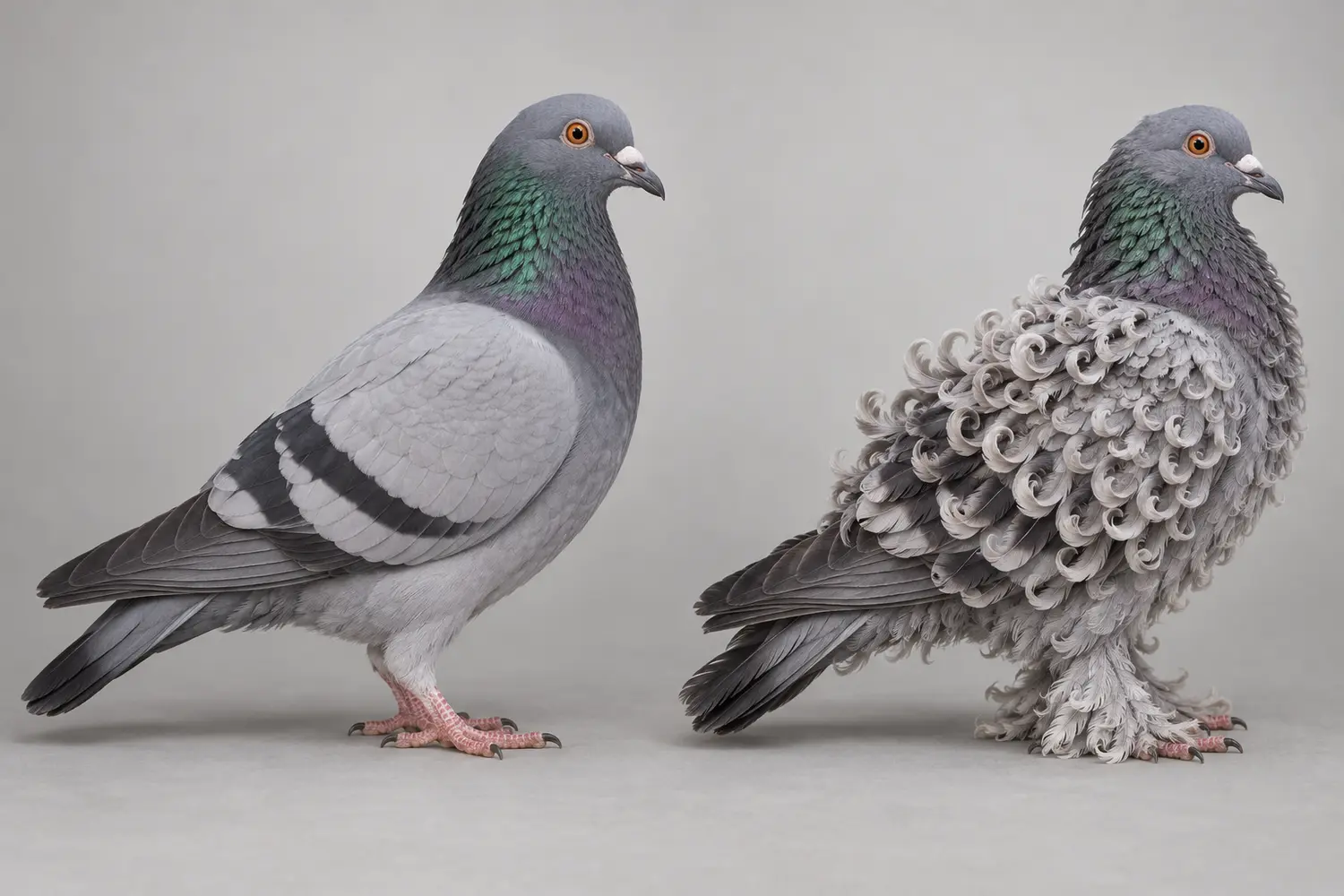
The most prominent curls lie on the shield—the broad outer surface of the folded wing—and across the saddle or back. These are largely contour feathers rather than the main feathers that generate lift and thrust during flight.
Standards also call for curled or waved feathering around the hocks and feet. The exact distribution, tightness and regularity vary among individuals. It is reasonable to say that curl patterns are individually variable, but the popular claim that no two birds can ever share the same pattern is not a scientifically tested identification rule.
Some Frillbacks are plain-headed, while others have a shell crest at the rear of the head, depending on the variety and standard. A crest and the curled body feathers are separate traits.
What colors can Frillback pigeons have?
Frillbacks occur in multiple recognized colors and patterns, including white, black, blue, red, yellow, silver and grizzle combinations. Exact recognition differs among national breed organizations.
Color does not create the curl. Pigmentation and feather structure are distinct biological features even though breeders select both when producing exhibition birds. A dramatically colored pigeon without the characteristic curled contour feathers is not a Frillback simply because it looks ornate.
Can Frillback pigeons fly?
Frillbacks can fly. Their primary flight feathers remain much less altered than the curled contour feathers of the wing shields. However, they are ornamental birds rather than racing athletes, and flight performance varies with breeding, body condition, feather quality, housing and individual health.
It would be inaccurate to say the curls make every Frillback flightless. It would also be unsafe to assume that every individual has the speed, endurance or predator avoidance skills of a free-living feral pigeon. Secure housing remains important.
Where did the breed originate?
The exact origin is uncertain. Historical accounts document curled pigeons in Europe centuries ago, with breeding activity reported in England, Germany, Belgium, the Netherlands, Hungary and Austria. Different sources have proposed broader Asian or Middle Eastern connections, but there is no single securely documented place and date for the breed’s beginning.
That uncertainty is common among old domestic breeds. They often existed in regional forms before breed clubs created written standards and pedigrees. Modern Frillbacks are therefore the product of both inherited variation and generations of decisions by breeders.
How are Frillbacks judged at pigeon shows?
Show standards evaluate more than the presence of a few curled feathers. In the National Pigeon Association standard published in 1993, the frill represented half of the 100 available points. Judges considered coverage, length, ending, closure, ringlet and overall curl.
Other points covered the head, color, body and foot feathering. This scoring system explains why exhibition birds may look more dramatically and evenly curled than pet-quality Frillbacks. A breed standard is an aesthetic framework, not a measure of biological health or individual worth.
Do Frillbacks need special care?
The basic requirements are those of other domestic pigeons: clean water, a nutritionally appropriate diet, social contact, secure housing, dry resting areas, space to exercise and access to an avian veterinarian when needed.
Ornamental feathers add practical considerations. Curled wing feathers and muffs can collect dirt or become damaged on wet, abrasive surfaces. Foot feathering can conceal injuries, parasites or compacted debris, so feet should be inspected regularly. Perches and loft surfaces should be designed to reduce breakage and contamination.
Owners should monitor body condition directly rather than judging health from apparent fluffiness. The curled plumage can change the bird’s outline, making weight loss or injury less obvious at a glance.
Are curled feathers harmful?
The presence of curls does not prove that an individual bird is suffering. Frillbacks can perform normal pigeon behaviors when responsibly bred and housed. Welfare depends on whether selection has compromised flight, mobility, vision, grooming, skin condition or reproduction, and on how the bird is managed.
Breeders and owners should prioritize sound movement, intact feathers, functional wings and feet, and freedom from chronic irritation over extreme appearance. Any pigeon with broken skin, repeated feather damage, difficulty moving or abnormal breathing needs assessment rather than being treated as merely unusual-looking.
Why Frillbacks matter to genetics research
Domestic pigeons offer striking examples of variation within one species. Because different breeds express repeatable traits, researchers can compare genomes, embryos and feather development to investigate how anatomical diversity arises.
Frillback plumage is especially interesting because curling also occurs in other domestic and wild birds. Determining whether the same molecular pathways produce similar curls in different lineages would help distinguish repeated genetic mechanisms from convergent appearances.
Frequently asked questions
Are Frillback pigeons born with curled feathers?
The inherited trait affects feathers as they develop. Young birds acquire the recognizable adult curl as their plumage grows and matures; the feathers are not manually curled.
Is a Frillback the same as a Frizzle chicken?
No. They are different domestic bird species. Both can have curved feathers, but the proven genetic mechanism in Frizzle chickens has not been established for Frillback pigeons.
Does every feather curl?
No. Curling is most conspicuous on the wing shields, back and ends of the foot feathers. Primary flight feathers and the tail remain more conventionally structured.
Are all curl patterns unique?
Individuals vary in coverage and ringlet shape, but “no two are identical” is an appealing description rather than a tested biological law.
Are Frillbacks wild pigeons?
No. They are a selectively bred domestic form of the rock pigeon and depend on responsible human care.
Sources
- Genomic determinants of epidermal appendage patterning and structure in domestic birds
- Pigeonetics takes flight: evolution, development and genetics of pigeon variation
- University of Utah Learn Genetics: Inherited characteristics in pigeons
- National Pigeon Association Frillback Standard, 1993
- Darwin’s Fancy Revised: genomic constitution of pigeon breeds