
A Spanish Galgo may be capable of a higher measured sprint speed than the best carefully filtered field estimate published for an African lion—but the viral claim that a Galgo runs at exactly 72 km/h while a lion reaches 70 km/h is not supported by equivalent tests. The two numbers usually come from unsourced lists, not a controlled head-to-head comparison. They also describe animals built for very different jobs.
Can a Galgo outrun a lion?
In a hypothetical straight race, a fit sighthound could plausibly outrun a lion once the initial acceleration phase has passed. However, there is no peer-reviewed experiment directly comparing a Galgo Español with a lion under the same conditions. That means a categorical “72 versus 70 km/h” verdict is more precise than the evidence allows.
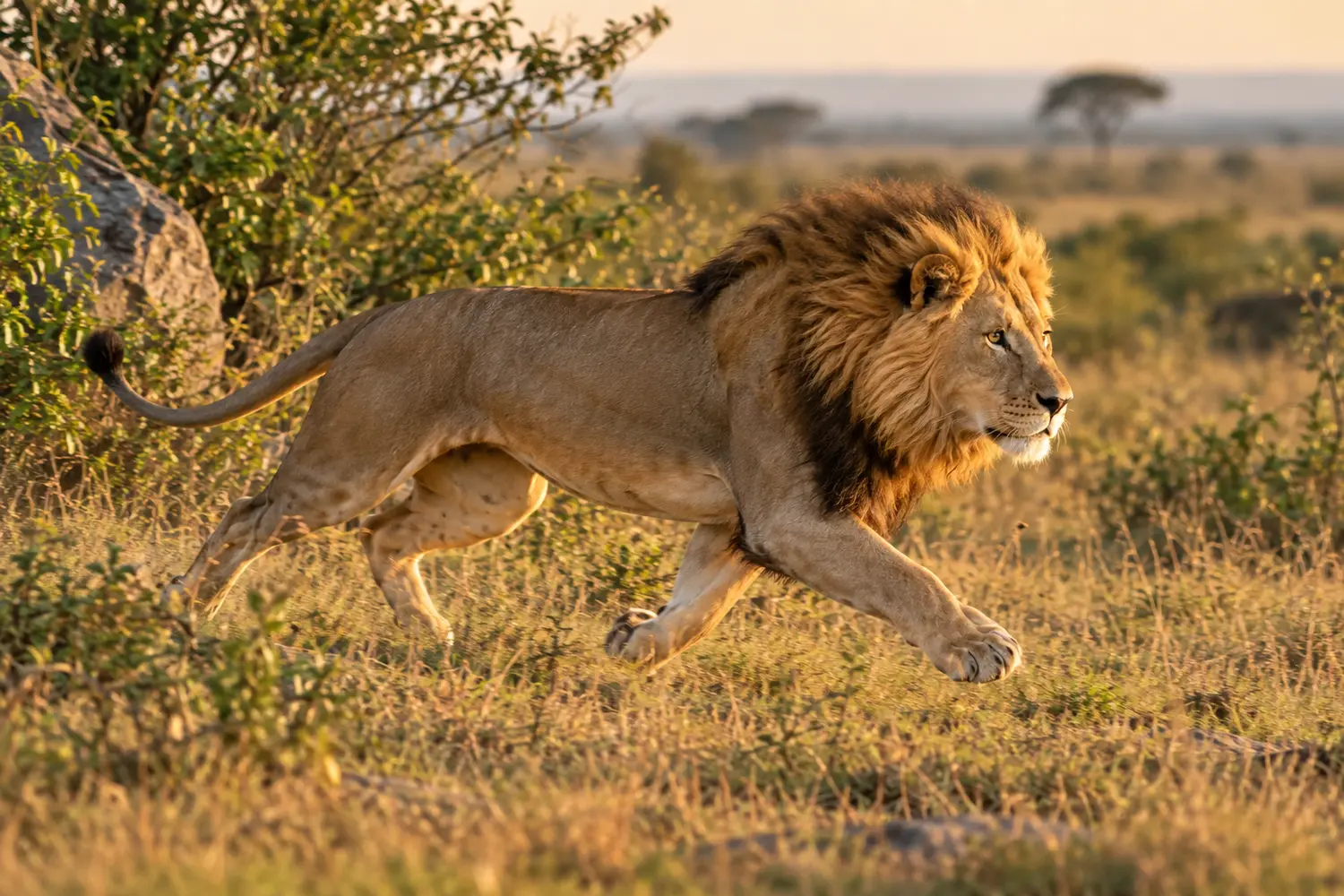
The best available scientific evidence comes from related—but not identical—measurements. A 2022 study that developed movement-filtering rules for GPS and accelerometer data from free-ranging African lions found that filtering implausible fixes reduced the apparent maximum from more than 150 km/h to 48 km/h. The authors were demonstrating why raw GPS spikes can badly inflate wildlife speed estimates, not claiming that 48 km/h is the absolute physiological limit for every lion.
What science says about sighthound speed
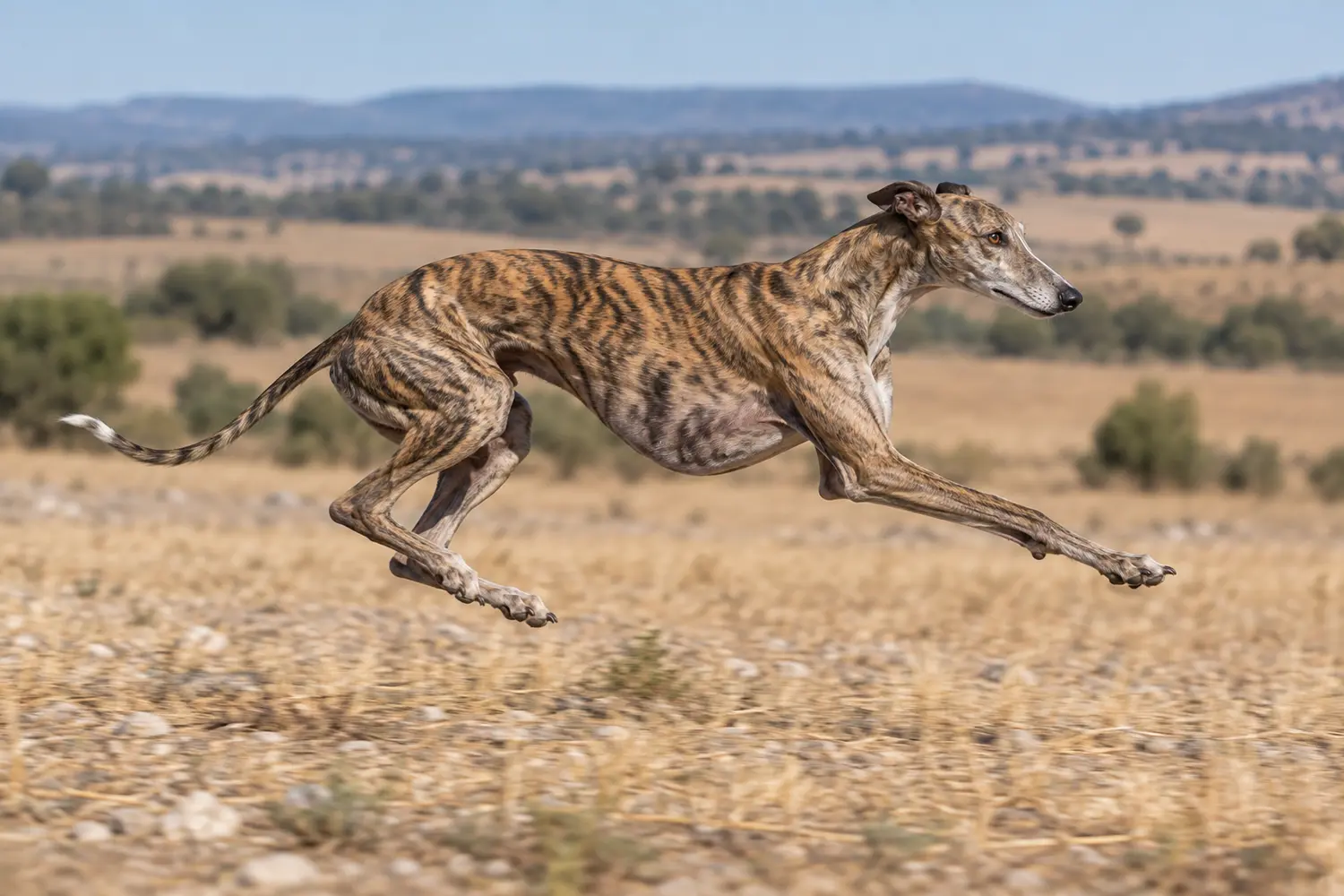
The Galgo Español is a Spanish sighthound developed for coursing hares over open and often uneven country. The Fédération Cynologique Internationale recognizes it as a distinct breed and describes a light, long-limbed dog with a deep chest, tucked abdomen and flexible, powerful movement. Those traits are well suited to fast galloping.
Published biomechanics research is much richer for racing Greyhounds than for Galgos. Studies comparing cheetahs and racing Greyhounds commonly use about 17 metres per second—roughly 61 km/h—as a maximum for the racing dogs studied. Other work reports Greyhounds galloping between 14 and 19 m/s in experimental and racing contexts. Those findings confirm that elite sighthounds are exceptionally fast, but they do not validate a universal 72 km/h top speed for every Galgo.
Breed names also matter. “Galgo Español” and “Greyhound” are not interchangeable labels. They share sighthound ancestry and similar running adaptations, but the FCI lists them as separate breeds. Evidence measured in track-racing Greyhounds should therefore be used as context, not silently presented as a direct Galgo measurement.
Why the lion is built for a different race
Lions are ambush predators. Their success depends on approaching close enough to prey that explosive acceleration, strength and control can finish the chase before the target escapes. Research on big-cat predation shows that launch distance strongly affects capture probability: getting close before the rush is often more important than sustaining a headline top speed.
A lion’s body is far heavier than a Galgo’s and carries the muscle, neck strength, claws and forelimb power needed to grapple large prey. That build is costly to accelerate and move at high speed. A Galgo sacrifices mass and grappling power for long limbs, a narrow body and an efficient galloping stride. It is therefore misleading to frame the comparison as “power versus speed” without explaining that each animal is optimized for a different ecological or human-selected task.
Why viral animal-speed numbers are unreliable
Maximum speed is unusually difficult to measure. GPS sampling rate, satellite error, track curvature, running surface, motivation, age, temperature and the duration over which speed is averaged can all change the result. A momentary device error can produce a spectacular but impossible number. Conversely, a field study may never capture an animal’s true maximum effort.
Comparisons are only fair when the same method measures both animals over similar distances and conditions. A racing-dog figure timed on a prepared track cannot be cleanly compared with a wild lion’s GPS speed in vegetation. The honest conclusion is a range with uncertainty, not two neat integers.
The evidence-based verdict
The Galgo likely has the advantage in sustained high-speed running, while the lion has the advantage in acceleration, mass and short-range capture power. But no reliable study proves the exact viral matchup of 72 km/h versus 70 km/h. The strongest measured evidence supports saying that elite sighthounds can reach around the low-to-high 60 km/h range, while carefully filtered field data have recorded lions at up to 48 km/h. Neither figure should be treated as a universal biological ceiling.
Frequently asked questions
Is a Galgo the same as a Greyhound?
No. The Galgo Español and the English Greyhound are separate recognized breeds. They are both sighthounds and share similar adaptations for fast running, but their histories, conformation and typical working environments differ.
Can lions really run 80 km/h?
That number is widely repeated, but direct field measurements are limited and vulnerable to GPS error. A peer-reviewed filtering study reported a maximum of 48 km/h after removing implausible movement fixes. This does not prove that no lion can ever run faster; it shows why confident internet maxima should be treated cautiously.
Would a Galgo survive a real encounter with a lion?
This article compares locomotion, not combat. Lions and Galgos do not naturally compete, and staging such an encounter would be dangerous and unethical. Speed alone does not predict the outcome of an animal conflict.
References
- Wilson et al. Decision rules for terrestrial movement: African lion GPS case study
- Hudson et al. Functional anatomy of the cheetah hindlimb, including Greyhound speed comparison
- Hudson et al. High-speed galloping in cheetahs and racing Greyhounds
- FCI Standard No. 285: Galgo Español
- Review of escape success and launch distance in big-cat predation