
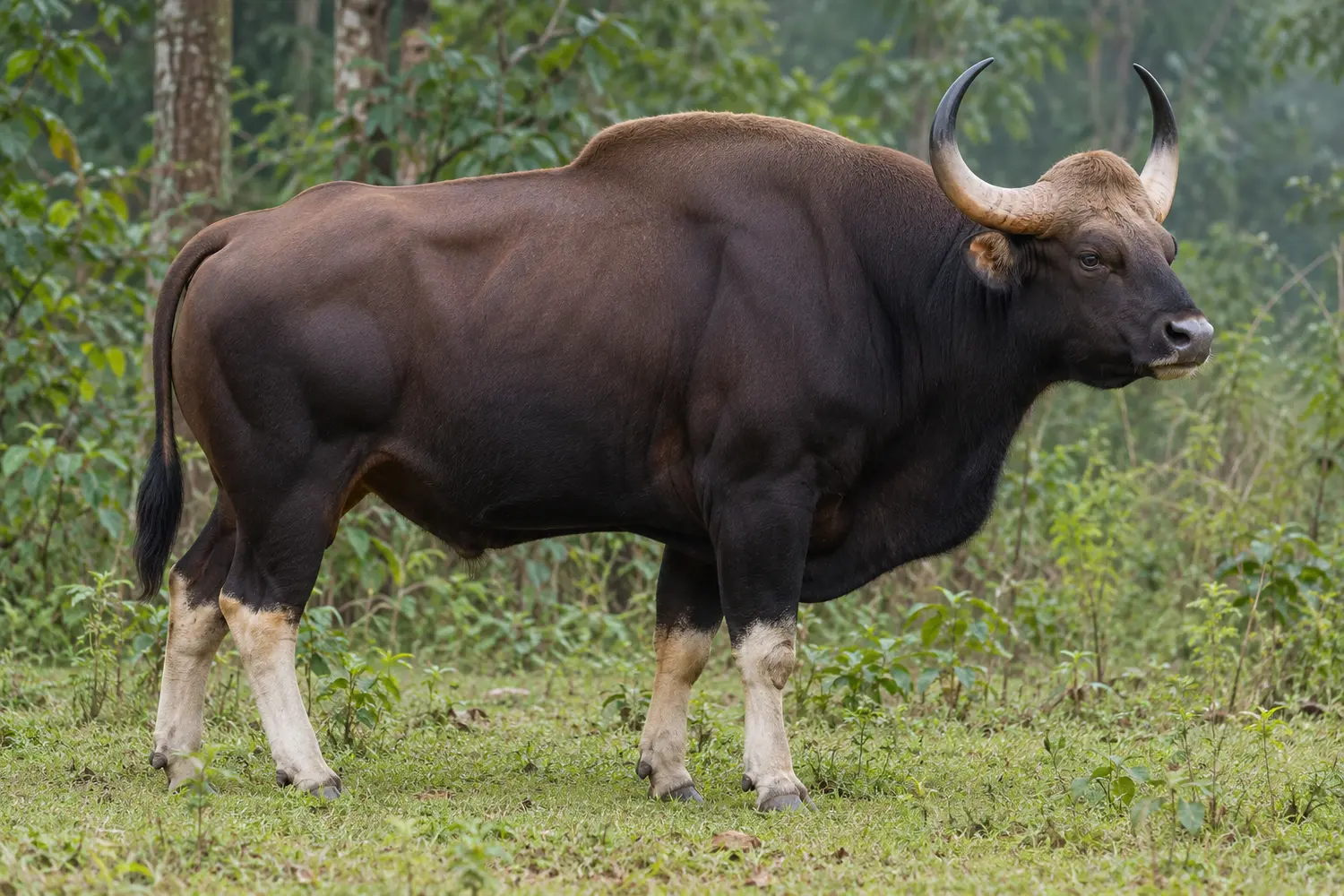
The gaur (Bos gaurus) is the world’s largest living wild cattle species. Adult males are exceptionally tall and heavy, with a prominent ridge over the shoulders that makes the front of the body look even more powerful. But “most muscular” and “strongest bovine” are not scientific rankings, and a 1,500-kilogram bull is an exceptional claim—not the normal size of a gaur.
Key takeaways
- Gaur are true wild cattle in the genus Bos, not true bison.
- Government studbook data give typical adult weights of about 600–1,000 kg for males and 450–800 kg for females.
- The high shoulder profile comes from skeletal proportions and a developed dorsal ridge, especially in mature males.
- Tigers do prey on gaur, particularly younger animals; tigers hunt alone rather than in packs.
- The species is classified as Vulnerable and is threatened by habitat loss, hunting, conflict and disease transmission from livestock.
Is a gaur the same as an Indian bison?
“Indian bison” is a familiar nickname, but it is taxonomically misleading. The gaur belongs to the cattle genus Bos, alongside domestic cattle, wild yak and banteng. True bison belong to the genus Bison. The scientific name for the wild gaur is Bos gaurus.
The distinction also matters because the domestic or semi-domestic mithun, or gayal, has often been classified as Bos frontalis. A detailed Mammalian Species review treats wild gaur and domestic mithun as closely related forms while retaining separate scientific names.
How big does a gaur get?
Gaur are widely recognized as the largest living cattle species. Size varies by sex, age and population. India’s Central Zoo Authority studbook lists a shoulder height of roughly 1.7–2.0 meters. It gives adult male weights of about 600–1,000 kilograms and female weights of about 450–800 kilograms. San Diego Zoo gives a broader shoulder-height range of 1.6–2.2 meters for gaur.
| Trait | Adult male | Adult female |
|---|---|---|
| Typical reported weight | 600–1,000 kg | 450–800 kg |
| Shoulder height | About 1.7–2.0 m in the Indian studbook | |
| Build | Larger, darker, stronger dorsal ridge | Smaller, usually browner |
Figures of 1,500 kilograms appear in popular accounts and some secondary references, but they should be understood as exceptional upper-end reports. They are not representative of most adult bulls. Exact comparisons with African buffalo, wild yak or domestic cattle also depend on whether researchers compare maximum records, averages, shoulder height or body mass.
Why are a gaur’s shoulders so high?
A mature bull’s front end rises noticeably above the hindquarters. The effect comes from the animal’s skeletal proportions, elongated vertebral processes and developed muscles along the neck and back. Males show the dorsal ridge most strongly, and their deep chest, thick neck and large forequarters add to the imposing outline.
It is tempting to describe this structure as a special “lifting machine,” but the anatomy literatur