
Gorilla vs jaguar comparisons are popular online, but the animals are not natural rivals. Gorillas live in equatorial Africa, while jaguars range through the Americas. They never encounter one another in the wild, and neither species evolved to fight the other. A useful comparison therefore asks how each animal’s body, diet and behavior fit its own ecological role—not which one would “win.”
Gorilla vs jaguar at a glance
| Trait | Gorilla | Jaguar |
|---|---|---|
| Natural range | Equatorial Africa | Americas |
| Ecological role | Large-bodied social primate and plant consumer | Solitary ambush predator |
| Typical movement | Knuckle-walking and climbing | Stalking, sprinting, climbing and swimming |
| Diet | Mostly vegetation and fruit, varying by species and season | Meat from a broad range of prey |
| Main physical specialization | Powerful upper body, grasping hands and large chewing apparatus | Compact muscular body, claws, canines and robust skull |
They occupy different continents and niches
Gorillas are African great apes. Western lowland gorillas inhabit forests and swampy clearings across parts of the Congo Basin. Jaguars occur from Mexico through Central America and into South America, using habitats that include tropical forest, wetlands, scrub and seasonally flooded grasslands. Their ranges do not overlap.
This geographic separation matters. A viral “face-off” image is an imagined comparison, not a wildlife event. The evolutionary pressures on a social forest ape are very different from those acting on a solitary big cat.
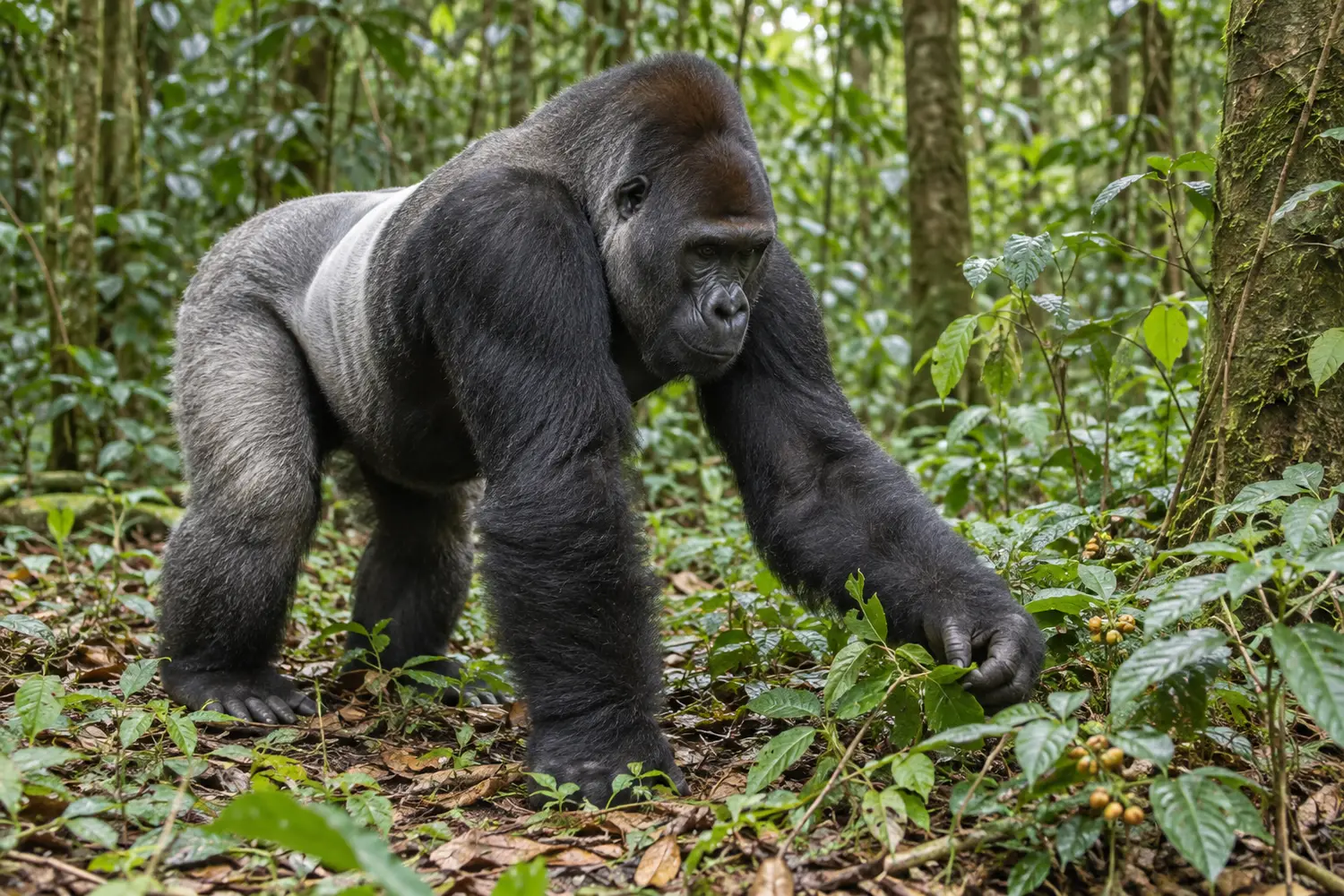
Gorilla anatomy supports climbing, travel and feeding
Gorillas have long arms, mobile shoulders, grasping hands and a trunk built to support a very large primate. Adults usually move on the ground by knuckle-walking, though younger animals climb more frequently. A mature male develops the familiar silver saddle and has substantial upper-body musculature.
Those features are often converted into claims about combat, but their everyday functions are broader. Gorillas use their limbs to travel, climb, manipulate vegetation and interact within a social group. Their jaws and teeth process fibrous foods as well as fruit. Studies of primate chewing mechanics show that bite-force estimates depend on body mass, muscle architecture, skull geometry, gape and where force is measured along the tooth row.
Western gorillas are commonly described as folivore-frugivores. Field research shows that their diet shifts with fruit availability; leaves, stems and other plant foods become more important when fruit is scarce. They may also consume small amounts of invertebrate material. This is not the feeding ecology of a dedicated predator.
Jaguar anatomy is adapted for ambush predation
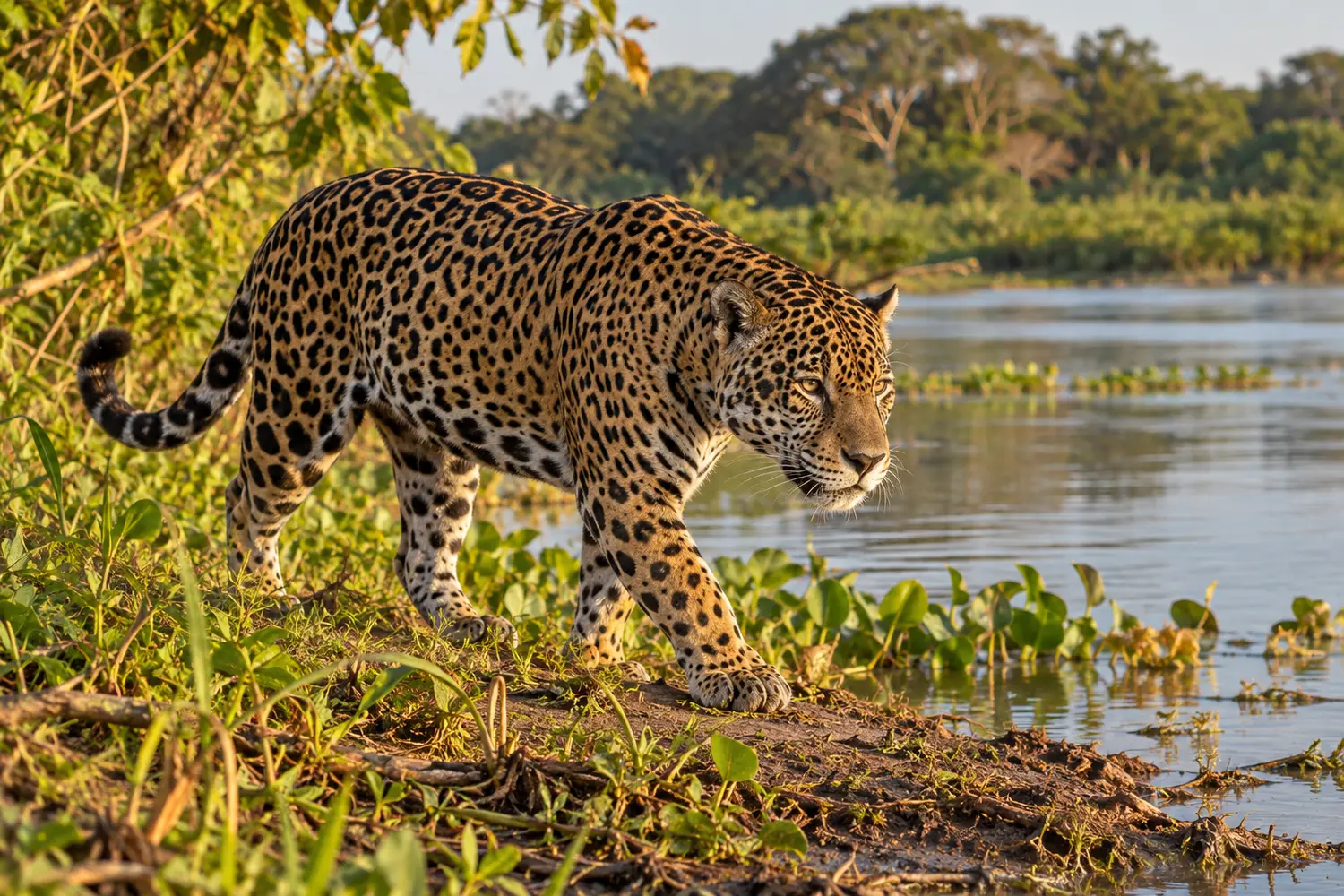
The jaguar (Panthera onca) is the largest cat native to the Americas. It has a compact, muscular body, a broad head, powerful forelimbs, retractile claws and strong canine teeth. Jaguars stalk prey from cover and use a short, explosive attack rather than a long-distance chase. They are also capable swimmers and often use river-edge habitats.
Jaguars eat many kinds of vertebrate prey. Documented diets include peccaries, deer, capybaras, caimans, turtles and smaller animals, with the mix changing by region and availability. Panthera notes that more than 85 prey species have been recorded. Their broad prey base helps explain why jaguars can occupy such varied habitats.
What bite-force comparisons can and cannot tell us
The claim that one animal has a bite of exactly “1,300 PSI” and the other exactly “1,500 PSI” looks precise, but it is not a sound basis for this comparison. Researchers do not usually obtain a universal species-wide PSI value by directly measuring many wild adults under identical conditions. Published studies may use skull dimensions, jaw-muscle cross-sectional area, lever mechanics or computer models. Results change with body size, gape, tooth position and the assumptions of the model.
Peer-reviewed work does support the conclusion that jaguars have strong jaw-adductor muscles and produce high bite forces relative to body size among living cats. That does not make every circulating PSI figure interchangeable with a gorilla estimate. It is more accurate to say that the jaguar’s skull and jaw system are specialized for subduing and consuming prey, while the gorilla’s chewing system serves a large-bodied primate with a predominantly plant-based diet.
Size numbers need context
Both species vary substantially. Gorilla size depends on species, subspecies, sex, age, health and whether an animal is measured in the wild or captivity. Jaguar body mass also varies geographically; Smithsonian sources give a broad adult range of roughly 30 to 150 kilograms. Presenting one narrow weight range as universal can be misleading.
Body mass alone does not predict behavior or the outcome of an artificial encounter. Anatomy, motivation, terrain, age and condition would all matter, which is why a responsible biological comparison should not turn those variables into a confident fight prediction.
Behavior is the biggest difference
Gorillas live in social groups and spend much of their day feeding, resting and traveling. They are generally not aggressive without cause, although a silverback can defend group members when threatened. Jaguars are usually solitary and rely on concealment, timing and close-range power to capture prey.
Calling the gorilla “brute force” and the jaguar an “apex assassin” may be dramatic, but it compresses complex animals into fight labels. The more truthful conclusion is that each is impressive because it is finely adapted to a different life.
Frequently asked questions
Do gorillas and jaguars live together?
No. Wild gorillas occur in Africa, while jaguars are native to the Americas.
Is a jaguar’s bite stronger than a gorilla’s?
There is no single standardized PSI dataset that makes the viral numbers directly comparable. Jaguars do have an unusually robust skull and high bite-force capacity relative to body size, but exact figures depend on methods and assumptions.
Would a jaguar hunt a gorilla?
No natural predator-prey relationship exists because their ranges are separated by the Atlantic Ocean. Any encounter scenario is hypothetical.
References
- Hartstone-Rose et al. Bite force estimation and felid masticatory muscles
- Taylor et al. Primate jaw-adductor architecture and bite force
- Seasonal diet of western gorillas in the wild
- Smithsonian’s National Zoo: Western lowland gorilla
- Panthera: Jaguar species profile
- Smithsonian: Movement of Life—Jaguar