Home > Mammal Articles > Hares vs. Rabbits: Seven Key Differences Explained

Hares vs. Rabbits: Seven Key Differences Explained

Published on

Hares and rabbits are close relatives in the family Leporidae, but they are not two individual species. “Hare” usually refers to species in the genus Lepus, while “rabbit” covers several other leporid genera. Hares generally have longer legs and ears, give birth to furred, open-eyed leverets above ground, and rely on speed. Many rabbits are more compact and give birth to blind, nearly hairless kits in sheltered nests.

Hares vs. rabbits at a glance

FeatureHaresRabbits
TaxonomyMostly genus LepusSeveral other genera
Typical buildLonger legs, larger feet and longer earsUsually more compact
YoungLeverets: furred, eyes open, mobileKits: nearly hairless, eyes closed, dependent
Birth siteUsually an above-ground form or shallow shelterUsually a concealed nest; some species use burrows
Main escape tacticSpeed and sustained bounding in open groundShort evasive bursts toward nearby cover
Social lifeOften solitary outside breedingVaries from solitary to highly social
These are useful tendencies, not rules without exceptions across every leporid species.

1. Hares and rabbits are groups, not one species each

The phrase “hares vs. rabbits” compares two branches within Leporidae. Brown hares, snowshoe hares and jackrabbits belong to Lepus; despite their American name, jackrabbits are hares. Rabbits include the European rabbit (Oryctolagus cuniculus), cottontails in Sylvilagus, pygmy rabbits and several less familiar lineages.

That diversity matters because a trait that fits the European rabbit may not fit every animal called a rabbit. The familiar contrast is biologically useful, but it should not be turned into an absolute checklist.

2. Hares usually have longer legs and ears

Adult hares are typically leaner, with longer hind limbs, larger feet and longer ears relative to the body. Those proportions suit rapid travel through open habitats. European brown hares also commonly show dark or black ear tips. Rabbits usually have shorter limbs and a more compact silhouette, although body size and ear length overlap among species.

Black-tipped ears are therefore a useful clue for some hares, not a universal definition. Some rabbits have conspicuously long ears, while environmental pressures can alter ear size even among close relatives.
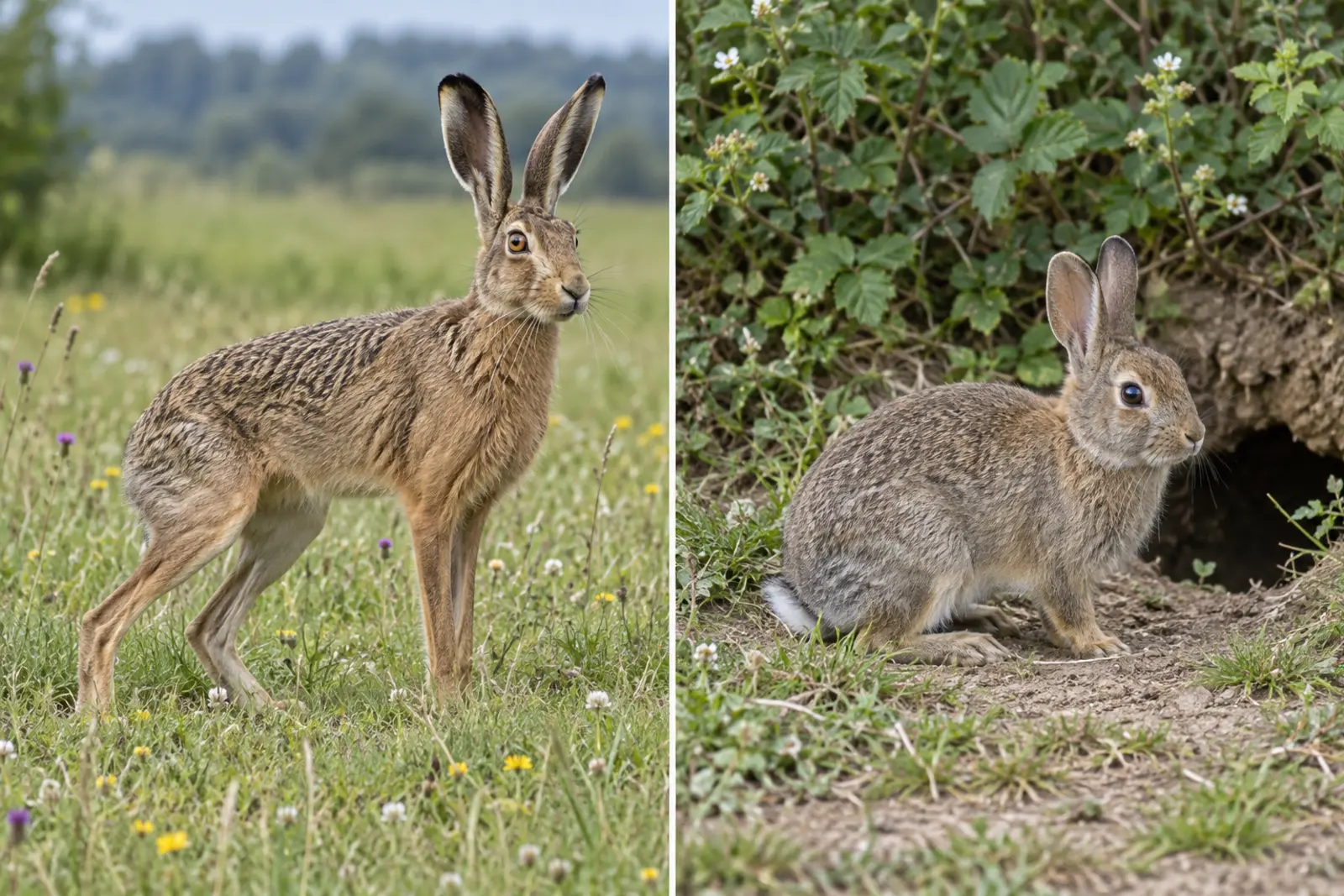
Long-legged brown hare beside a compact European rabbit near a burrow
A brown hare has longer legs and ears than this European rabbit. The panels show typical proportions, not exact scale.

3. Leverets are born far more developed than rabbit kits

The most reliable difference appears at birth. Hare young are called leverets. They are precocial: born with fur, open eyes and enough coordination to move soon after birth. Rabbit young are called kits or kittens. They are generally altricial: born blind, nearly hairless and dependent on a warm, protected nest.

This is not a judgment about which strategy is “better.” Precocial leverets require a longer pregnancy and are exposed above ground, so camouflage and early mobility matter. Rabbit kits develop in a sheltered nest and invest more growth after birth.

Furred open-eyed hare leverets beside blind nearly hairless rabbit kits in a nest
Hare leverets are precocial and rest above ground; rabbit kits are altricial and develop in a sheltered nest. This is an original educational reconstruction.

4. Hares use forms; not all rabbits build warrens

Many hares rest and give birth in a shallow above-ground depression called a form, often hidden by grass or low vegetation. They may also use natural cover, and some hare species occupy rocky or snowy shelters. They do not typically depend on elaborate communal burrow networks.

The European rabbit is the classic warren-builder. It digs connected underground chambers that provide shelter and nursery space for a social colony. But the viral shortcut “rabbits live in warrens” is too broad. Many cottontails do not excavate large warrens; females may make shallow nest scrapes or use existing shelter. Pygmy rabbits are notable burrowers but are not highly social like European rabbits.

5. Hares are built for escape speed

Long hind limbs and a flexible spine help hares accelerate and cover ground with powerful bounds. The European hare is frequently assigned maximum speeds between roughly 55 and 70 km/h, but those numbers are difficult to standardize across observation methods. The defensible conclusion is that hares are generally faster and better suited to sustained escape across open ground than most rabbits.

Rabbits often combine short bursts, abrupt turns and quick retreats into dense vegetation or burrows. That strategy matches a more compact body and a life lived closer to cover. It does not mean rabbits are slow; it means speed is used differently.

6. Their social systems overlap more than memes suggest

Hares are often solitary, although they gather during breeding and may feed near one another where food is concentrated. European rabbits can form organized colonies within warrens. These examples created the popular contrast of “solitary hare versus social rabbit.”

Across the entire family, however, social behavior varies. Animal Diversity Web notes that some leporids live in large communal dens while others are solitary. Many cottontails do not live in stable warren communities. Social structure should therefore be identified at species level.

7. Both are herbivorous lagomorphs—not rodents

Hares and rabbits belong to the order Lagomorpha, along with pikas. They are not rodents. One anatomical distinction is that lagomorphs have a second small pair of upper incisors behind the large front pair. Like many herbivores, they also re-ingest nutrient-rich soft fecal pellets, called cecotropes, to extract more value from plant food.

Both groups eat grasses, herbs, leaves, bark and other vegetation depending on season and habitat. Diet alone is not a reliable way to tell a hare from a rabbit.

How to identify a hare or rabbit safely

  • Look at overall proportions: hares usually appear taller and leggier.
  • Check the ears: long ears with dark tips support a hare identification in many regions.
  • Watch the escape route: a hare may run across open ground, while a rabbit often dives toward cover.
  • Use location and species range before relying on one visual trait.
  • Never disturb a nest to inspect the young. A mother may visit only briefly, and her absence does not prove abandonment.

Frequently asked questions

Can hares and rabbits breed with each other?

Generally no. They belong to different genera, with important genetic and reproductive differences. The “Belgian hare” is not a hare–rabbit hybrid; it is a domestic rabbit breed selected for a hare-like shape.

Is a jackrabbit a rabbit?

No. Jackrabbits are hares in the genus Lepus. The common name developed from “jackass rabbit,” referring to their long donkey-like ears.

Are baby hares called bunnies?

“Bunny” is an informal term. The precise term for a young hare is leveret; a young rabbit is a kit or kitten.

References