
Harpy eagle vs. golden eagle comparisons bring together two very different apex raptors. A female harpy eagle is usually the heavier bird and has exceptionally robust feet for seizing mammals in rainforest trees. A golden eagle generally has the longer wings and is built to soar, search and pursue prey across open mountains, grasslands and deserts. Neither is a universal “winner”: each is specialized for its own habitat and hunting problems.
Harpy eagle vs. golden eagle at a glance
| Feature | Harpy eagle | Golden eagle |
|---|---|---|
| Scientific name | Harpia harpyja | Aquila chrysaetos |
| Typical habitat | Tropical lowland forest | Open mountains, cliffs, grasslands and shrublands |
| Adult weight | Males about 4–6 kg; females about 6–9 kg | Roughly 3–6.1 kg, with females larger |
| Wingspan | About 1.76–2.01 m | About 1.85–2.24 m |
| Body plan | Heavy body, broad rounded wings, long tail, huge feet | Long broad wings, fingered tips, powerful soaring build |
| Important prey | Sloths, monkeys and other forest animals | Rabbits, hares, ground squirrels, birds and other regional prey |
| Global range | Central and South America | Northern Hemisphere |
These figures are useful ranges, not fixed limits. Sex, age, geography and measurement method all matter. In both species, females are larger than males, so a large female should not be treated as the average individual.
Which eagle is bigger?
By body mass, the harpy eagle usually has the advantage. Modern zoo and field summaries place females around 6–9 kg, while males are lighter. The golden eagle is less massive on average; the U.S. National Park Service gives a broad adult range of 3,000–6,125 g. A large female golden eagle can therefore overlap with a smaller harpy eagle, but the heaviest typical harpies exceed the usual golden eagle range.
Wingspan reverses the picture. Harpy eagle wingspans are commonly around 1.76–2.01 m, whereas golden eagles span roughly 1.85–2.24 m. Longer wings do not automatically mean a larger or stronger animal. They reflect different flight environments: open-country soaring rewards span and efficient gliding, while dense forest rewards compact maneuverability.

Why their wings and tails look different
A harpy eagle often hunts below or near the rainforest canopy. Its relatively short, broad wings can generate lift at lower speed, and its long tail helps it brake, turn and thread around trunks and branches. It may wait quietly on a perch before making a short, forceful approach toward prey in a tree.
A golden eagle searches much more open country. Long, broad wings with separated “finger” feathers at the tips support soaring on rising air and covering large areas with limited flapping. Golden eagles can also accelerate in steep descents, but soaring efficiency and controlled pursuit are at least as important as headline-grabbing maximum speeds.
Talons and grip: why PSI rankings mislead
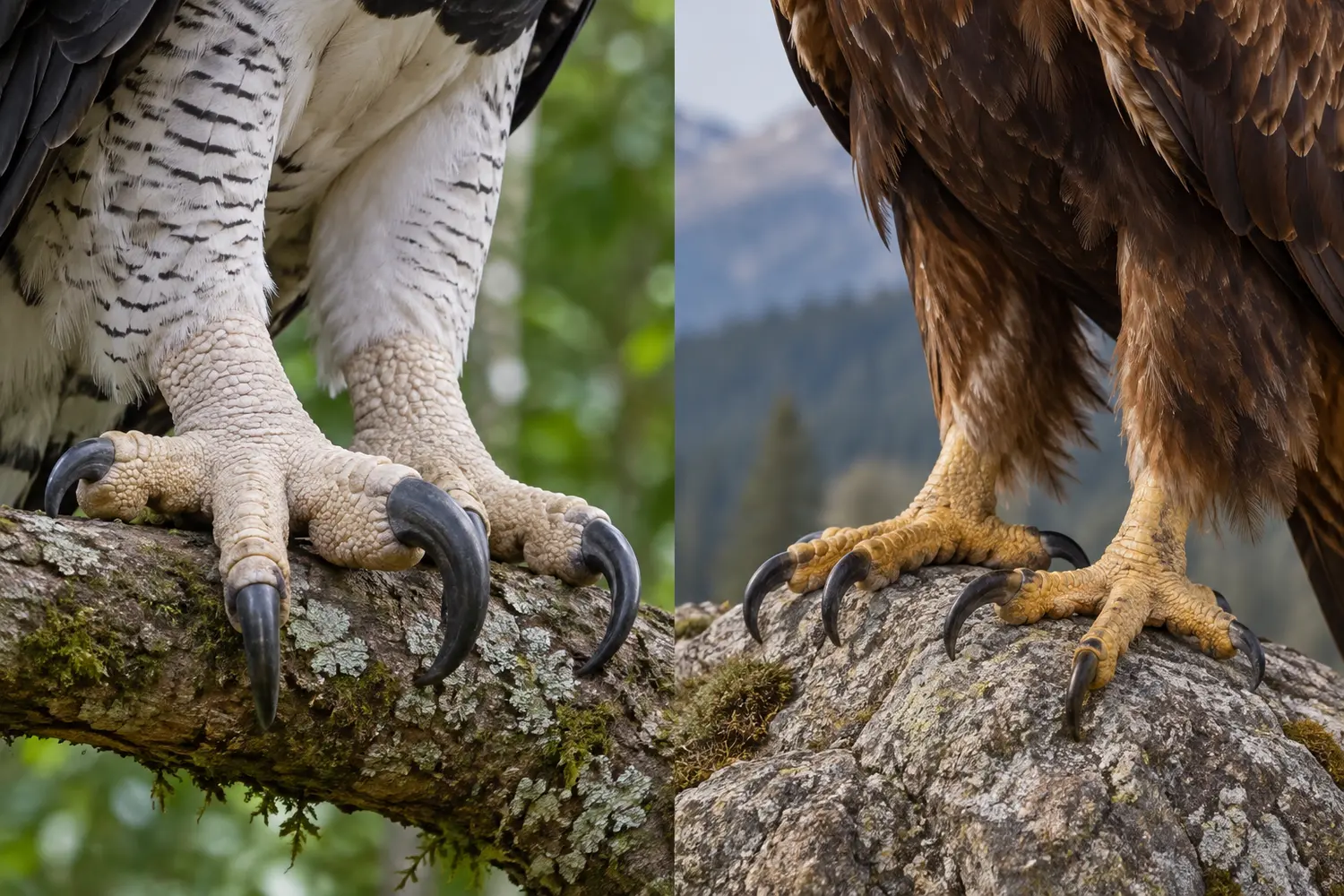
The harpy eagle has strikingly thick lower legs, long toes and enormous curved talons. The rear claw of a large female may approach 12–13 cm, depending on exactly how it is measured. Its feet are suited to wrapping around both branches and medium-sized arboreal prey. Learn more in our detailed harpy eagle profile.
Golden eagle feet are also formidable, but they are proportioned for a wider range of mostly terrestrial prey. The toes spread around an animal while flexor tendons and powerful leg muscles help maintain a secure hold. Golden eagles can kill substantial prey, yet most meals are far smaller than goats or deer.
Viral graphics often assign the harpy eagle a grip of 530 PSI and the golden eagle another precise pressure value. Those numbers should not be treated as standardized scientific measurements. Force and pressure are different quantities; pressure changes with contact area, posture, individual size and which toes are loaded. There is no universal field test that makes a simple cross-species PSI ranking reliable. Our guide to how eagle talons actually work explains the mechanics in more detail.
What do harpy eagles hunt?
Harpy eagles specialize in animals that live in tropical forest trees. Sloths and primates are important in many studies, joined by porcupines, opossums, coatis, anteaters, reptiles and large birds. Diet varies among regions and nests. The bird may feed where it captures a large animal or transport only part of it, so “can kill” and “can carry whole” are not the same claim.
This hunting style explains the harpy eagle’s heavy body and oversized feet. It does not mean every strike is successful, every prey animal is lifted, or the eagle routinely carries loads equal to its own mass. Dense foliage also makes stealth, short-distance acceleration and precise foot placement more useful than a record-breaking long dive.
What do golden eagles hunt?
Golden eagle diets are geographically diverse. Rabbits, hares, marmots, ground squirrels and other mammals are important across much of the range, and the birds also take grouse and other birds, reptiles, carrion and young ungulates where opportunities arise. Pairs sometimes cooperate, with one bird driving prey toward the other.
Golden eagles have been recorded attacking mountain goat kids and other young hoofed mammals. However, the popular image of an eagle routinely knocking goats or deer from cliffs exaggerates rare events. A scientific review of mountain-goat defenses cites historical reports that include an occasional successful cliff fall, but observations also document unsuccessful attacks. This is not the species’ everyday hunting method, and it does not support a general claim that golden eagles regularly kill adult deer.
Can a golden eagle really dive at 320 km/h?
Cornell Lab notes that dives close to 200 mph—about 320 km/h—have been clocked for golden eagles. That is best understood as a reported maximum in a steep descent, not a normal cruising or hunting speed. Actual speed changes with wind, slope, starting altitude, flight path and behavior. A golden eagle may use a low contour flight, a shallow glide or an ambush from a perch instead of a spectacular vertical dive.
Harpy eagles are not built to challenge that open-air descent record. Their advantage is control in cluttered forest. Comparing only top speed is like comparing a mountain glider with a powerful canopy aircraft: the result says more about habitat than overall superiority.
Which eagle is stronger?
There is no scientifically meaningful single answer. “Strength” might refer to body mass, foot dimensions, lifting ability, acceleration, endurance or the force used in one behavior. The harpy eagle is heavier and has more massive feet, adaptations that help it restrain arboreal mammals. The golden eagle has the greater wingspan and excels at efficient flight and pursuit in open terrain.
A staged fight prediction would add little biology. The species live on different continents, do not meet in nature and were not shaped to duel one another. Habitat does not simply award victory to one bird; it changes whether the comparison makes ecological sense at all.
Conservation differences
Harpy eagles depend on extensive tropical forest and reproduce slowly. Forest loss, fragmentation and shooting have removed them from parts of their former range, and the species is globally classified as Vulnerable. Protecting mature nesting trees matters, but breeding pairs also need wide areas of connected hunting habitat.
Golden eagles occupy a much wider Northern Hemisphere range. Regional threats include collisions and electrocution on infrastructure, poisoning, disturbance near nests, illegal killing and changes in prey or habitat. A broad range does not make every local population secure, so conservation priorities differ by country and landscape.
Frequently asked questions
Is a harpy eagle heavier than a golden eagle?
Usually, especially when comparing females. Female harpy eagles commonly reach about 6–9 kg, while published golden eagle ranges generally top out a little above 6 kg. Individual ranges overlap, so sex and the actual bird matter.
Which has the larger wingspan?
The golden eagle generally has the larger wingspan, reaching roughly 2.2 m in published summaries. Harpy eagle wings are shorter relative to the bird’s heavy body, an advantage for maneuvering among trees.
Do harpy and golden eagles live together?
No. Harpy eagles inhabit tropical forests of Central and South America. Golden eagles occur across parts of North America, Europe, Asia and North Africa, mainly in open or mountainous landscapes.