
The honey badger’s reputation is often inflated into myth, but one of its most useful defenses is entirely real: thick, tough skin that fits loosely over much of the body. That combination makes the animal difficult to hold and gives it room to turn when something grips its neck or back.
This does not make a honey badger invulnerable. Lions, leopards and spotted hyenas can kill them, and their skin is not literal armor. Instead, the hide works as one part of a broader defensive system that includes a compact build, strong forelimbs, long digging claws, powerful jaws, scent-gland secretions and forceful threat displays.
Why is honey badger skin so unusual?
The honey badger, or ratel (Mellivora capensis), is a mustelid related to weasels, otters and other badgers. Accounts from zoological references consistently describe its skin as thick, tough and loosely fitted. The looseness is especially important around the neck and shoulders, where a predator is likely to grab.
When skin is tightly anchored to the tissues beneath it, an external grip can restrict the whole body. A looser hide can move relative to the muscles and skeleton. In a honey badger, that mobility may allow the animal to twist its head and shoulders toward an attacker rather than remaining pinned in the direction of the grip.
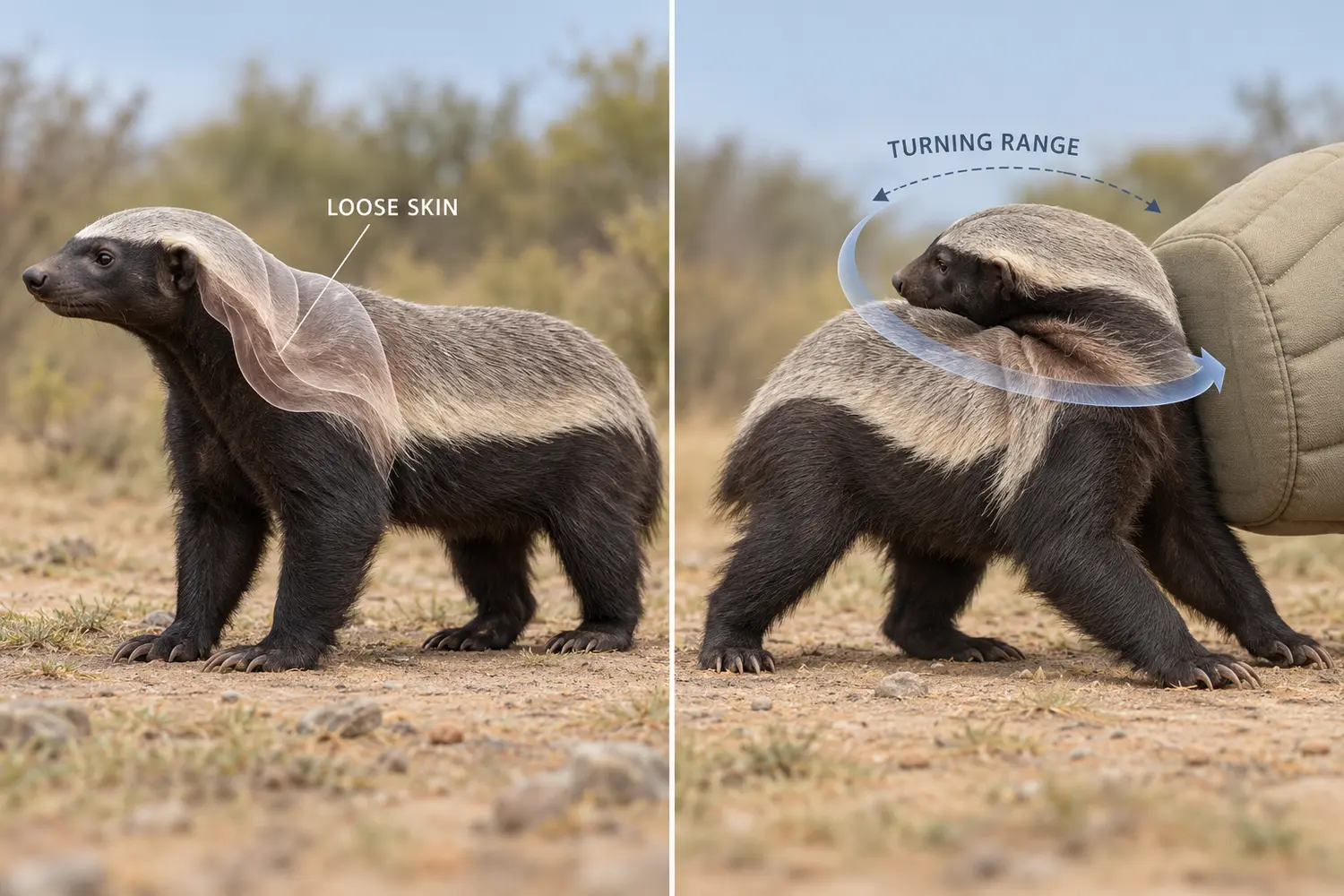
Can a honey badger really turn inside its skin?
The familiar phrase is vivid but should not be taken literally. The animal does not rotate independently inside a stationary bag of skin. Its mobile hide gives the body more room to twist under a grip, helping the honey badger turn its head toward the source of pressure and use its teeth or claws.
San Diego Zoo and Animal Diversity Web both describe this defensive movement. Historical and modern species accounts likewise report that the tough, loose skin makes it harder for predators to obtain a firm hold. The benefit is mechanical: a grip on fur and skin does not always translate into complete control of the animal beneath.
That is different from saying every predator bite is harmless. Teeth can still penetrate, crushing force can still injure, and a sufficiently powerful predator can overpower a honey badger. The adaptation improves the odds of escape; it does not guarantee survival.
Is the skin bite-proof or stinger-proof?
No biological skin should be described as universally bite-proof. Honey badger skin and the fatty tissues beneath it can offer useful protection against teeth, claws and close-contact fighting, but they are not an impenetrable shield. Location, force, tooth shape and the size of the attacker all matter.
The same caution applies to bee stings. Honey badgers raid nests for bee larvae and other food, and their coat and skin can reduce exposure. Yet unprotected areas around the eyes, nose and mouth remain vulnerable. Their common name can also mislead: field studies show that they are generalist, opportunistic predators rather than animals that live mainly on honey.
How loose skin fits the rest of the body
A honey badger is built low to the ground, with a broad back, short powerful limbs and large front claws. This body plan is effective for digging into burrows and excavating prey, but it also provides stability during a confrontation. The animal presents a compact target with relatively little exposed underside.
Loose skin adds mobility to that compact frame. Strong neck and shoulder muscles help the animal turn, while the jaws and claws provide a way to respond once it has done so. Anal scent glands can release a strong odor, and a loud rattling roar or charge may persuade an opponent to disengage before physical contact escalates.
These traits work together. The skin alone does not explain the honey badger’s defensive success, just as claws alone do not explain its digging ability.
Are honey badgers immune to snake venom?
Honey badgers sometimes hunt venomous snakes and can survive bites that would disable many mammals. Molecular studies have identified changes in their muscle-type nicotinic acetylcholine receptor, the target used by some snake alpha-neurotoxins. One amino-acid substitution changes the receptor’s chemical environment and reduces the ability of certain toxins to bind effectively.
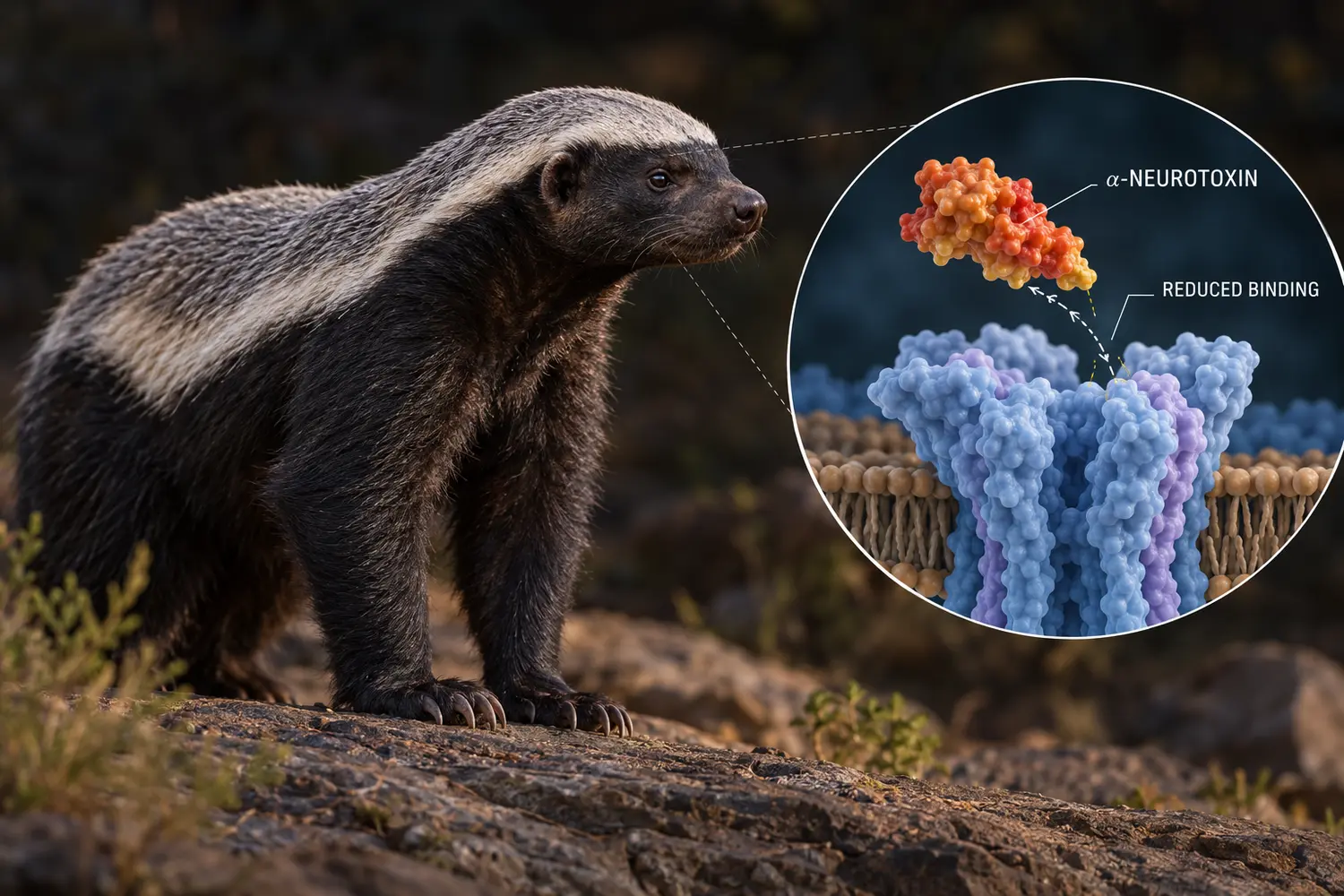
That finding supports resistance to a specific class of neurotoxins; it does not show that honey badgers are immune to every venom, every snake species or every dose. Snake venoms are complex mixtures that may include neurotoxins, tissue-damaging cytotoxins, blood-affecting toxins and other components. A bite can still cause pain, injury, incapacitation or death.
Skin and venom resistance are also separate adaptations. Thick skin may make some bites less effective if the fangs fail to penetrate deeply, while receptor-level resistance acts after a toxin enters the body. Neither mechanism should be treated as absolute protection.
Do honey badgers attack everything they see?
The viral image of a permanently enraged animal is misleading. Honey badgers are capable defenders, but field research describes them primarily as solitary, wide-ranging foragers. They spend much of their time searching and digging for rodents, reptiles, insects, birds, eggs and other available food.
A threat display may look exceptionally aggressive because a cornered honey badger benefits from convincing a larger animal that the encounter will be costly. Defensive boldness is not the same as indiscriminate aggression. Like other wildlife, honey badgers generally have more to gain from feeding, breeding and avoiding serious injury than from unnecessary fights.
What can kill a honey badger?
Adult honey badgers are challenging prey, not predator-proof animals. Documented predators include lions, leopards and spotted hyenas, with older, weaker or young individuals generally more vulnerable. Cubs may also be taken by other carnivores.
People can present a greater and more persistent risk. Honey badgers may be killed in conflict with beekeepers and poultry owners, caught in traps, poisoned indirectly during predator-control campaigns or struck on roads. Their broad range supports a global Least Concern classification, but local populations can decline where persecution and habitat change are intense.
Five myths about honey badger skin
- Myth: The skin is bulletproof. It is tough biological tissue, not ballistic armor.
- Myth: Nothing can bite through it. Large carnivores can injure and kill honey badgers.
- Myth: The animal spins freely inside a motionless skin sack. Loose attachment allows extra twisting movement; the body and hide still move together.
- Myth: Thick skin creates total venom immunity. Skin may reduce penetration, while molecular resistance affects only some toxins.
- Myth: Honey badgers never retreat. Threat displays and escape are both sensible ways to avoid costly injury.
Frequently asked questions
How thick is honey badger skin?
Popular sources often give a single measurement, especially for the neck, but skin thickness varies across the body and published species accounts do not support treating one number as universal. “Thick, tough and loose” is the more defensible description.
Why is the skin loose?
Loose attachment makes it harder for a predator to immobilize the whole body by gripping the hide. It gives the honey badger additional room to twist, turn toward the grip and attempt to escape.
Can honey badgers survive cobra bites?
They can survive some bites, and research supports receptor-level resistance to certain cobra-like alpha-neurotoxins. Survival still depends on venom composition, dose, bite location and the health of the individual.
Are honey badgers related to European badgers?
Both belong to the mustelid family, but the honey badger is the only living species in the genus Mellivora and is placed in its own subfamily, Mellivorinae.
A real adaptation without the superhero mythology
Honey badger skin is remarkable because it combines toughness with mobility. It helps reduce the effectiveness of a predator’s grip and gives the animal a better chance to turn, defend itself and escape. But the hide is neither invincible armor nor the sole reason honey badgers are formidable.
The accurate story is more interesting: multiple traits—skin, muscles, claws, jaws, behavior and selective toxin resistance—work together in a compact carnivore adapted to difficult prey and dangerous encounters.