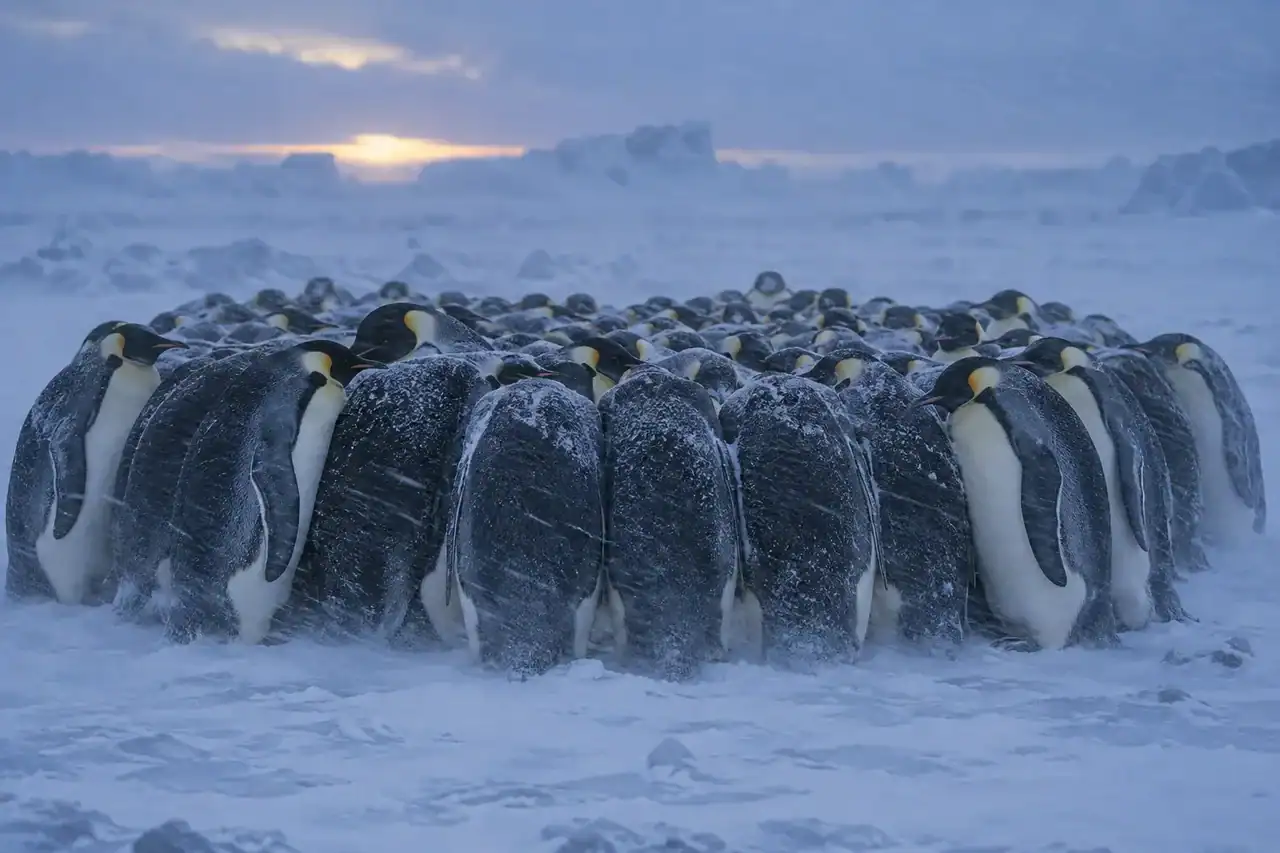
Emperor penguin fathers keep a single egg warm through the Antarctic winter by balancing it on their feet beneath a feathered brood pouch. The male incubates for roughly 65–75 days, but his total fast can last about four months. He survives by using stored body fat, minimizing movement, conserving heat and joining tightly packed huddles with other males.
Key takeaways
- The female lays one egg and carefully transfers it to the male before returning to sea to feed.
- The male keeps the egg off the ice on his feet, covered by a warm brood pouch.
- Incubation lasts about 65–75 days, while the male’s full breeding fast may approach four months.
- Huddling, insulation, stored fat and extremely economical movement help males survive.
- This is shared parental care: after the female returns, both parents alternate brooding and foraging.
Why does the male emperor penguin incubate the egg?
Emperor penguins (Aptenodytes forsteri) breed during the Antarctic winter, when access to open water may be many kilometres from the colony. A female produces one egg in late autumn or early winter. Laying it consumes substantial energy, so she must return to the ocean to rebuild her reserves and collect food for the chick.
The male takes over at the colony. This division of labour gives the egg continuous protection while the female feeds at sea. It is not simply a story of the father replacing the mother: the entire breeding cycle depends on both adults performing different, tightly timed roles.
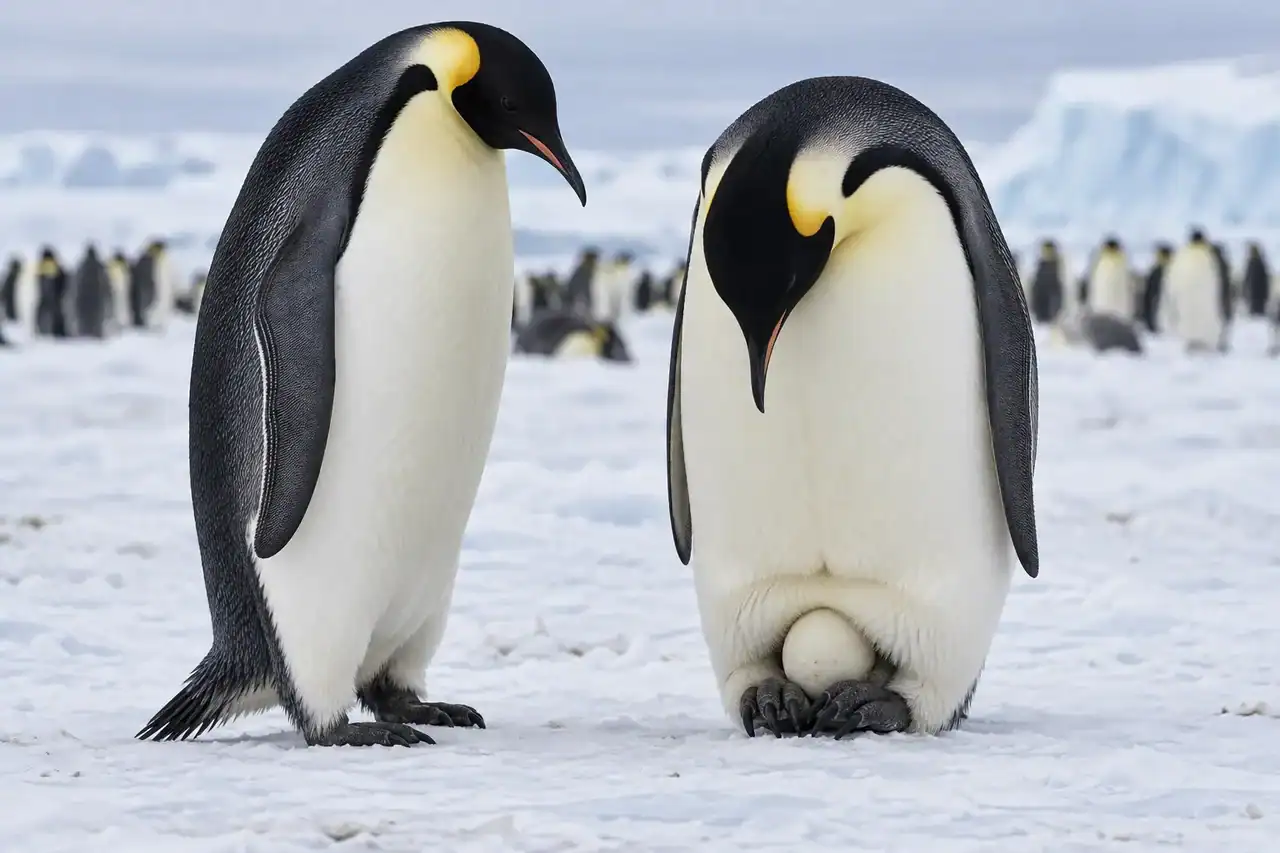
How does an emperor penguin father keep the egg warm?
The egg never sits in a nest. There are no twigs or dry ground on the sea ice, and direct contact with the frozen surface could quickly chill it. Instead, the male rolls the egg onto the tops of his feet and lowers a specialized fold of abdominal skin—the brood pouch—over it.
According to the Australian Antarctic Program, the protected egg is maintained at about 38°C even when outside temperatures fall well below −35°C. The transfer between parents is delicate because an exposed or dropped egg can lose heat rapidly.
How long do male emperor penguins go without food?
The incubation period is commonly given as 65–75 days. However, the male has already been fasting since arriving at the breeding colony, so the complete fast is longer. Government and research sources describe a total of roughly 110–120 days, or about four months, by the time the egg hatches and the female returns.
During this period the male cannot leave to hunt because the egg must remain on his feet. He lives on fat accumulated before the breeding season and may lose close to half his body mass. Exact duration and weight loss vary with timing, weather, travel distance and the female’s return.
The adaptations that make the winter fast possible
Dense insulation and heat recovery
Emperor penguins have multiple layers of dense, scale-like feathers and substantial fat reserves. Their relatively small bills and flippers reduce exposed surface area. Blood vessels in the extremities also exchange heat, limiting energy loss as warm blood travels outward and cooler blood returns toward the body.
A low-energy posture
An incubating male stands with the egg supported above the ice and keeps his flippers close to his body. He may remain nearly motionless for long periods. Every unnecessary movement consumes energy that cannot be replaced until he reaches the sea again.
The life-saving huddle
When cold and wind intensify, males pack together. Huddling reduces the body surface exposed to the weather and creates a much warmer local environment. The Australian Antarctic Program reports that huddling can cut heat loss by as much as 50%.
A huddle is not a frozen wall of birds. A 2011 PLOS ONE study found that penguins make coordinated steps every 30–60 seconds. These small movement waves gradually reorganize the group, helping it remain densely packed without permanently trapping individuals at the cold edge.