
Snakes can have hundreds of bones, but there is no single bone count that applies to every species. Their skeleton is dominated by a long vertebral column and many paired ribs. Depending on species and how the count is defined, snakes may have roughly 100–400 trunk vertebrae plus as many as 200 tail vertebrae. A large individual can therefore possess far more individual skeletal elements than a human or dog.
Key takeaways
- Snake bone counts vary substantially among species and individuals, so “500+ bones” is possible for some large snakes but is not a universal king cobra total.
- An adult human is conventionally described as having 206 bones, although anatomical variation and counting conventions can change the number.
- A dog is often listed at about 319 bones, but tail vertebrae, dewclaws, sex and counting methods introduce variation.
- More bones do not automatically make an animal stronger, faster or more flexible; proportions, joints, muscles, connective tissues and behavior all matter.
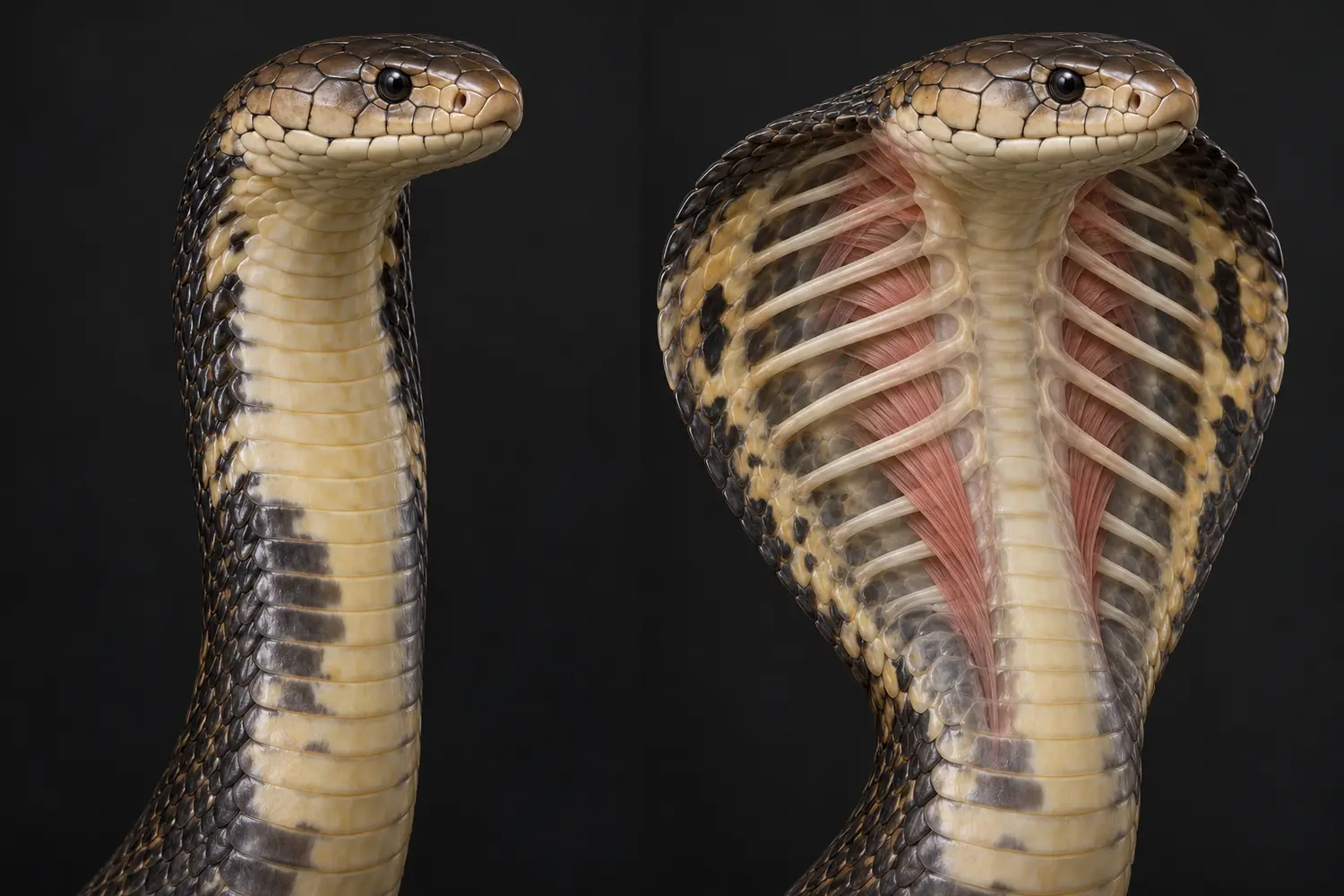
- Cobras spread their hoods by actively moving elongated neck ribs with specialized muscles.
How many bones does a snake have?
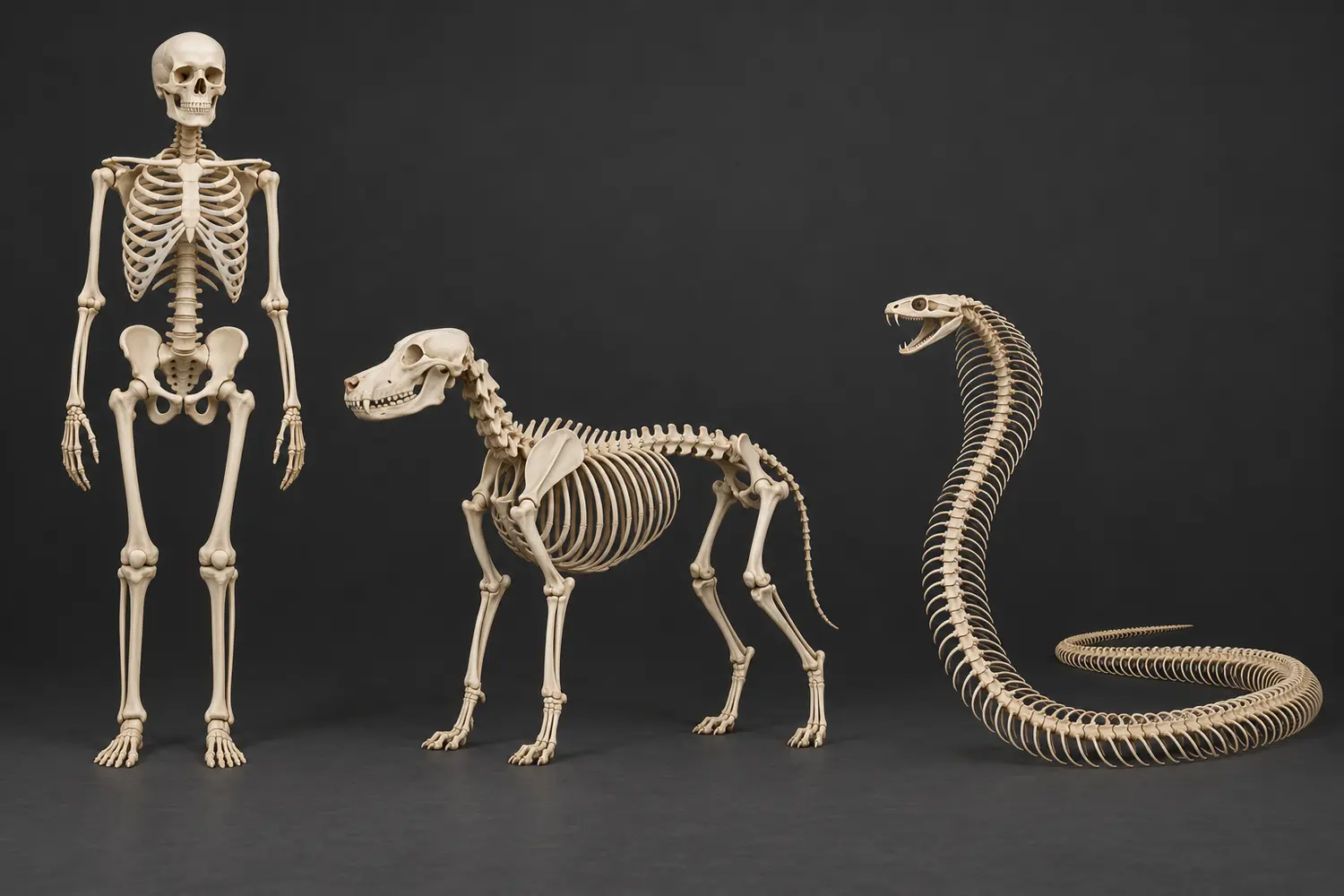
The honest answer is a range rather than one exact figure. The Natural History Museum notes that snakes have about 100–400 vertebrae in the main spine and can have up to roughly 200 more in the tail. Many of the precaudal vertebrae carry a pair of ribs. Add the skull and other small skeletal elements, and the total can reach several hundred bones.
Counts vary because snakes differ enormously in body plan. A short-bodied viper and a long king cobra do not have identical numbers of vertebrae. Even closely related species can differ, and researchers may count fused or paired structures differently. This makes a viral statement such as “a king cobra has exactly 500 bones” too precise unless it refers to a documented specimen and a defined counting method.
Why snakes have so many vertebrae and ribs
The snake body evolved through extreme elongation of the axial skeleton. A developmental review notes that snakes commonly have more than 300 vertebrae, compared with about 60 in a mouse and roughly 65 in the green anole used as an example in that paper. Most precaudal snake vertebrae bear ribs rather than being divided into a large rib-free lumbar region like that of many mammals.
This repeating structure creates many short, linked segments. Muscles running along the body can bend different regions against the ground, vegetation or tunnel walls. But the bones do not act alone. Locomotion also depends on muscle activation, joint geometry, skin and the directionally organized friction of the ventral scales.
Nor do the ribs all serve one simple “walking” function. Research on rectilinear movement has shown that the relationship among ribs, skin and belly scales differs by locomotor mode. In other behaviors, ribs can move substantially—for example when a cobra raises its hood or when some snakes reshape their bodies during gliding or burrowing.
How a king cobra forms its hood
A king cobra does not inflate its hood with air. It raises and rotates elongated ribs in the neck, spreading the overlying skin laterally. A biomechanical study identified the levator costae and supracostalis lateralis superior among the prime muscles that erect the hood. Other muscles help connect the ribs to the skin and control the display.
The hood is primarily a defensive visual signal that makes the snake appear broader. It is not a rigid shield, and the ribs do not detach from the vertebral column. Smithsonian descriptions likewise note that king cobras flatten their neck ribs to produce the hood.
Human, dog and snake bone counts compared
| Animal | Commonly cited count | Important qualification |
|---|---|---|
| Adult human | About 206 bones | Anatomical variation and different counting conventions can alter the total. |
| Adult dog | About 319 bones | Tail length, dewclaws, sex-specific bones and counting methods produce variation. |
| Snake | Several hundred skeletal elements | Species, size, vertebral count and definition of “bone” make one universal total impossible. |
Humans: 206 is a convention, not a universal constant
Medical references commonly state that an adult human skeleton has 206 bones. Infants start with more elements that later fuse. Accessory bones, sesamoids and differences in how skull or fused structures are counted mean that healthy adults do not all have an identical total. A historical anatomy review concluded that establishing one definitive human bone count is more complicated than the familiar textbook number suggests.
Dogs: approximately 319, with a variable tail
Veterinary anatomy references commonly give the adult dog a total near 319 bones. The number is approximate because caudal vertebrae vary with tail anatomy, and digit anatomy can differ. Male dogs also possess an os penis. Breed selection can greatly change the size and shape of bones without necessarily producing the same change in their number.
The viral claim that dogs have “unattached collarbones” needs refinement. Dogs do not have a functional bony clavicle joining the shoulder to the trunk as humans do. Their forelimbs are suspended from the torso largely by muscles and connective tissues—a muscular sling that helps absorb forces during locomotion. Calling this a loose or floating shoulder is more accurate than implying a normal human-like collarbone is simply disconnected.
Snakes: many repeating axial elements
A snake allocates much of its skeleton to vertebrae and ribs instead of limbs and limb girdles. Museum specimens show just how variable the totals can be: Cambridge’s Museum of Zoology reconstructed a 3.5-meter python from 316 vertebrae and 518 ribs, while a study of an Indian rock python reported 280 vertebrae and 264 pairs of ribs. These specimen figures illustrate variation; they are not templates for every snake.
Does having more bones make an animal more flexible?
Segment number can influence the range and distribution of movement, but “more bones equals more flexibility” is not a general biological law. Flexibility depends on the shape of joints, the orientation of articular surfaces, ligaments, muscles and the range permitted at each joint. Hundreds of vertebrae give a snake many locations where small bends can accumulate into a large body curve, yet each segment also has processes that resist damaging rotation and stabilize the column.
The reverse slogan—“fewer bones mean rigidity”—is also misleading. Humans have fewer vertebrae than snakes but highly mobile shoulders, hands and necks. Dogs achieve fast, efficient running through limb proportions, spinal movement, muscles and tendons, not simply by possessing more bones than humans.
Does bone count measure strength?
No. Bone count is not a strength ranking. Strength can refer to the load a bone withstands, muscle force, bite mechanics, endurance or whole-body performance. Those properties depend on material structure, cross-sectional geometry, body size and many other factors.
A snake’s numerous small vertebrae support an elongated, limbless body plan. A dog’s skeleton supports quadrupedal locomotion. A human skeleton supports upright posture and highly manipulative hands. Each arrangement involves trade-offs, but none can be judged by adding bones and declaring a winner.
Frequently asked questions
Do king cobras really have more than 500 bones?
A large snake can exceed 500 individual skeletal elements when vertebrae, paired ribs and skull bones are counted, but there is no reliable universal total for every king cobra. Use specimen-specific figures only when the counting method is stated.
Do snakes have a backbone?
Yes. Snakes are vertebrates with a long spinal column composed of many articulated vertebrae. Their ribs attach to most trunk vertebrae.
Do snakes use their ribs to move?
Ribs participate in body support and some specialized movements, but snake locomotion is produced by an integrated system of vertebrae, muscles, skin and ventral scales. The exact role of rib motion varies with the locomotor mode.
Does every adult human have exactly 206 bones?
No. Two hundred six is the standard teaching figure, but accessory bones, sesamoids, fusions and counting conventions create healthy variation.