
A Siberian Husky vs gray wolf comparison can be visually striking: both are northern canids with erect ears, thick coats and athletic bodies. Yet the resemblance should not obscure the central fact. A Siberian Husky is a domesticated working dog selected to cooperate with people, while a gray wolf is a wild predator adapted to survive within a family-based pack and a natural ecosystem.
They share evolutionary ancestry, but a Husky is not a small wolf, and a wolf is not an oversized Husky. Their bodies, behavior and relationships with humans reflect very different histories.
Siberian Husky vs gray wolf at a glance
| Trait | Siberian Husky | Gray wolf |
|---|---|---|
| Identity | Domestic dog breed, Canis lupus familiaris | Wild canid, Canis lupus |
| Primary context | Human-directed sled and companion work | Wild foraging, territoriality and reproduction |
| Typical structure | Medium-sized, compact and balanced | Generally longer-legged, larger-pawed and more robust |
| Social environment | People and other dogs under human care | Family pack and wild territory |
| Responsible comparison | Anatomy, behavior and ecology—not a staged fight | |
A Husky was selected to work with people
The Siberian Husky breed standard describes a medium-sized working dog that is quick and light on its feet, with a body built to pull a light load at moderate speed over long distances. The desired animal should appear powerful without being heavy or coarse. Official standards place adult males at 45–60 pounds and females at 35–50 pounds, while emphasizing balance rather than maximum size.
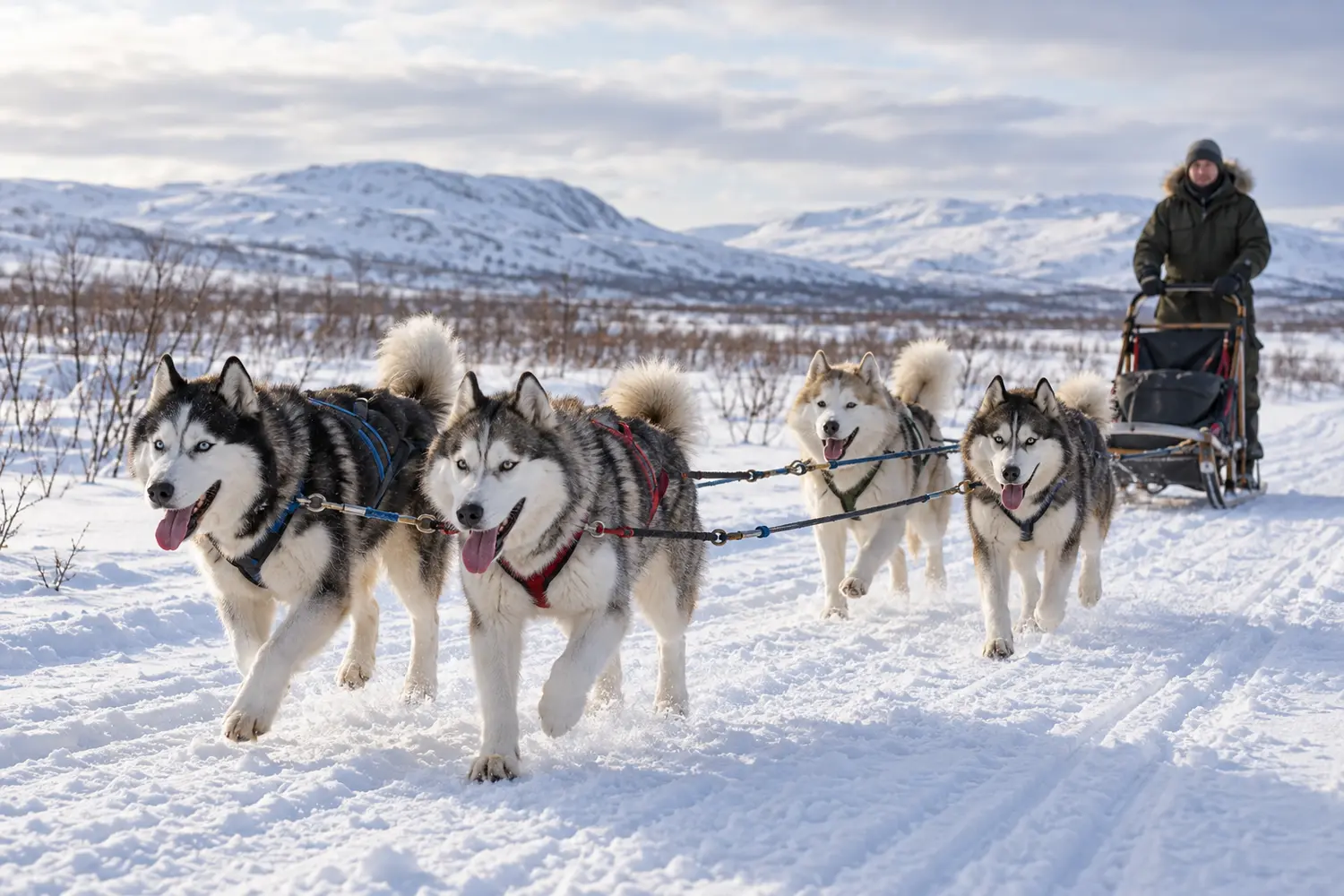
That background helps explain the Husky’s combination of endurance, efficient movement and social willingness to work in a team. Recent physiological research on trained Siberian and Alaskan Huskies found racing-season changes consistent with more efficient mitochondrial function, although performance depends on conditioning, health, diet and individual variation.
A thick double coat provides insulation, but it does not make every Husky automatically comfortable in every cold-weather activity. Working dogs still need appropriate conditioning, hydration, veterinary care and protection from environmental extremes.
A gray wolf is adapted to wild survival
Gray wolves vary substantially across their enormous geographic range. Sex, age, region, prey and subspecies all influence body size. In Yellowstone, National Park Service figures list average masses around 50 kilograms for males and 41 kilograms for females, but those numbers are local examples rather than universal species averages.
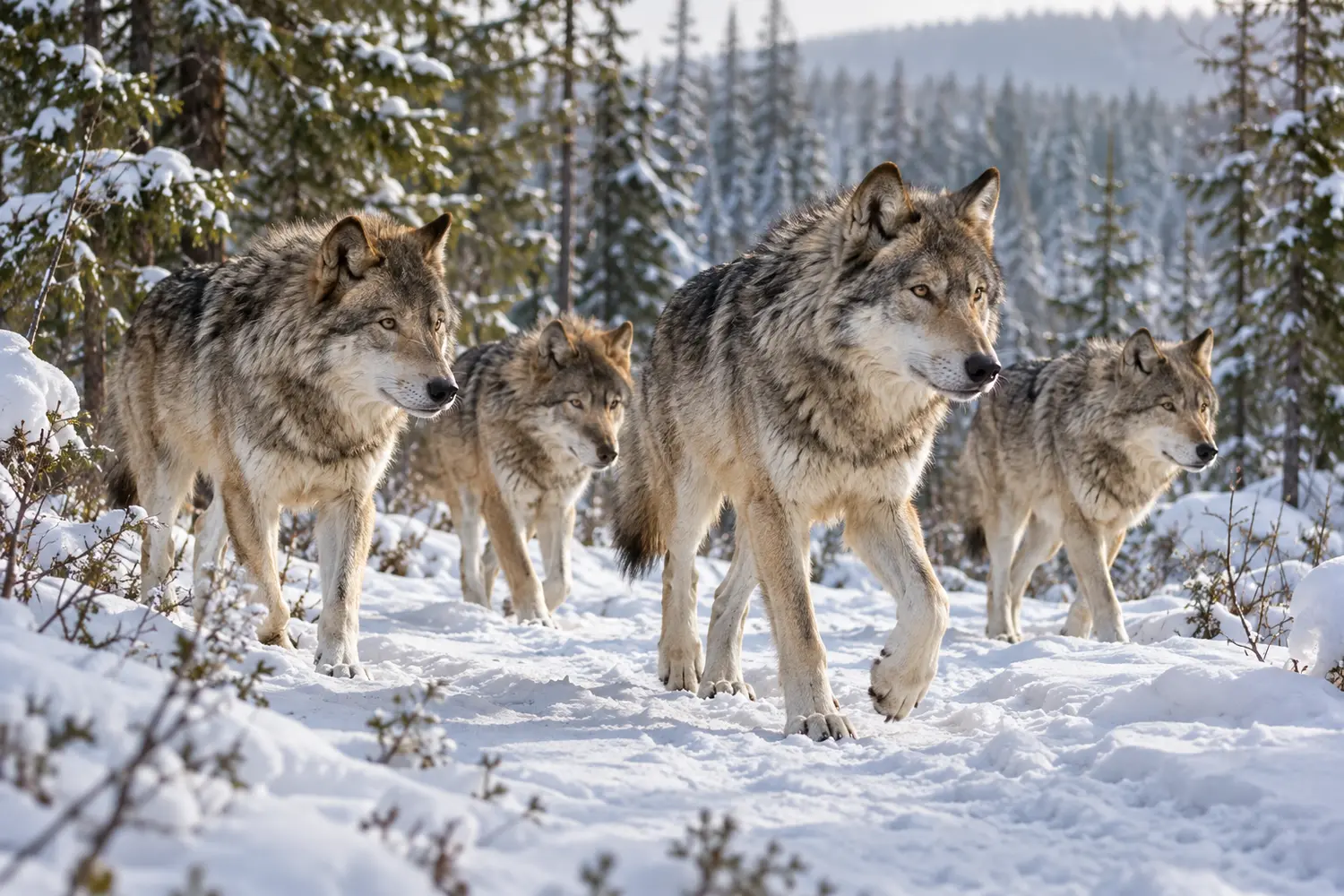
Compared with a Siberian Husky, a gray wolf generally has longer legs, larger feet, a narrower chest and a tail that usually hangs more naturally instead of curling over the back. The wolf’s skull, teeth and body are parts of a complete wild feeding and locomotor system—not proof of a single universal “power” score.
Wolf packs are commonly family groups. Cooperation can help wolves defend territory, raise pups and hunt larger prey, but pack size and hunting behavior vary with prey, season and local ecology. Wolves also take smaller prey and may travel without hunting.
Domestication changed more than appearance
Dogs descend from ancient wolf populations, but modern dog breeds are not derived directly from today’s living wolves. Thousands of years of domestication followed by focused breed selection altered dogs’ size, development, reproduction and behavior.
Research comparing dogs and wolves shows that simple slogans—such as “dogs are friendlier and wolves are smarter”—are inadequate. Experience and rearing matter, and different studies test different abilities. Still, domestication clearly shaped dogs for a socio-ecological niche closely connected to humans. Studies have found stronger spontaneous interest in human proximity and cooperative communication in dogs, even when carefully socialized wolves can also form strong bonds with caregivers.
A Husky’s wolf-like outline therefore does not make it a wolf hybrid. The Siberian Husky is an established domestic breed with a documented standard and working history.
Why the 320 PSI and 400 PSI claims do not work
The source poster assigns 320 PSI to the Husky and 400 PSI to the wolf. These should not be treated as verified breed and species averages.
Bite force changes with body size, skull shape, tooth position, gape, motivation and measurement method. Research in domestic dogs has produced very different values at the canine and molar teeth, and reviews caution that direct measurements, anesthetized muscle stimulation, skull-based lever models and computer simulations are not interchangeable.
PSI also describes pressure, not simply force. Without the contact area and a standardized protocol, a precise PSI number can create false confidence. It cannot reliably answer which animal is “stronger.”
Are Huskies safe substitutes for wolves?
No animal should be chosen only for a wild appearance. Siberian Huskies are domestic dogs, but they are energetic working animals that need secure containment, exercise, training and social contact. Individual prey drive and escape behavior also require responsible management.
A gray wolf is wildlife, not a difficult dog breed. Keeping or approaching one involves major welfare, legal and safety issues. Wild wolves should be observed from a respectful distance and managed according to local wildlife regulations.
Would a Husky and a wolf fight?
A forced encounter would be dangerous and scientifically meaningless. Outcomes would depend on the individuals and circumstances, while the comparison would teach little about either species. Responsible owners prevent domestic dogs from chasing, approaching or feeding wild carnivores.
The meaningful contrast is not “resilience versus lethal power.” It is human-directed endurance work versus the broader demands of survival in the wild.
Frequently asked questions
Is a Siberian Husky part wolf?
No. The Siberian Husky is a domestic dog breed, not a wolf-dog hybrid. Dogs and wolves share ancestry and can interbreed, but that does not make every wolf-like dog a hybrid.
Is a gray wolf always larger than a Husky?
Many adult gray wolves are larger and longer-legged than Siberian Huskies, but wolves vary by sex, age and region. “Always” is too absolute.
Why do Huskies look like wolves?
They retain several northern, spitz-type features—erect ears, a dense coat and an athletic outline—that people associate with wolves. Breed selection also preserved traits useful for cold-weather work.
Which has greater endurance?
The comparison has no single test. Huskies were selected and trained for sustained sled work under human care. Wolves routinely travel through wild territories while foraging and defending a pack’s range. The tasks and conditions differ.
References
- American Kennel Club — Official Standard of the Siberian Husky
- Fédération Cynologique Internationale — Siberian Husky
- Sælen-Helgesson et al. — Endurance training and mitochondrial respiration in Huskies
- Range and Marshall-Pescini — Comparing wolves and dogs
- Lazzaroni et al. — Social interaction of dogs and wolves with humans
- U.S. National Park Service — Yellowstone Wolf Facts
- Kim et al. — Bite Forces and Their Measurement in Dogs and Cats