
Nearly two decades after researchers photographed an unfamiliar black monkey in the forests of the Democratic Republic of the Congo, a combination of field observations, anatomy, genetics and vocal recordings has established it as a species new to science. Its scientific name is Colobus congoensis, and researchers recommend the local name Likweli as its English common name.
The description, published in PLOS ONE in July 2026, is unusually significant. Likweli is reported as only the fifth newly described African monkey species in roughly 75 years. It is also a reminder that “discovery” is rarely a single moment: local knowledge and an initial photograph began a long process of surveys and comparison before scientists could formally name the animal.
What is the correct scientific name of Likweli?
The accepted name introduced by the species description is Colobus congoensis. The name Colobus dongdensis, which has circulated in some social-media posts, is incorrect.
Congoensis refers to the Congo region. The study’s authors retained “Likweli,” a vernacular name used by some communities near the monkey’s range, as the recommended common name. That choice acknowledges that the animal was not unknown to everyone simply because it had not yet received a formal scientific description.
How was this new monkey species found?
The first research encounter came in 2008, when a field team photographed part of an unusual black monkey during an expedition in central DRC. The image did not provide enough detail to name a species. Researchers needed repeat observations, specimens suitable for anatomical and genetic comparison, and evidence that the population differed consistently from known colobus monkeys.
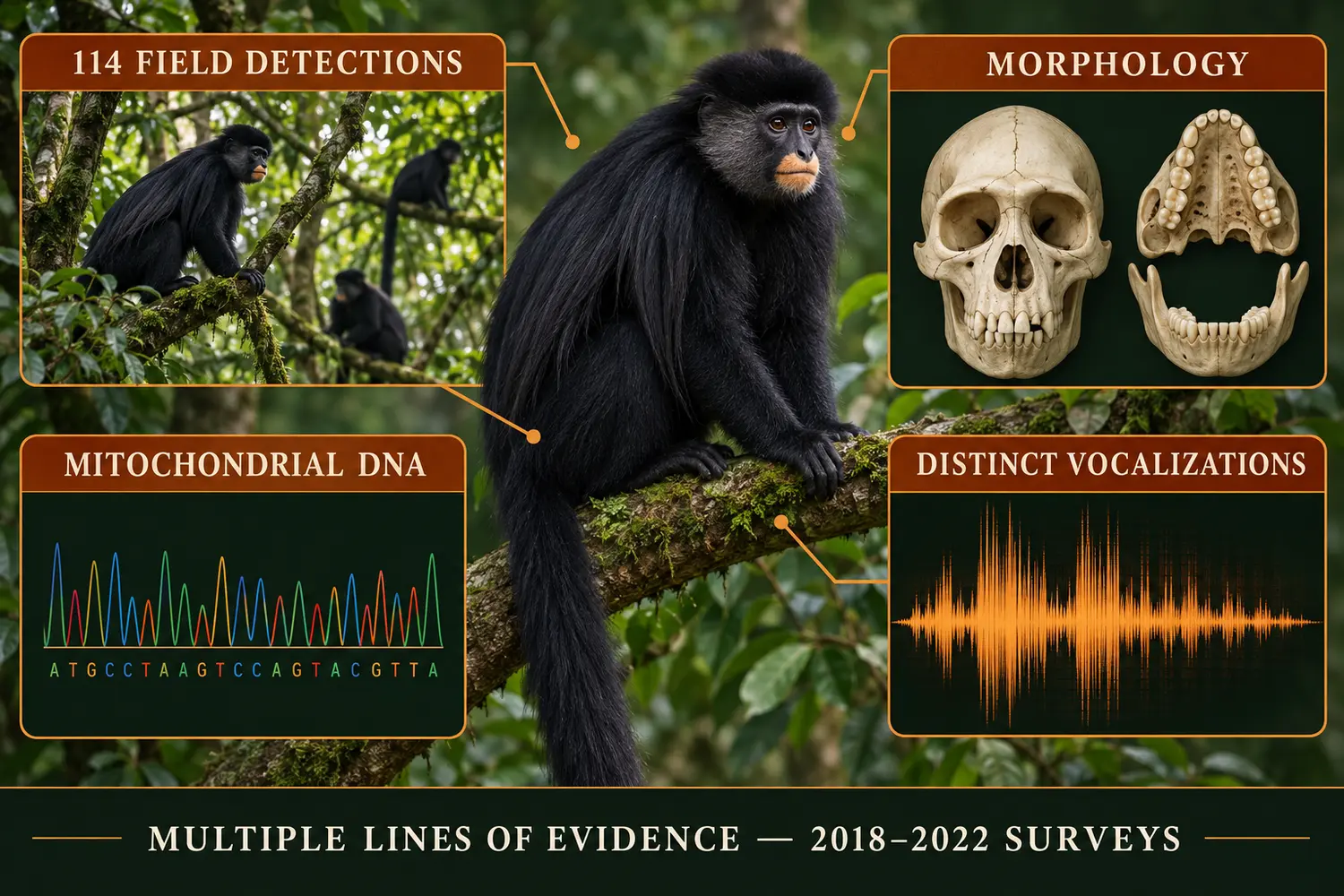
Fieldwork intensified years later. Between 2018 and 2022, teams recorded 114 detections in and around Lomami National Park. The animals were difficult to study because they spend much of their time high in closed-canopy forest and appear to be uncommon even within their limited known range.
The formal description did not rest on DNA alone. Researchers brought together:
- external appearance and body size;
- skull and dental morphology;
- mitochondrial genetic evidence;
- geographic separation from related monkeys;
- field ecology and group observations; and
- the structure of deep, resonant vocalizations.
What does Likweli look like?
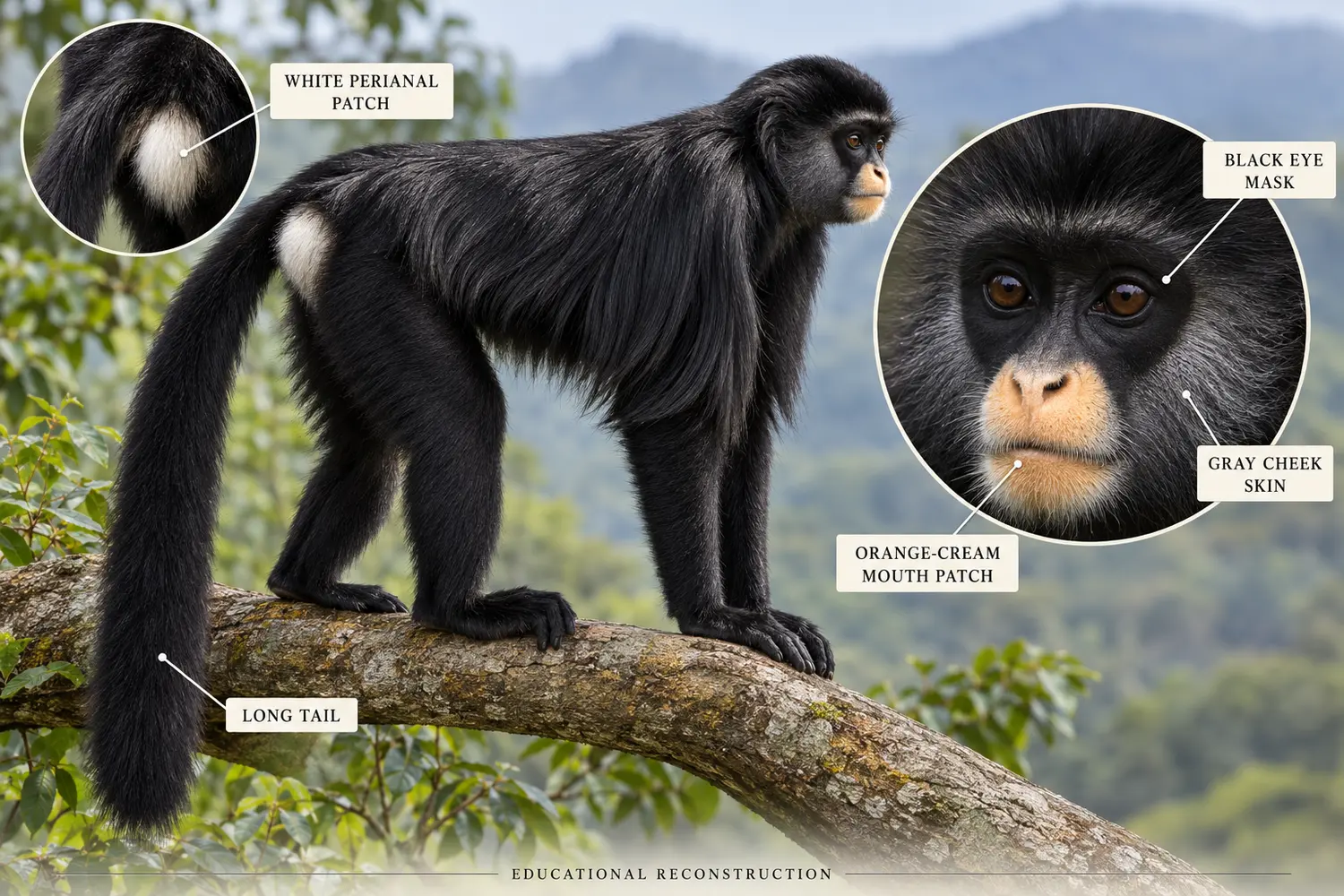
Likweli is a relatively small member of the black-and-white colobus genus Colobus, but its coat is predominantly glossy black rather than strongly patterned in black and white. Longer hair around the shoulders gives it a cape-like outline, and it has the long tail typical of arboreal colobus monkeys.
The most conspicuous facial feature is a pinkish-orange to orange-cream area surrounding the mouth, philtrum and parts of the lower nose. Dark gray bare skin over the cheekbones and temples contrasts with black skin around the eyes, producing the mask-like appearance described in the study.
The species also has a white perianal patch. The researchers reported sexual differences in that patch: it bears fine white hair in males and is bare in females. These features should be treated as a combination, not as a one-mark field-identification rule for distant photographs.
Is Likweli the same as the black colobus?
No. Genetic and morphological analyses place Likweli as the closest known living relative—or sister species—of the black colobus, Colobus satanas. But the two are geographically separated by more than 1,200 kilometers and differ in appearance, body and skull size, teeth and other traits.
Likweli’s orange-cream mouth patch, gray cheeks and white perianal area help distinguish it from the nearly all-black face and body associated with the black colobus. The new species also occupies a different part of central Africa, between major river systems that can act as long-term barriers to primate movement.
Where does Colobus congoensis live?
The known range lies in east-central DRC, in the interfluve between the Lomami and Congo—also called the Lualaba—rivers. Most records come from Lomami National Park and surrounding forest.
Researchers estimated the documented range at about 1,700 square kilometers. Within that area, Likweli was associated mainly with high, closed-canopy forest on deep clay soils and islands of terra firme forest. A known range is not necessarily the absolute biological limit: further surveys could expand it, but conservation decisions must use the evidence currently available.
The monkeys were often encountered in small groups, averaging approximately 6.2 individuals in the field data. They also occurred in mixed-species associations with other colobine monkeys, including Piliocolobus parmentieri and Colobus angolensis.
What does Likweli sound like?
Colobus monkeys are known for powerful long-distance calls. Recordings of Likweli include deep, resonant roars and shorter snort- or croak-like sounds. Acoustic analysis found structural differences from the calls of related species, adding another independent line of evidence to the taxonomic case.
A distinctive call does not automatically reveal its function. In other colobus monkeys, loud calls can contribute to spacing, group coordination, contact or alarm. Researchers need observations linking Likweli calls to specific social and environmental contexts before assigning the same meaning.
What does Likweli eat?
Like other colobines, Likweli has a specialized multi-chambered stomach that supports fermentation of plant material. Field observations suggest it eats leaves and fruit, and reports indicate fruit may be more important than expected for a typical leaf-eating colobus. However, the species remains poorly studied, so its seasonal diet and ecological role should not be reduced to a single food category.
By eating fruit and moving through the canopy, Likweli may disperse seeds. Confirming the importance of that service will require detailed feeding observations and seed-fate studies rather than assuming it from diet alone.
Is Likweli already endangered?
The species description proposes a preliminary IUCN category of Endangered. That is a scientific recommendation based on the small known range and population, together with projected pressure from hunting and habitat conversion. It should not be confused with a completed, separately published assessment on the official IUCN Red List.
Most of the documented range lies within Lomami National Park, which provides an important conservation foundation. Legal protection does not remove every risk. Hunting can still occur, nearby land use can change, and a species concentrated in one area is vulnerable to localized disturbance.
The study identifies continued protection of Lomami National Park and collaboration with neighboring communities to reduce hunting as priority actions. Further surveys are also essential to estimate abundance, define the full range and monitor trends.
Why did confirmation take almost 20 years?
Large mammals are not necessarily easy to document in tropical forests. Dense vegetation limits visibility, canopy animals may remain far above observers, and roads or trails can be scarce. A rare species may be heard more often than seen.
Taxonomy also demands repeatable evidence. A blurry image can suggest that something unusual exists, but naming a species changes scientific databases, conservation policy and how future specimens are identified. Researchers therefore compared multiple datasets and related species before publishing a name.
The long process is better described as recognition than instantaneous discovery: local people supplied a name, field teams accumulated sightings, specialists compared anatomy and DNA, and acoustic work added evidence from the animal’s voice.
Why the fifth new African monkey claim matters
Newly named frogs, insects or small reptiles are reported relatively often, but African monkeys have received generations of scientific attention and require large territories. Describing five new African monkey species over approximately 75 years makes each addition noteworthy.
The count depends on taxonomic definitions and the date range used, so it is not a universal measure of discovery rates. Its value is context: finding a distinct canopy monkey in the 21st century shows how much biological diversity can remain poorly documented in remote forests.
Frequently asked questions
Is Colobus dongdensis a valid name for Likweli?
No. The species was formally described as Colobus congoensis.
Was Likweli unknown to local people?
Not entirely. Some communities near its range used the name Likweli. Formal scientific recognition came later after researchers assembled genetic, anatomical, acoustic and field evidence.
Did genetic testing alone prove it was a new species?
No. Mitochondrial DNA supported the conclusion, but morphology, teeth, geography, appearance and vocalizations also contributed.
Is Likweli officially listed as Endangered by the IUCN?
The 2026 study proposed a preliminary Endangered classification. That recommendation is not the same as a finalized IUCN Red List assessment.